
AMD Completes $8.2B World Labs Acquisition: What Does It Mean for AMD Stock?

 Prefer us on Google

The AMD World Labs acquisition was completed on November 13, 2026, bringing AI researcher Fei-Fei Li and her spatial-intelligence team into Advanced Micro Devices (NASDAQ: AMD). AMD confirmed the transaction on November 16, while its SEC filing disclosed approximately $8.2 billion in agreed consideration and the issuance of 14,978,322 new shares. The deal strengthens AMD's AI research capabilities but also raises questions about share dilution, future revenue opportunities and the company's position against Nvidia. This article examines the deal terms, World Labs' technology, AMD's financial position and the implications for investors.
The AMD World Labs acquisition represents a move beyond selling AI processors. World Labs develops models capable of generating and simulating interactive three-dimensional environments, with potential applications in robotics, physical AI and autonomous systems. By bringing model researchers closer to its GPU and software engineers, AMD aims to design infrastructure around the computing requirements of future AI workloads rather than relying exclusively on hardware development.
For investors, the AMD World Labs acquisition creates a distinction between long-term strategic value and near-term financial results. AMD's data-center revenue nearly doubled year over year in the third quarter, but the World Labs transaction adds new shares without immediately guaranteeing additional earnings. Whether the acquisition ultimately benefits AMD stock will depend on research integration, future products, customer adoption and AMD's ability to convert AI innovation into profitable growth.
Key Takeaways
- Acquisition completed: AMD closed its approximately $8.2 billion all-stock acquisition of World Labs on November 13 and issued 14,978,322 shares to the former owners.
- AI research expansion: Fei-Fei Li joined AMD as executive vice president and chief scientist, bringing expertise in spatial intelligence, robotics and world models.
- Stock-market implications: The deal could strengthen AMD's long-term AI strategy, but new share issuance, integration costs and uncertain commercialization timelines remain important investor considerations.
What Happened in AMD's Acquisition of World Labs?
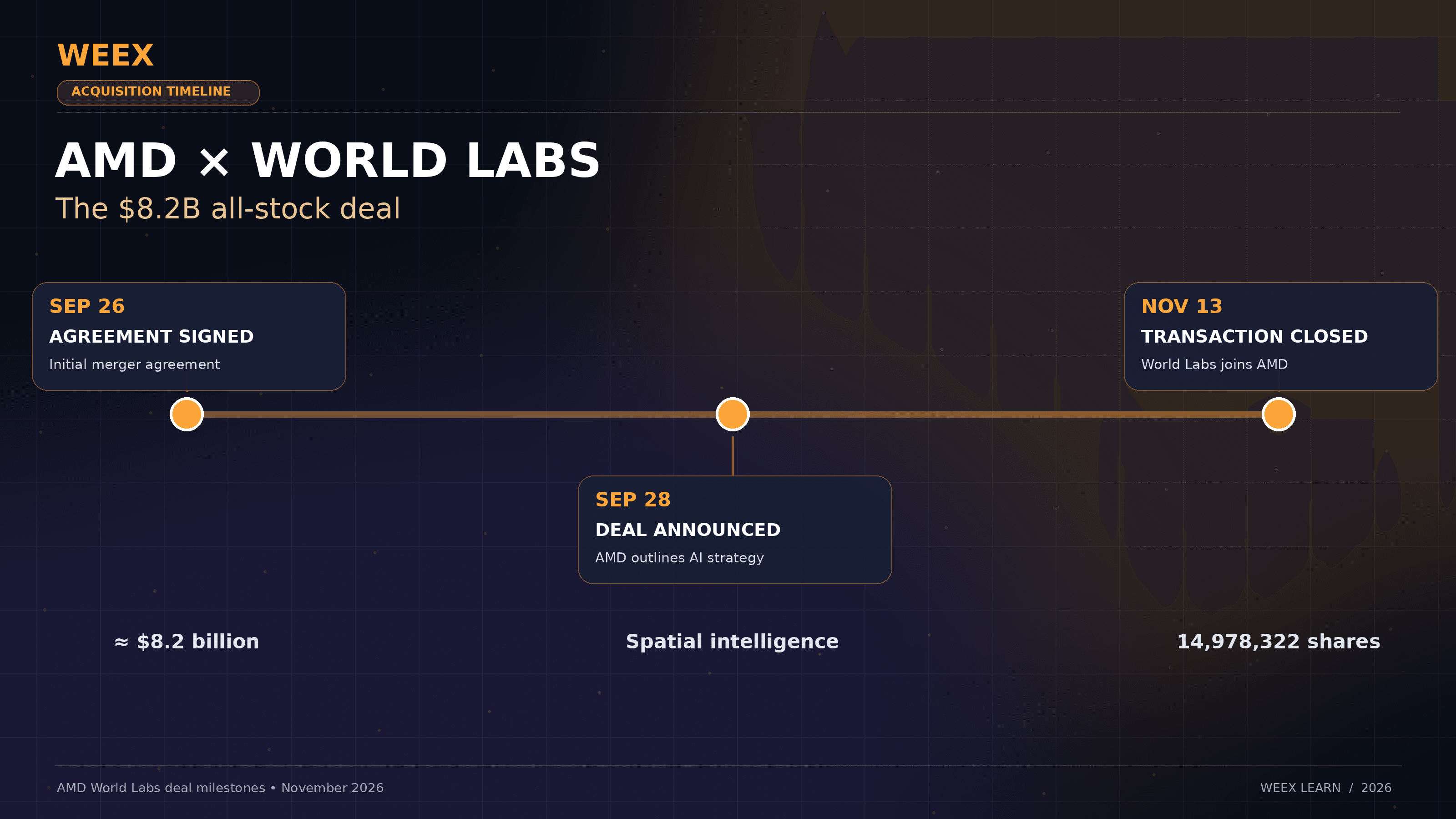
AMD announced on November 16 that it had completed its acquisition of World Labs Technologies, following the merger agreement signed on September 26 and publicly announced on September 28. The transaction was structured as an all-stock acquisition, meaning AMD paid the former World Labs shareholders with newly issued AMD shares rather than the entire consideration being paid in cash.
An amended Form 8-K filed on November 16 confirmed that the transaction closed on November 13 and that AMD issued exactly 14,978,322 common shares to former World Labs shareholders. The original agreement valued the transaction at approximately $8.2 billion, subject to contractual adjustments.
This distinction between the deal announcement and the closing matters. September's announcement established AMD's intention to acquire World Labs, while November's filing confirmed the completed transfer and final share issuance. Investors can therefore assess the transaction using actual closing information rather than the earlier proposed terms alone.
AMD–World Labs Acquisition: Key Facts
| Category | Confirmed Information |
|---|---|
| Acquirer | Advanced Micro Devices, Inc. (NASDAQ: AMD) |
| Acquired Company | World Labs Technologies, Inc. |
| Original Agreement | September 26, 2026 |
| Acquisition Announced | September 28, 2026 |
| Transaction Closed | November 13, 2026 |
| Completion Announced | November 16, 2026 |
| Agreed Purchase Price | Approximately $8.2 billion, subject to adjustment |
| Payment Structure | AMD common stock |
| Final Shares Issued | 14,978,322 |
| Key Appointment | Fei-Fei Li, EVP and Chief Scientist |
| Strategic Focus | Spatial intelligence, world models and future AI infrastructure |
Sources: AMD acquisition completion announcement and AMD November 16 Form 8-K/A.
AMD's acquisition also brings World Labs' existing model research team into closer collaboration with its hardware, networking and software organizations. The company describes the combination as an effort to create AI infrastructure that is informed by how advanced AI models are evolving.
For background on the original September agreement and the earlier market debate, see WEEX's previous analysis, AMD Stock Bought the 'Godmother of AI' for $8.2 Billion: Why Shares Fell Anyway.
Why Does AMD Want World Labs' AI Research Team?
World Labs specializes in spatial intelligence, an area of artificial intelligence concerned with how systems understand and interact with three-dimensional environments. Unlike models designed primarily to generate text or recognize static images, spatial-intelligence systems aim to represent physical spaces, reconstruct environments and simulate how objects and agents behave.
The applications extend beyond visual content creation. Robotics developers can use simulated environments to train and evaluate systems before deploying them in the physical world. Developers can also explore interactive environments for design, autonomous navigation and virtual-world applications.
For AMD, these emerging workloads create an opportunity to understand future computing requirements at an earlier stage. Training and running complex world models may require substantial memory capacity, efficient GPU processing, high-speed communication and specialized software.
How Could World Models Influence AMD's AI Products?
| AI Application | Computing Requirement | Potential Relevance to AMD |
|---|---|---|
| Interactive 3D Generation | Graphics and AI processing | GPU architecture and software optimization |
| Robotic Simulation | High-volume simulation workloads | Accelerators and computing systems |
| Physical AI Research | Spatial reasoning and model training | AI research and hardware co-design |
| Real-Time Environment Processing | Low-latency inference | Memory, networking and system performance |
| Large-Scale World Models | Distributed training infrastructure | Data-center GPUs and software platforms |
Sources: AMD's World Labs acquisition announcement and AMD Ventures' World Labs research overview. The potential applications are analytical interpretations rather than announced product specifications.
The strategic argument is straightforward: if AMD understands how future AI models operate, its engineers may be better positioned to design the hardware and software used to run them. That is particularly relevant as AI workloads expand from language generation into robotics, simulation and real-time interaction.
However, research expertise does not automatically translate into commercial success. World models must demonstrate practical usefulness, customers must adopt the resulting technology, and AMD must compete effectively on performance, software compatibility and total operating costs.
What Role Will Fei-Fei Li Play at AMD?
Fei-Fei Li joined AMD as executive vice president and chief scientist following the acquisition, reporting directly to AMD Chair and CEO Lisa Su. According to the company's announcement, she will work with the World Labs team and AMD engineers to advance foundational AI research and influence future infrastructure development.
This appointment is significant because it places a research leader directly within AMD's senior leadership structure. Rather than treating World Labs solely as a separate software business, AMD is positioning its model expertise as part of a wider technology strategy.
World Labs and AMD already had a technical relationship before the acquisition. In its September announcement, World Labs described earlier collaboration focused on model training and inference optimization using AMD GPUs. This existing relationship may help the teams work together, although successful integration will still depend on research priorities, engineering execution and product-development decisions.
The company's research activities also provide a way to assess future progress. World Labs has published work on spatial-intelligence models and interactive 3D environments, including its Atlas model family. Investors can monitor whether subsequent research demonstrates practical advantages when deployed on AMD computing systems.
The appointment should therefore be evaluated through measurable research and commercial outcomes, not merely through the reputation of an individual scientist.
-- Price
How Will the 14.98 Million New Shares Affect AMD Stock?
The AMD World Labs transaction introduces an important financial consideration because AMD issued approximately 14.98 million new common shares to complete the deal. When a public company issues additional shares, existing investors generally own a smaller percentage of the business unless they acquire more shares or an offsetting reduction in share count occurs.
This effect is commonly called share dilution. It does not mean that AMD's business automatically becomes less valuable by the full amount of the issuance, because the company has acquired World Labs in exchange. Instead, investors must evaluate the value of the acquired business and its future earnings potential against the increase in shares outstanding.
Diluted earnings per share are especially important. If the number of shares increases faster than earnings, earnings per share can face pressure even when total net income grows. Conversely, if the acquired research and technologies eventually support profitable products, the benefits could help offset dilution over time.
What Is Confirmed and What Remains Uncertain?
| Question | Current Assessment |
|---|---|
| Has the acquisition closed? | Yes, November 13, 2026 |
| Were new AMD shares issued? | Yes, 14,978,322 shares |
| Was the deal entirely cash-funded? | No, it was structured as an all-stock transaction |
| Will existing ownership percentages be diluted? | Generally yes, absent offsetting changes |
| Will World Labs immediately increase AMD earnings? | Not established by the closing announcement |
| Is the acquisition guaranteed to lift AMD stock? | No |
Source: AMD Form 8-K/A, November 16, 2026.
Another useful distinction is that transaction value does not equal new revenue. The approximately $8.2 billion purchase price represents consideration for acquiring World Labs, not an amount AMD immediately earns or records as sales. Similarly, issuing 14.98 million shares is an equity-financing event, not evidence of customer demand.
The long-term financial impact will become clearer through future earnings reports, integration disclosures and the contribution of new AI products to AMD's business.
Can the Acquisition Strengthen AMD's Position Against Nvidia?
AMD has been expanding its AI computing portfolio through GPUs, EPYC server processors, software and system-level infrastructure. The World Labs acquisition could deepen that strategy by connecting advanced model research with hardware development.
Nvidia's AI position has benefited from a broad ecosystem combining accelerators, networking technology and developer software. AMD competes by developing alternative computing platforms, but the availability of hardware alone is only one part of the purchasing decision for large AI customers.
Customers also consider software compatibility, model performance, development tools, power consumption and the cost of operating infrastructure at scale. World Labs' researchers may help AMD identify future workloads and optimize its technology for them.
For example, a spatial-intelligence model designed to interact with complex 3D environments may have different memory and inference requirements from a conventional text-generation model. Understanding those differences could influence AMD's future computing-system design.
Nevertheless, the acquisition does not establish that AMD will outperform Nvidia or secure new contracts immediately. The commercial question is whether AMD can turn research capabilities into products that customers prefer on measurable criteria such as cost, performance and ease of deployment.
For broader industry context, WEEX previously examined Microsoft's AMD AI partnership and the strategy of diversifying AI infrastructure beyond Nvidia.
What Do AMD's Latest Earnings Say About Its Ability to Fund AI Expansion?
AMD entered the acquisition from a period of substantial financial growth. In its third-quarter results released on November 3, the company reported revenue of approximately $13.4 billion, up 45% year over year, while its data-center segment generated $8.5 billion in revenue, an increase of 97%.
These figures show that AMD's AI infrastructure operations were expanding rapidly before the World Labs acquisition closed. However, the third-quarter financial results should not be interpreted as incorporating revenue or earnings from a company acquired in mid-November.
AMD Q3 2026 Financial Snapshot
| Financial Metric | Q3 2026 | Year-over-Year Change |
|---|---|---|
| Total Revenue | $13.377 billion | +45% |
| Data Center Revenue | Approximately $8.5 billion | +97% |
| GAAP Gross Margin | 54% | +2 percentage points |
| GAAP Operating Income | $2.832 billion | +123% |
| GAAP Net Income | $2.428 billion | +95% |
| GAAP Diluted EPS | $1.46 | +95% |
| Non-GAAP Diluted EPS | $2.09 | +74% |
Source: AMD Third Quarter 2026 Financial Results, November 3, 2026. Non-GAAP EPS is a company-defined adjusted measure.
The strong data-center growth provides useful context for AMD's acquisition strategy. The company is investing in advanced AI capabilities while its existing server and accelerator businesses expand. That could support continued research spending, but it also raises expectations for future financial returns.
Investors should examine whether the additional research capabilities eventually contribute to customer adoption, pricing power or improved product margins. Until those effects appear in reported results, the acquisition's benefits remain primarily strategic.
Why Didn't the Acquisition Automatically Push AMD Stock Higher?
A positive strategic announcement and a positive immediate stock-price reaction are not the same thing. Public equity prices reflect both the expected value of future opportunities and the costs or uncertainties associated with achieving them.
The market had already known about the proposed World Labs acquisition since September. Therefore, the November closing confirmed a previously announced transaction rather than introducing an entirely unexpected investment. Some of the strategic implications may already have been reflected in investor expectations.
The final share issuance also gave investors more precise information about the transaction's equity impact. However, whether the acquisition increases AMD's intrinsic value depends on future outcomes that cannot be measured from the closing announcement alone.
An internal WEEX market snapshot at approximately 10:30 Beijing Time on November 17 showed an AMD stock-related reference quotation of 504.48 USDT, marked as closed, while the AMDUSDT perpetual futures interface displayed approximately 511.91 USDT and a 24-hour change of -2.02%. These were observations from different WEEX products at a specific time, not interchangeable Nasdaq stock prices or proof that the acquisition caused the decline.
The distinction matters because stock-linked instruments and perpetual contracts have different pricing, trading-hour and margin mechanisms. A closed-market reference quotation and a live derivatives quote should not be combined to calculate the official movement of AMD common shares.
What Should AMD Investors Watch After the World Labs Deal?
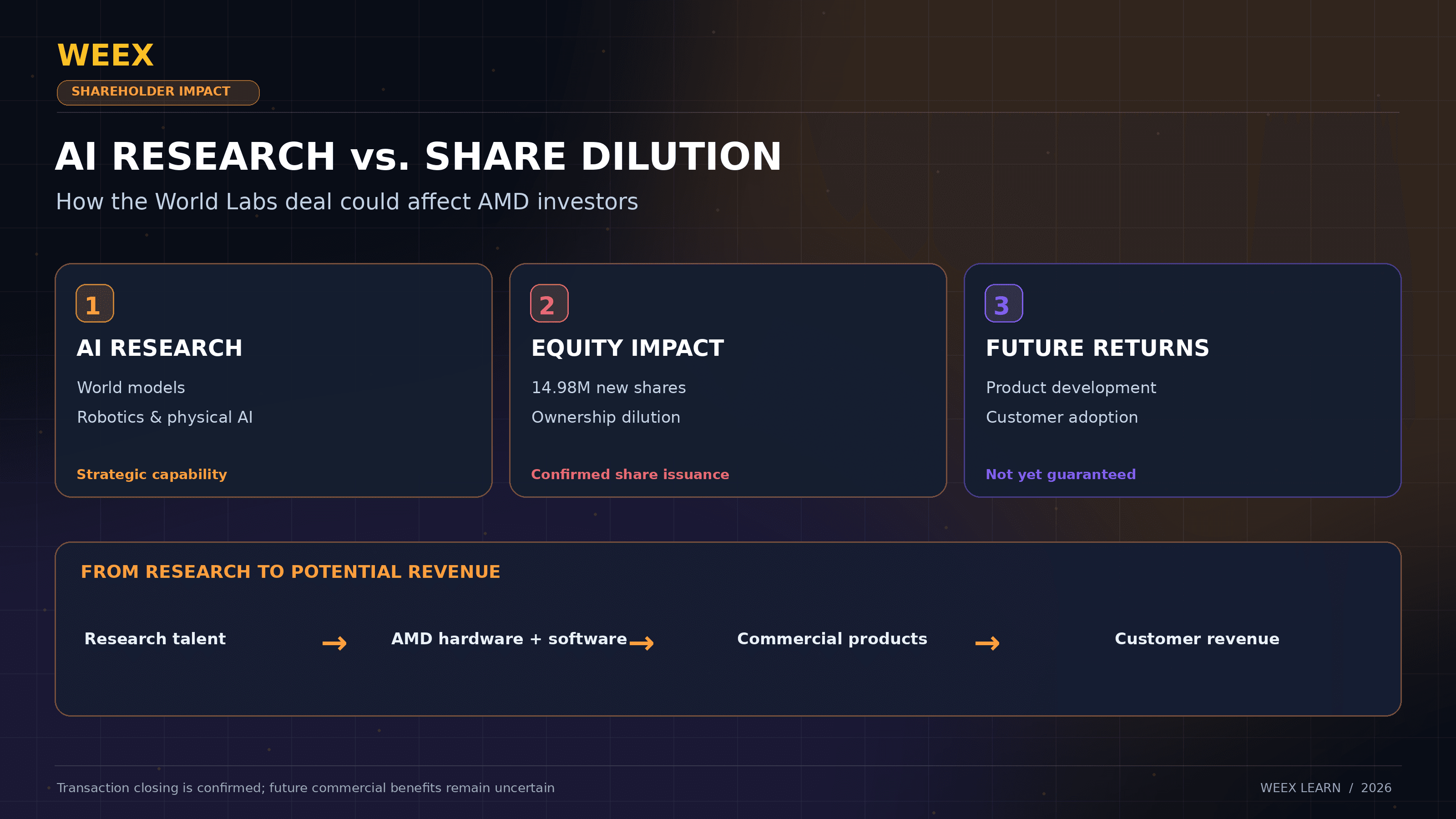
The first indicator will be research integration. Investors can monitor whether AMD and World Labs publish meaningful technical results, establish new development tools or demonstrate world-model workloads running efficiently on AMD hardware.
The second is product commercialization. AI research can be valuable without generating immediate revenue, but public-market expectations eventually depend on customer adoption. Relevant evidence could include developer demand, enterprise deployments, product partnerships and measurable improvements in computing performance.
The third is financial discipline. AMD's Q3 data-center growth was strong, but investors should assess whether research spending and integration expenses are matched by sustained revenue growth and operating profitability. Over time, earnings per share will also help reveal whether the benefits of the acquisition justify the additional share issuance.
These measures offer a more useful framework than treating the closing of an acquisition as an automatic signal to buy or sell AMD.
How to View and Trade AMD on WEEX
WEEX provides access to AMD-related stock-linked products and perpetual futures, subject to product availability, regional eligibility and trading conditions. These products provide price exposure under their respective terms and are not equivalent to directly owning AMD common shares through a securities brokerage.
Step 1: Register on WEEX and Prepare USDT
Visit the WEEX website and sign in or create an account. Complete the applicable verification requirements and prepare a USDT balance using a supported funding method. Before trading, check the products available to your account and review the relevant trading fees and market rules.
Step 2: Open the AMD Stock-Related Trading Page
Navigate to the WEEX AMD/USDT stock-related trading page. Review the market status, reference quotation, available liquidity and supported order types. Because the product tracks AMD-related market performance rather than representing directly registered common shares, owning it does not provide ordinary shareholder rights such as voting or direct dividend entitlement.
For a clearer explanation of the difference, see What Are Spot Stock Tokens? How Synthetic Stock Trading Works.
Step 3: Review the Order and Monitor Your Position
If trading is available, choose an eligible order type, enter the intended amount, review the execution price and fees, and confirm the order. Monitor any resulting position through your WEEX account.
Users interested in derivatives can separately review AMDUSDT Perpetual Futures. Perpetual contracts introduce margin, funding payments, leverage and liquidation risk. Trading may also be restricted by circuit breakers, so verify the live status before attempting to open or close a position.
Conclusion
AMD's $8.2 billion acquisition of World Labs has moved from an announced agreement to a completed transaction. The company now has additional expertise in spatial intelligence and world models, with Fei-Fei Li joining its senior leadership and nearly 15 million new shares issued to former World Labs shareholders.
The strategic opportunity lies in connecting advanced AI research with AMD's hardware, software and systems. The financial challenge is proving that this expertise can lead to commercially successful products and sufficient earnings growth to justify the transaction.
For AMD investors, the closing itself is only the beginning. Future research outcomes, product adoption, AI infrastructure revenue and earnings-per-share performance will provide stronger evidence of whether the acquisition delivers lasting value.
FAQ
1. Has AMD completed its acquisition of World Labs?
Yes. AMD completed the acquisition on November 13, 2026, and publicly announced the closing on November 16. The company confirmed the completion in an amended Form 8-K filing.
2. How much did AMD pay for World Labs?
The original acquisition agreement specified approximately $8.2 billion in AMD common stock, subject to contractual adjustments. At closing, AMD issued 14,978,322 new shares to former World Labs shareholders.
3. What is World Labs, and why did AMD acquire it?
World Labs is an AI research organization focused on spatial intelligence and world models that can generate and simulate interactive 3D environments. AMD acquired the team to deepen its understanding of emerging AI workloads and help inform future hardware, software and infrastructure development.
4. Will the World Labs acquisition dilute AMD shareholders?
The issuance of new AMD shares generally reduces existing shareholders' proportional ownership unless offset by other changes. Whether the deal ultimately benefits earnings per share depends on future financial contributions and the company's overall performance.
5. Can I trade AMD-related products on WEEX?
WEEX provides AMD stock-linked and perpetual futures product interfaces, subject to availability and account eligibility. Stock-linked products do not represent direct ownership of AMD common shares, while perpetual futures introduce additional risks related to leverage, funding and liquidation.
This content is provided for general informational purposes only and doesn't constitute financial, investment, legal, or tax advice. Any events, rewards, online promotions, or related information mentioned herein should not be considered a recommendation, solicitation, or invitation to purchase, sell, trade, or otherwise deal in any crypto assets. Crypto assets are highly volatile and may result in loss. The availability of WEEX services, products, and related events may vary by region. You are responsible for ensuring that your participation is in accordance with applicable local laws and regulations.
You may also like
View moreBinance Hack: Can the DOJ Recover $1.1B in Frozen USDC?
Beginner9 minWEEX Product GuideNVIDIA Rehires Jensen Huang Just 11 Days Later: What Changed Behind the Scenes?
Beginner7 minWEEX Product GuideEthereum Glamsterdam Delayed: Could 15,000 Smart Contracts Be at Risk?
Beginner9 minWEEX Product GuideXLM Price Drops 2.48% Before Stellar's Bell Vote: Can Protocol 30 Change the Trend?
Beginner8 minWEEX Product GuideTether Backs SCRYPT: Could USDT Become the New Rail for Global Payments?
Beginner6 minWEEX Product GuidePolygon's Purley Hard Fork Is Live: What Changes for POL and Network Security?
Beginner7 minWEEX Product Guide


