
Jensen Huang Returns—and AI Stocks Explode: Can the Rally Last?

 Prefer us on Google

Key Takeaways
- NVIDIA's November 23 reinstatement of Jensen Huang as CEO helped trigger a broad rebound across U.S. technology and artificial intelligence stocks.
- NVIDIA gained 31.48%, while the Nasdaq Composite closed 6.65% higher and the S&P 500 advanced 4.92% during the same trading session.
- AI infrastructure companies, semiconductor manufacturers and cloud computing providers participated in the rally, reflecting renewed investor confidence across the sector.
- NVIDIA's earnings and AI spending outlook remain important fundamentals, but valuation, infrastructure financing and governance risks could limit the sustainability of the rebound.
The AI stock rally accelerated on November 23 after NVIDIA reinstated Jensen Huang as CEO, sending its shares up 31.48% and lifting major technology indexes. The AI stock rally spread beyond NVIDIA to semiconductor manufacturers and cloud infrastructure companies as investors reassessed leadership uncertainty. This article examines the AI stock rally, the companies benefiting from Huang's return and whether underlying AI demand can sustain the recovery.
Why Did Jensen Huang's Return Trigger a Broad AI Stock Rally?
The November 23 rebound began with NVIDIA's announcement that Jensen Huang would return as president and CEO after an extraordinary leadership transition.
His reinstatement removed a significant source of uncertainty for a company whose products underpin much of the global AI computing ecosystem.
NVIDIA supplies processors, networking technology, software and integrated computing systems used by cloud companies, AI developers and enterprise customers.
Because many technology businesses depend on access to NVIDIA's hardware and infrastructure, the company's leadership developments can influence market expectations well beyond its own shares.
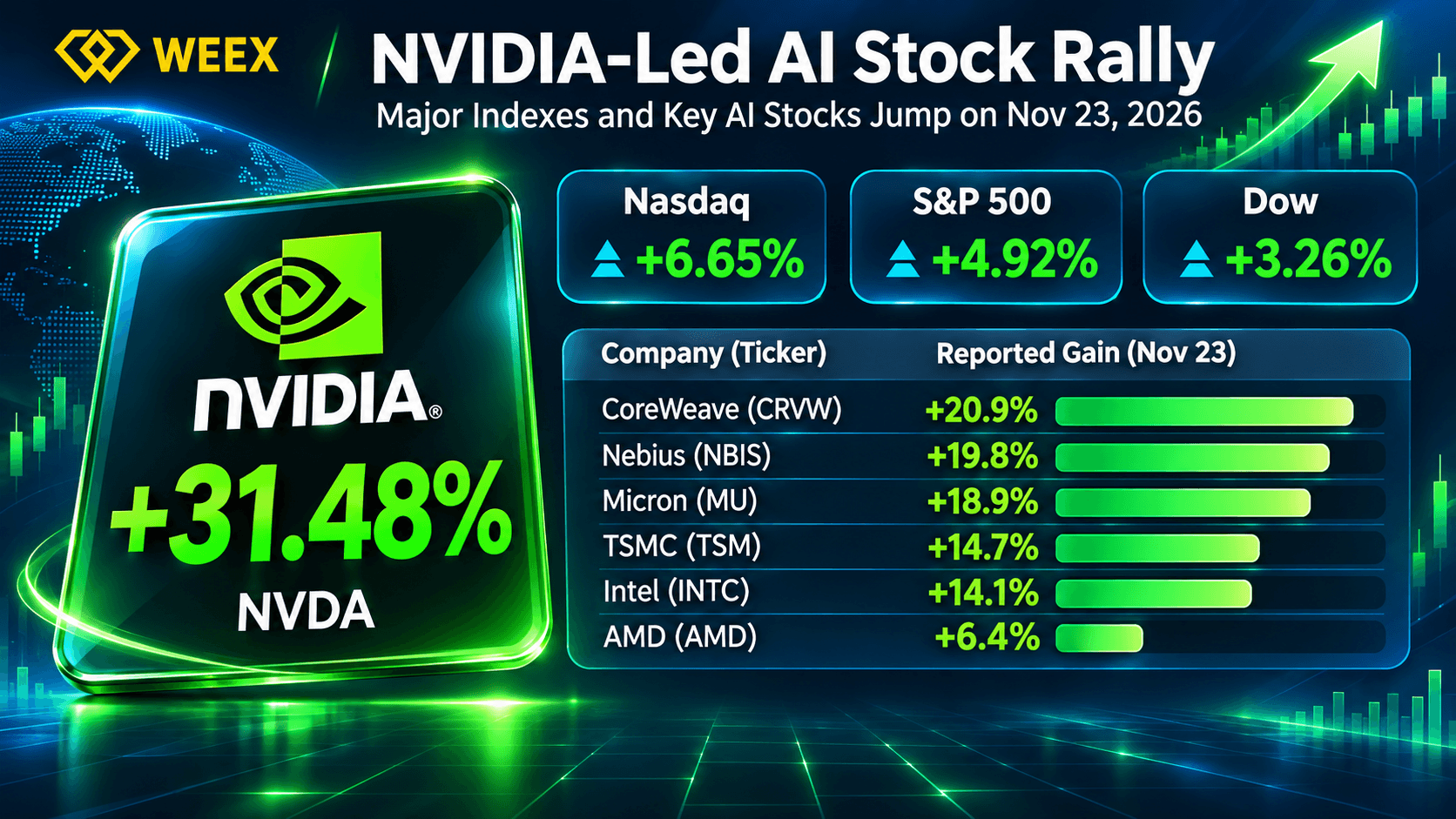
Reuters reported that the Nasdaq Composite surged 6.65% on November 23, while the S&P 500 advanced 4.92% and the Dow Jones Industrial Average gained 3.26%.
NVIDIA itself rose 31.48%, demonstrating the scale of investor repricing following the announcement.
Wall Street Market Performance — November 23, 2026
| Market Indicator | November 23 Movement |
|---|---|
| NVIDIA (NVDA) | +31.48% |
| Nasdaq Composite | +6.65% |
| S&P 500 | +4.92% |
| Dow Jones Industrial Average | +3.26% |
| Nasdaq Composite Closing Level | 24,122.76 |
| S&P 500 Closing Level | 7,250.38 |
| Dow Closing Level | 49,715.94 |
Source: Reuters — Wall Street Roars Back as NVIDIA Reinstates Jensen Huang, November 23, 2026. Figures refer to the reported U.S. trading session.
The rebound followed a period of weakness in AI-related companies, as investors had become increasingly concerned about infrastructure spending, valuation and whether technology companies could generate adequate returns on their investments.
Huang's return helped improve confidence, but the market reaction should not be interpreted as evidence that the fundamental concerns surrounding the industry have disappeared.
Which AI Stocks Benefited Most From Huang's Return?
The rally extended into several companies involved in supplying, manufacturing or operating AI computing infrastructure.
Cloud infrastructure providers were among the notable beneficiaries because their business models often depend on access to advanced computing hardware, continued customer demand and the ability to finance infrastructure expansion.
Semiconductor companies also attracted renewed attention as investors reassessed the prospects for AI hardware investment.
For example, CoreWeave and Nebius gained substantially during the session, while Micron Technology and Taiwan Semiconductor also advanced.
AI Infrastructure Stock Performance
| Company | Ticker | Reported Intraday Gain | AI Industry Connection |
|---|---|---|---|
| NVIDIA | NVDA | Approximately 31% | AI accelerators and computing platforms |
| CoreWeave | CRWV | Approximately 20.9% | AI-focused cloud infrastructure |
| Nebius | NBIS | Approximately 19.8% | AI cloud and data center services |
| Micron Technology | MU | Approximately 18.9% | Memory and semiconductor technology |
| Taiwan Semiconductor | TSM | Approximately 14.7% | Semiconductor manufacturing |
| Intel | INTC | Approximately 14.1% | Semiconductor products and manufacturing |
| Advanced Micro Devices | AMD | Approximately 6.4% | AI processors and semiconductor products |
Source: Stock Analysis — Nasdaq and AI Stock Rally, November 23, 2026, approximately 2:25 p.m. ET. Figures are intraday observations and should not be represented as synchronized official closing returns.
The differences between company returns show that investors were not treating every AI-related stock identically.
Businesses with substantial exposure to data center construction and AI computing demand experienced particularly strong buying interest.
However, a rapid price recovery does not necessarily mean that projected future earnings have increased by the same percentage.
Stock prices reflect expectations, risk appetite and valuation as well as current financial results.
-- Price
Why Is NVIDIA So Important to the Entire AI Industry?
NVIDIA occupies a central position in the AI infrastructure ecosystem because its hardware and software are used across a broad range of applications.
Large AI models require extensive computing resources for training and inference. NVIDIA's GPUs and associated technologies help provide those resources.
Its CUDA software platform and networking technologies also contribute to a broader ecosystem used by developers, research institutions and cloud service providers.
When investors become more confident about NVIDIA's strategic direction, they may also reassess the outlook for companies that purchase, deploy or manufacture the technologies supporting its platforms.
How NVIDIA Connects Different AI Industries
| Industry Segment | Relationship to NVIDIA | Main Economic Driver |
|---|---|---|
| Semiconductor Manufacturing | Produces components used in advanced chips | Chip orders and manufacturing capacity |
| AI Memory | Supplies high-bandwidth memory and related technologies | Memory demand and pricing |
| Cloud Infrastructure | Deploys NVIDIA computing systems | Customer demand and utilization |
| Data Center Equipment | Supplies networking, power and cooling infrastructure | AI infrastructure expansion |
| Enterprise AI | Uses computing capacity for AI applications | Software adoption and customer spending |
| NVIDIA | Designs integrated computing platforms | Product demand, margins and execution |
Source: Industry analysis based on NVIDIA's disclosed business model and ecosystem relationships.
These relationships help explain how one company's leadership announcement can affect a broad group of stocks.
However, the commercial benefits remain uneven.
A semiconductor supplier may benefit from additional equipment orders, while a cloud provider must also demonstrate that the infrastructure it purchases can generate sufficient revenue to cover its operating and financing costs.
An increase in demand for NVIDIA hardware therefore does not guarantee stronger profitability for every company building AI infrastructure.
Does NVIDIA's Financial Performance Support the Rally?
NVIDIA's latest earnings provide a stronger basis for evaluating its business than the leadership announcement alone.
On November 17, 2026, the company reported fiscal third-quarter 2027 revenue of $115.8 billion, an increase of 103% year over year.
Data Center revenue reached $107.6 billion, representing approximately 93% of total quarterly revenue.
The results demonstrate NVIDIA's substantial exposure to AI infrastructure demand.
The company also provided fourth-quarter revenue guidance of approximately $130 billion, plus or minus 3%.
However, these numbers were reported before Huang's return and should not be interpreted as financial gains produced by his reinstatement.
NVIDIA Q3 FY2027 Earnings and Outlook
| Financial Metric | Reported Value |
|---|---|
| Quarterly Revenue | $115.8B |
| Revenue Growth YoY | +103% |
| Data Center Revenue | $107.6B |
| Data Center Growth YoY | +110% |
| GAAP Net Income | $65.3B |
| GAAP Diluted EPS | $2.70 |
| GAAP Gross Margin | 74.8% |
| Q4 FY2027 Revenue Guidance | $130B ± 3% |
| Q4 Expected Gross Margin | 71%–72% |
Source: NVIDIA Official Q3 FY2027 Financial Results, November 17, 2026.
The earnings suggest that demand for advanced computing infrastructure remains substantial.
Nevertheless, investors should distinguish between revenue growth, profitability and the price they are willing to pay for future earnings.
A company can deliver strong financial results while its stock declines if the market had already anticipated even stronger performance.
Similarly, a major market rally may reflect improved confidence without an equivalent change in near-term financial forecasts.
Can NVIDIA's Vera Rubin Platform Sustain AI Growth?
NVIDIA's Vera Rubin computing platform represents an important component of its current product strategy.
In its November 17 earnings announcement, the company said it had begun shipping Vera Rubin NVL72 systems, with deployments involving major cloud and infrastructure partners.
The company identified several organizations participating in the rollout, including CoreWeave, Google Cloud, Microsoft Azure, Oracle Cloud Infrastructure and Nebius.
This matters because the next phase of AI computing investment depends not only on demand for individual processors but also on large integrated systems.
Advanced AI infrastructure requires networking, memory, software, power and cooling capabilities that operate together efficiently.
Why Does the Product Roadmap Matter?
NVIDIA's ability to execute its product roadmap affects customers planning major data center investments.
Cloud operators must coordinate procurement, construction, networking and customer commitments. Delays in a critical computing platform could affect broader infrastructure schedules.
Huang's return may improve investor confidence in strategic continuity, but the company has not announced that reinstatement itself changes previously disclosed product delivery dates.
The more meaningful evidence will come from actual shipment volumes, successful deployments, customer utilization and financial results.
For a deeper review of the earnings data, see NVIDIA Q3 2027 Earnings: Revenue Hits $115.8B as Leadership Questions Persist.
Why Could the AI Rally Fade After the Initial Rebound?
An event-driven rally can improve market sentiment rapidly, but its durability depends on whether underlying business conditions support the new valuations.
The November 23 recovery followed a period in which investors had raised questions about heavy infrastructure spending and the financing required to support AI expansion.
Some AI-focused cloud companies must make substantial upfront investments in computing systems before earning revenue from customers.
If borrowing costs increase or customer demand weakens, these businesses may experience greater financial pressure even while demand for AI technology remains positive over the long term.
Three Risks Investors Should Monitor
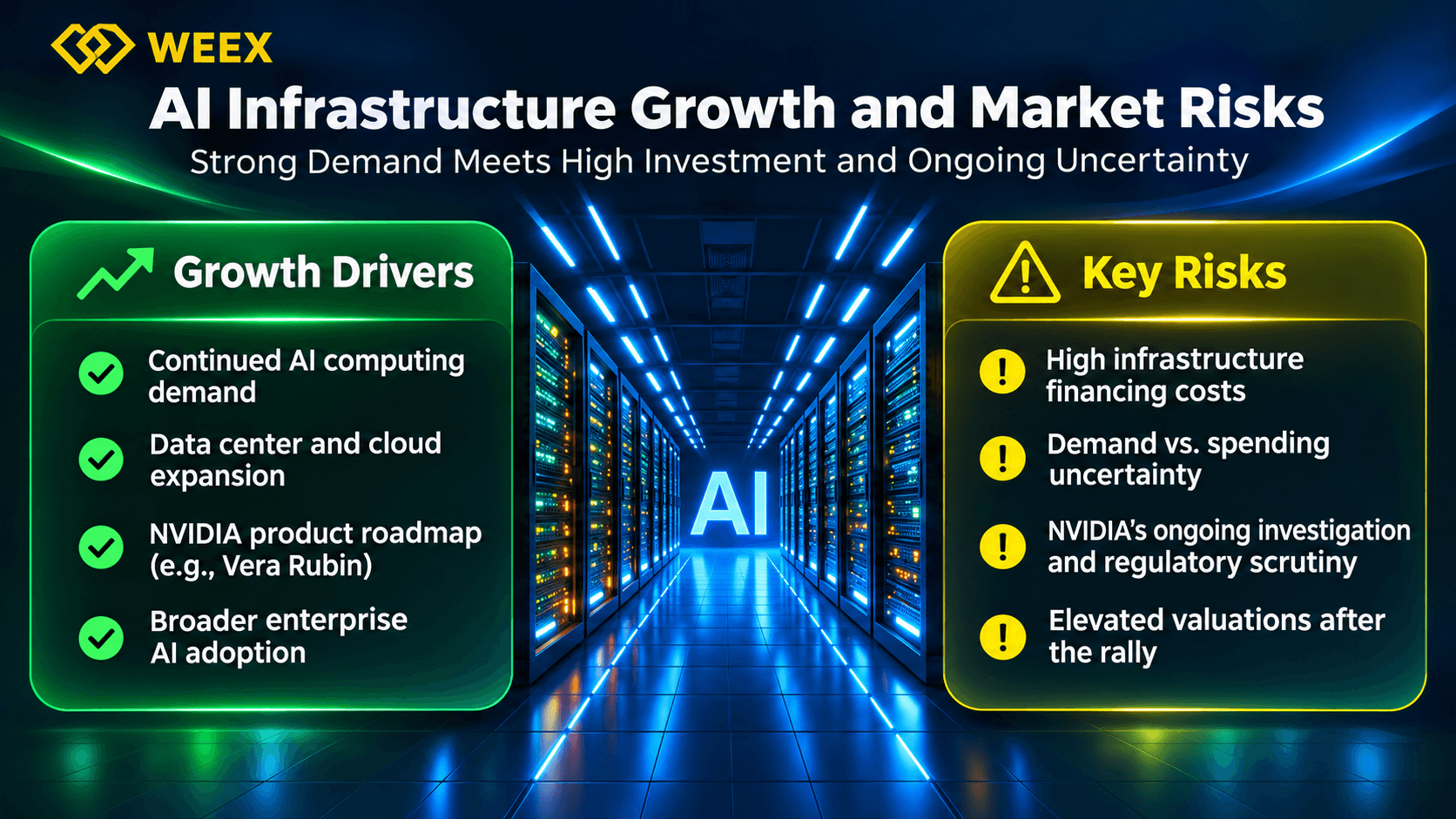
AI infrastructure financing: Data center expansion requires substantial capital. Companies dependent on external financing may be sensitive to interest rates, credit conditions and investor confidence.
Demand versus spending: High capital expenditure can support future growth, but investors need evidence that computing capacity is being used productively and generating adequate returns.
NVIDIA's governance and regulatory exposure: Huang's reinstatement resolves the immediate CEO vacancy, but the company's independent investigation and export-control oversight continue.
These risks make it important to distinguish a short-term sentiment recovery from a fundamental improvement across the AI industry.
What Could Happen Next to AI Stocks?
| Scenario | Conditions | Possible Market Implication |
|---|---|---|
| Continued Rally | Strong AI demand and stable financial outlook | Positive sentiment may persist |
| Consolidation | Investors reassess valuations after large gains | Stocks may trade in a narrower range |
| Renewed Correction | Financing concerns or weaker earnings | AI-related stocks may face pressure |
| Uneven Recovery | Stronger companies outperform weaker businesses | Greater divergence within the sector |
Source: Analytical scenarios based on November 2026 industry developments. These are not guaranteed market outcomes.
Investors should also monitor upcoming economic data and changes in interest-rate expectations, since these can influence valuations across growth-oriented technology companies.
Alt: AI stock rally analysis showing NVIDIA, cloud infrastructure companies, semiconductor demand and financing risks.
Does Huang's Return Guarantee Further Gains for NVIDIA?
No. Huang's return represents an important leadership development, but it does not guarantee that NVIDIA shares will continue rising.
The November 23 surge reflects a substantial reassessment of uncertainty associated with his departure.
A longer-term increase in business value would require NVIDIA to maintain its competitive position, deliver its product roadmap and generate sufficient profits from expanding AI demand.
Investors should therefore assess management continuity alongside customer orders, gross margins, competitive developments and broader market conditions.
For additional background, see Jensen Huang Resigns as NVIDIA CEO: What Happens to NVDA Stock Next?.
How to Buy or Trade NVIDIA-Related Products on WEEX
WEEX offers access to NVIDIA-related stock products and a USDT-margined perpetual futures contract, subject to product eligibility and current trading conditions.
These products are separate from buying registered NVIDIA common shares through a conventional securities brokerage.
Step 1: Review the NVDA Market
Visit the WEEX NVDA Stock-Related Product Page to review the available quotation, product details and trading status.
Step 2: Check the NVDAUSDT Perpetual Contract
Users can review contract specifications through the WEEX NVDAUSDT Futures Page.
At the time of preparation, the public futures page displayed a circuit-breaker notice restricting order execution. Users must verify the current status and any resumption announcement before attempting to open or close a position.
Step 3: Understand Product and Market Risk
When trading is enabled, review the relevant order type, execution conditions, trading fees and available liquidity.
For perpetual futures, assess leverage, funding rates, margin requirements and liquidation conditions.
NVIDIA-related derivatives may react differently from ordinary Nasdaq shares, particularly around major corporate announcements and periods outside regular U.S. trading hours.
Conclusion
The AI stock rally on November 23 demonstrated how strongly NVIDIA's leadership developments can influence investor confidence across the technology sector. Jensen Huang's return helped lift semiconductor manufacturers, cloud infrastructure companies and major U.S. indexes.
However, the AI stock rally occurred against a backdrop of substantial infrastructure spending, financing concerns and demanding market valuations. NVIDIA's financial results remain strong, but profitability and execution will determine whether broader industry expectations are justified.
For investors monitoring the AI stock rally, the most important indicators are actual computing demand, customer spending, infrastructure economics and subsequent earnings performance rather than the immediate market reaction to a leadership announcement.
FAQ
1. Why did AI stocks rise after Jensen Huang returned?
NVIDIA's announcement reduced uncertainty about its executive leadership and helped restore confidence in the AI infrastructure sector. Investors also reassessed companies involved in semiconductor manufacturing, data centers and cloud computing.
2. How much did NVIDIA stock rise on November 23, 2026?
NVIDIA shares gained 31.48% during the November 23 U.S. trading session. The Nasdaq Composite also rose 6.65%, reflecting a broader technology-market rebound.
3. Which AI-related companies benefited from the rebound?
Companies including CoreWeave, Nebius, Micron Technology and Taiwan Semiconductor recorded substantial gains during the November 23 session. Their movements reflected market expectations and should not be interpreted as confirmed changes in revenue.
4. Will Jensen Huang's return guarantee higher AI stock prices?
No. The announcement may support confidence, but stock performance still depends on earnings, valuation, industry demand, financing conditions and broader market sentiment. A single-day rally does not establish a sustainable upward trend.
5. Can users access NVIDIA-related trading products on WEEX?
WEEX provides NVIDIA-related stock and futures product pages. Availability can change during periods of unusual volatility, so users should verify current trading restrictions, fees and risk conditions before submitting an order.
This content is provided for general informational purposes only and doesn't constitute financial, investment, legal, or tax advice. Any events, rewards, online promotions, or related information mentioned herein should not be considered a recommendation, solicitation, or invitation to purchase, sell, trade, or otherwise deal in any crypto assets. Crypto assets are highly volatile and may result in loss. The availability of WEEX services, products, and related events may vary by region. You are responsible for ensuring that your participation is in accordance with applicable local laws and regulations.
You may also like
View moreDOJ Seeks Forfeiture of $1.1 Billion in USDC Linked to Binance Hack: What Happened?
Beginner7 minWhat Is Moonriver (MOVR)? WEEX Spot Market
Beginner3 minWhat Is SoSoValue (SOSO)? WEEX Spot Market
Beginner3 minWhat Is DigiByte (DGB)? WEEX Spot Market
Beginner3 minNVIDIA Rehires Jensen Huang Just 11 Days Later: What Changed Behind the Scenes?
Beginner7 minWEEX Product GuideNVDA Stock Surges 31% as Jensen Huang Returns: Can the Rally Last?
Beginner9 min
Contents
Popular coins
Latest articles


