
What Is a Blockchain Node? Types, 2026 Counts, and Real Costs

 Prefer us on Google


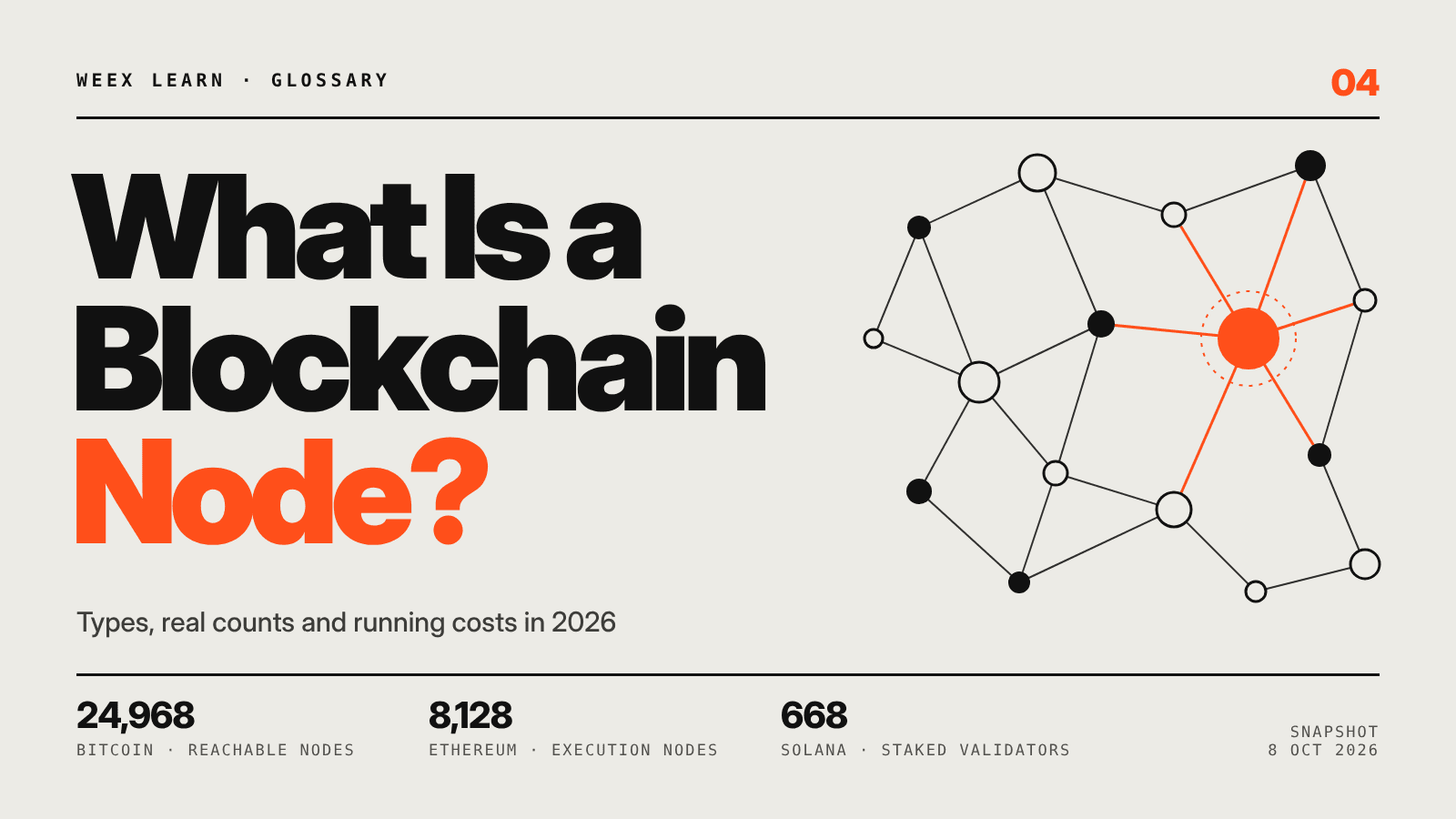
A blockchain node is a computer running a network's client software: it keeps its own copy of the ledger, checks every transaction and block against the rules, and passes the valid ones on to its peers. That one sentence answers what is a blockchain node, but "node" covers several different jobs, and the node counts quoted for Bitcoin, Ethereum and Solana measure less than they seem to. Below: what a node does when a transaction lands, the types that matter, real counts and hardware requirements as of October 2026, and whether running one is worth your money.
What a Blockchain Node Does When a Transaction Arrives
A blockchain has no central server. Its rules hold only because thousands of independent machines keep the same data and refuse anything that breaks them. Each machine is a node, and the software it runs (Bitcoin Core, Geth, Agave) is called a client.
Say you send 0.01 BTC from a phone wallet. The wallet does not write to "the blockchain". It signs a transaction and hands it to a node, usually one run by the wallet's provider rather than by you, and that node is the transaction's entry point to the network.
Every node that hears about the transaction then does the same three jobs:
- Validate. Is the signature correct? Do the coins exist, and are they unspent? Is the fee above the node's minimum? Fail one check and the transaction is dropped, never forwarded.
- Relay. A valid transaction goes into the node's mempool, its waiting room for unconfirmed payments, and is announced to the node's peers, which repeat step one for themselves.
- Store. When a miner or validator packs the transaction into a block, the node re-checks the entire block before adding it to its own copy of the chain. One invalid transaction and the whole block is rejected, whoever produced it.
No node takes another node's word for anything. That is why a block producer cannot award itself extra coins: thousands of machines it does not control would reject the block.
Types of Blockchain Nodes: Full, Pruned, Archive, and Light
Types differ in how much data they keep and how much they verify themselves.
- Full node. Verifies every transaction and block itself. A Bitcoin full node stores the whole chain; an Ethereum full node verifies everything but keeps only recent state, typically the latest 128 blocks, and regenerates older state on demand.
- Pruned node. Does the same verification, then deletes old block data. As of October 2026, bitcoin.org lists 7 GB of disk for a pruned Bitcoin Core node against 750 GB by default. Same security for you; you just cannot serve history to others.
- Archive node. Keeps every historical state. On Ethereum that means 12 TB or more with Geth or Nethermind, or roughly 2.2 to 2.5 TB with Reth or Erigon, per ethereum.org (page updated August 2026). Block explorers need one; almost nobody else does.
- Light node (SPV). Downloads block headers only and asks full nodes for proof that a transaction is in a block. Light enough for a phone, but dependent on full nodes. Ethereum.org still says the network "does not support a large population of light nodes yet."
- RPC or infrastructure node. A full or archive node run as a commercial service, such as Infura, which wallets and apps query over the internet. A wallet like MetaMask uses a default node provider unless you point it at your own.
Node vs. Miner vs. Validator: Who Actually Makes the Rules?
Every miner and validator runs a node, but most nodes are neither. Miners (proof of work) and validators (proof of stake) are block producers, paid to propose new blocks. Ordinary full nodes are paid nothing and check the producers' work.
On Bitcoin, mining means specialized ASIC hardware burning electricity, which is why it is rarely practical to mine Bitcoin from home, while a full node runs on ordinary hardware. On Ethereum, a validator is a staking key attached to a node, backed by at least 32 ETH. Since the Pectra upgrade of 7 May 2025, one validator can hold up to 2,048 ETH.
Producers propose; nodes decide what counts. The clearest test was SegWit2x, a hard fork to 2 MB blocks agreed by a group of miners and businesses, which was cancelled on 8 November 2017 for lack of consensus. A deal among large players was not enough once the wider population of nodes would not follow.
-- Price
How Many Blockchain Nodes Are There in October 2026?
Nobody knows exactly, and 2026 made that obvious. Counts come from crawlers that connect to "reachable" nodes, those accepting inbound connections. Nodes behind home routers and firewalls go uncounted.
- Bitcoin. Bitnodes, the reference counter since 2013, went dark when its domain expired on 3 May 2026, and several dashboards built on its API went down with it. A rebuilt crawler under a new operator, btcnodes.io, reported 24,968 reachable nodes at block height 970,428 on 8 October 2026. That same week BTC Node Atlas completed handshakes with only 3,685, and BitMEX Research's Bitnod.es listed 31,002. Three crawlers, a more than eightfold spread.
- Ethereum. Ethernodes showed 8,128 execution-layer nodes and 5,690 consensus-layer nodes on 8 October 2026. Validatorqueue.com, using beaconcha.in data, showed 857,234 active validators securing 43.7 million ETH.
- Solana. Solana Compass listed 668 staked validators among 3,719 nodes in October 2026. Anza's Agave client documentation asks for 12 cores, 256 GB of RAM and a 2 Gbit/s symmetric line for a staked validator, which explains much of the gap.
Set the Ethereum figures against each other and the first trap appears: 857,234 validators over 5,690 visible consensus nodes is about 150 validators per machine, at an average of roughly 51 ETH each. Validators are keys, not computers.
Why Node Count Is Not the Same as Decentralization
A node count tells you how many machines answered a crawler. It does not tell you who owns them, where they sit, or what code they run, and those are what decide whether a network survives a bad day.
Hosting. On 8 October 2026, Ethernodes classed 42.9% of execution-layer nodes and 54.3% of consensus-layer nodes as running in hosting providers. Amazon alone accounted for 32.9% of the hosted nodes it listed; add Hetzner and OVH and three companies carried about 64%. The cost showed on 20 October 2025, when an AWS outage left Infura unable to serve data for Ethereum, Base, Polygon, Arbitrum and Optimism, and some MetaMask users saw zero balances. The chains kept producing blocks; people could not reach them. Bitcoin leans the other way: an April 2026 analysis of crawler snapshots by Bitcoin developer b10c found more reachable nodes on residential networks than on hosting ones.
Client monoculture. If most nodes run the same software, one bug hits them all. On 4 December 2025, just after Ethereum's Fusaka upgrade, a bug took down nearly all Prysm consensus nodes. Participation fell to 75%, 248 of 1,344 slots were missed, and validators missed about 382 ETH in rewards, according to Prysm's own post-mortem. Finality held because Prysm ran roughly 23% of validators, under the one-third danger line. The same post-mortem warned that Lighthouse may have held more than 56% by 12 December. In October 2026, Ethernodes showed Geth on about 40% of execution-layer nodes, Nethermind on 34%, Reth on 14% and Besu on 7%. Bitcoin is far more uniform: Coin Dance attributed 83.6% of public nodes to Bitcoin Core and 16.3% to Knots, itself a Core derivative, the same month.
The better question for any chain is how many independent operators, hosts and codebases would have to fail or collude before it stops. That number is always far smaller than the node count.
Should You Run a Blockchain Node? Costs and Payoff
Run one if you hold meaningful funds in self-custody or build on-chain. Do not run one for income.
What you gain is verification and privacy. Your own node checks your balance and incoming payments against the rules instead of taking a provider's answer. It also plugs a leak: ethereum.org warns that with public nodes "personal information can be leaked to these third-party services", in practice your IP address tied to your wallet addresses. And you can still broadcast when a provider is down.
What you do not gain is money. A non-validating full node earns nothing on Bitcoin or Ethereum; rewards go only to block producers.
The costs, as of October 2026:
- Bitcoin full node. Bitcoin.org's requirements list 750 GB of disk, 2 GB of RAM as the recommended minimum, a one-time 740 GB download and about 150 GB of upload a month. Pruning cuts disk to 7 GB, but you still download and verify all 740 GB once. A spare laptop with a 1 TB SSD will do; a capped broadband plan may not.
- Ethereum node. Ethereum.org's node guide sets the minimum at a 2-core CPU, 16 GB of RAM, a 2 TB NVMe SSD and 25 Mbit/s, and notes that 2 TB will likely be outgrown by 2027. The recommended build is 32 GB and 4 TB, running two clients: one execution, one consensus.
- Solo validating. Add 32 ETH, about $82,000 at the roughly $2,570 shown on WEEX's ETH/USDT spot market on 8 October 2026. Validatorqueue.com showed a 24-day entry queue and a network staking rate of 2.59% APR that day, a variable figure, not a promise. Downtime costs only small penalties. The expensive mistake is running the same keys on two machines for "redundancy", which is how solo stakers have been slashed.
So what is a blockchain node worth to you? If your coins sit on an exchange, the exchange's nodes do the verifying and you are trusting them to. If you hold your own keys, a pruned Bitcoin node or a 2 TB Ethereum box is the cheapest way to stop relying on anyone else's copy of the ledger.
FAQ
1. Is a crypto wallet a blockchain node?
Usually not. Most mobile and browser wallets hold your keys and sign transactions, then rely on someone else's node to read balances and broadcast. The exception is a wallet attached to a full node you run yourself, such as Bitcoin Core's.
2. What happens if a node goes offline?
For an ordinary full node, nothing: it downloads the blocks it missed when it reconnects. A validator is different. Ethereum.org states that going offline while the network is finalizing normally brings no slashing, only small inactivity penalties that grow when many validators are offline together.
3. Does running your own node make transactions faster or cheaper?
No. Fees and confirmation times are set by competition for block space, which your node does not change. What changes is whose copy of the chain you rely on: yours instead of a provider's.
This content is provided for general informational purposes only and doesn't constitute financial, investment, legal, or tax advice. Any events, rewards, online promotions, or related information mentioned herein should not be considered a recommendation, solicitation, or invitation to purchase, sell, trade, or otherwise deal in any crypto assets. Crypto assets are highly volatile and may result in loss. The availability of WEEX services, products, and related events may vary by region. You are responsible for ensuring that your participation is in accordance with applicable local laws and regulations.
You may also like

What Is Blockchain Interoperability? How Cross-Chain Bridges and Messaging Work
Anonymous Crypto Wallet: 5 Privacy Levels and What Each Hides
Ethereum 2030 Roadmap: Vitalik's Cryptographic World Computer

WEEX Strategy Trading: 4 Ways to Automate Your Crypto Trades
What Is Pons Crypto (PONS), and How to Trade PONS on WEEX?

Pi Network vs Other Mobile Mining Projects: What's the Difference

Donald Trump Oil Stock Investments: 9 Names, 6 Tradable Now
Stealth XST Coin: The $1,806 Daily Volume Behind a $2.3M Cap

What Happened to Raini Studios Token? RST After the Game Shutdown

Why Is Raini Studios Token (RST) Up Today Despite Low Trading Volume?
Before You Buy CyberLeek: You Should Know CYBERLEEK Token Risks First
Crude Oil Price Holds Its Iran Premium as Hormuz Stays Shut

犇犇 Coin Explained: How Unitree Robot Dog Meme Is Going Viral

Eiffage Stock (FGR): The Two Engines, the Motorway Concession End Dates and the 26 August 2026 Half-Year Results
SPCX Stock Price and the $116 Billion Lockup Expiry Tomorrow: What Actually Happens on August 6

South Korea Apologizes for SK Hynix Leveraged ETFs: What It Means for SKHA SKHN Holders
GOOG Stock After Q2 Earnings: Why a Record EPS Sank 7%

STABLE Crypto Airdrop Guide: How to Claim 50,000 USDT Rewards on WEEX
What Is Blockchain Interoperability? How Cross-Chain Bridges and Messaging Work
Anonymous Crypto Wallet: 5 Privacy Levels and What Each Hides
Ethereum 2030 Roadmap: Vitalik's Cryptographic World Computer
WEEX Strategy Trading: 4 Ways to Automate Your Crypto Trades
What Is Pons Crypto (PONS), and How to Trade PONS on WEEX?
Pi Network vs Other Mobile Mining Projects: What's the Difference
Contents
Popular coins
Latest articles



