
Huobi HTX Releases "2026 Digital Asset Trends Whitepaper": Global Liquidity Reconfiguration, Defining the New Era of "On-Chain Finance"

 Prefer us on Google


Article Source: HTX
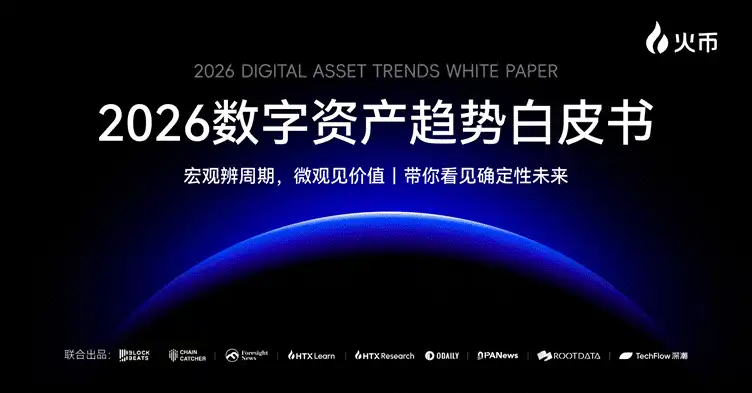
Recently, Huobi HTX officially released the "2026 Digital Asset Trends Whitepaper" (hereinafter referred to as the "Whitepaper"). This Whitepaper was jointly released by numerous industry institutions and media including BlockBeats, ChainCatcher, Foresight News, HTX Learn, HTX Research, Odaily, PANews, Rootdate, and TechFlow. In the current market downturn and cautious industry sentiment, this lengthy report, aimed at re-examining the development path of digital assets from a structural perspective, has emerged to provide forward-looking judgments and a systematic framework for the market, helping investors establish long-term confidence and cognitive anchors in an uncertain cycle.
The Whitepaper delves into an in-depth analysis of the top ten core trends in the 2026 digital asset market and points out that digital assets are completing the historic establishment of their asset class, bidding farewell to the singular "price cycle-driven" approach. They are now officially entering a new era of "structure trend-driven" and gradually transitioning from a highly volatile innovative field to a core part of the global asset allocation system. Amid this wave of global liquidity reshaping, Huobi HTX is taking a core strategic approach of "stability, transparency, institutionalization, AI empowerment," aiming to become a trusted trading and asset service infrastructure for long-term capital under the dual drive of technology and system, anchoring the direction of the new era of on-chain finance.
Macro New Landscape: From "Digital Gold" Positioning Solidification to Stablecoin Market Scale Reaching New Heights
The Whitepaper predicts that in 2026, global monetary policy will enter a "rebalancing" phase, and the interest rate differentials between the Federal Reserve and emerging markets will no longer move in sync. In this complex macro environment, BTC will solidify its "digital gold" positioning. Core assets like Bitcoin are no longer at the edge of "innovative experiments" but are deeply integrated into the global asset allocation model as structural assets, forming a hedge combination with US bonds and gold, with its pricing power further shifting towards medium to long-term capital. At the same time, ETH is expected to become the core vehicle for yield assets. With its mature staking and DeFi infrastructure, Ethereum has established its position as "on-chain national debt," becoming a cash flow-driven growth asset.
In terms of liquidity, the stablecoin market scale will reach new heights. The function of stablecoins has expanded from a simple trading medium to the infrastructure for global cross-border payments and settlements. Huobi HTX points out: "In 2026, the market is no longer asking 'whether digital assets have value' but is asking 'what percentage to allocate.'" With the stablecoin market scale surpassing 300 billion USD, a "chain-based settlement system" based on the US dollar has taken shape. Through deep cultivation of liquidity depth, Huobi HTX has become a frontline battlefield for global macro funds to gauge the market temperature.
Institutional Wave and On-Chain Asset: RWA Acceleration and Derivatives Explosion
By 2026, there has been a significant transformation in institutional entry. The institutional share will continue to rise, while retail volatility will slow down. The whitepaper summarizes the three major paths of institutional participation: direct asset allocation, yield enhancement (achieving robust cash flow through collateralization, RWA), and infrastructure participation (deeply deploying trading platforms and custodial equity in institutions). The entry of long-term funds is making market behavior more rational, and volatility is gradually converging. At the same time, the Real World Assets (RWA) scale will grow rapidly. The tokenization of US Treasuries and fixed income assets has brought a stable source of income onto the chain. Whitepaper data shows that the global RWA scale has surpassed $340 billion, with US Treasuries, gold, and even commodities such as electricity and soybeans being digitally mapped via blockchain.
With the increasing number of institutional participants, on-chain derivatives trading is expected to experience an explosion. Perpetual contracts and options products are gradually moving onto the chain, with pricing mechanisms becoming more mature. In response to this trend, Huobi HTX has fully upgraded its institutional service capabilities, building a "compliance bridge" to the on-chain world for professional capital through comprehensive API interfaces, customized risk control support, and deep integration with top global custodians, helping users lock in structural premiums amid macro fluctuations.
Infrastructure Upgrade and Rise of Intelligent Body Economy: zkEVM and AI Agent Dual-Drive
By 2026, the digital asset infrastructure is undergoing a dual-track transformation, propelling the industry into a new era of "Multi-Trillion L1" and "Automated Execution":
At the infrastructure level, Ethereum has solved 80% of the proof bottleneck through zkEVM protocol-level integration, entering the "Multi-Trillion L1" era, integrating ecosystem liquidity with ultimate performance and security, completely ending the narrative of the "Ethereum killer." In this context, modular blockchain will become the mainstream architecture. As underlying protocols are commoditized, value is shifting at scale from the protocol layer to "fat applications," and the L2 driven by super dApps and AI Agent economy will become the ecosystem core.
At the same time, AI Agent will become the on-chain execution entity. AI agents are replacing humans as the core of trading, revenue management, and risk control. As of March 2026, the economic output generated by AI Agents (aGDP) has reached hundreds of millions of dollars. The trading mode is transitioning from "manual operation" to "intent-driven," heralding the rise of the intelligent body economy.
Huobi HTX is at the forefront of technology and has launched HTX AI Skills. Users only need to input natural language, and AI can complete market analysis, strategy generation, and assist in execution. This "intent-driven" trading new paradigm greatly reduces the threshold, allowing ordinary investors to enjoy professional and intelligent on-chain financial services.
-- Price
Embracing 2026, Huobi HTX's strategic foundation is transparent competition and regulatory certainty
In an era of structural differentiation, competition between platforms has shifted from traffic competition to "trust competition." Transparent competition will become the core difference of trading platforms. In its whitepaper, Huobi HTX emphasizes that transparency is no longer just an added bonus but a survival baseline. Huobi HTX has taken the lead in the industry to implement "Proof of Reserves (PoR) normalization," achieving asset transparency and verifiability through technical means. At the same time, as regulation gradually becomes clearer, the gray areas will narrow further. In the year 2026 when global regulation tends to be clear, the compliant operation of Huobi HTX is demonstrating strong risk resilience.
Huobi HTX promises to its global users: Security and transparency are the foundation of platform development. In the future, Huobi HTX will focus its strategic layout on three main lines: continuously upgrading institutional service capabilities, integrating on-chain assets and yield products, and advancing global compliance layout.
As stated in the conclusion of the whitepaper: the digital asset market is transitioning from "comprehensive bull market" to "survival of the fittest," marking an era for professionals and long-term strategists. In 2026, Huobi HTX introduced the four key strategic keywords of "stability, transparency, institutionalization, AI empowerment," aiming to not only be a trade matcher but also a builder of on-chain financial infrastructure. In the grand narrative of liquidity reconstruction, Huobi HTX is willing to join global participants in ushering in the next golden decade of digital assets.
About Huobi HTX
Huobi HTX was founded in 2013 and has developed over 12 years from a cryptocurrency exchange to a comprehensive blockchain business ecosystem, covering digital asset trading, financial derivatives, research, investment, incubation, and other businesses.
As a leading global Web3 portal, Huobi HTX adheres to a development strategy of global expansion, ecosystem prosperity, wealth effect, and security compliance, providing comprehensive, secure, and reliable value and services to cryptocurrency enthusiasts worldwide.
This content is provided for general informational purposes only and doesn't constitute financial, investment, legal, or tax advice. Any events, rewards, online promotions, or related information mentioned herein should not be considered a recommendation, solicitation, or invitation to purchase, sell, trade, or otherwise deal in any crypto assets. Crypto assets are highly volatile and may result in loss. The availability of WEEX services, products, and related events may vary by region. You are responsible for ensuring that your participation is in accordance with applicable local laws and regulations.
You may also like

Weekend Dividends: How Franklin Templeton's Tokenized Money Fund Breaks Traditional Barriers?

Cyber Loses 5.213 Million CYBER in Theft, Equivalent Tokens Destroyed

The Ethereum Foundation prioritizes post-quantum migration

Mr&强 Analyzes Bitcoin and Ethereum Pressure Zones
42 Million ETH Worth $72 Billion at Risk of Quantum Attack
U.S. Stocks and Crypto Market Under Pressure, World Bank Explores USDC Aid Payments

Ethereum to Transition to Post-Quantum Cryptography by 2028-2029

Pylona Launches on Sonic with Initial Asset EBX01
Bitcoin Reserves Just Found a New Use on Wall Street, but There’s a Catch

CCTV's 300 Million Yuan Pyramid Scheme: Who is Behind It?
Protocol Guild Completes Q4 2026 Member Audit

Aave’s USDC loans surge 36% to $2.6 billion as liquid collateral share plunges

Samsung Wallet Starts Supporting Zero-Fee USDC Transfers via Sui Network

Sentora Supplies 99.99% RLUSD in Morpho XRP Lending Market

Ethereum Foundation cuts 20% of staff, doubles security team

Chainflip Vault Hacked for Approximately $12.6 Million, Preliminary Investigation Points to Network Library Vulnerability

Joseph Lubin: Synchronous Composability Technology Connects Private Networks with the Ethereum Ecosystem

CFTC Guidance Allows Inclusion of Crypto Assets in Operating Cost Resources

CFTC Guidance: Bitcoin and Ethereum Operating Reserves Discounted by at Least 20%
Base Prioritizes Quantum Security for 2027, Everest Upgrade Introduces New Transaction Type
Robinhood Chain pays Ethereum 70% more than Base despite 64% lower fees

BitMine Increases Holdings by 7,819 ETH, Tom Lee States ETH's Annual Supply Growth Rate is Comparable to Bitcoin's

Ondo USDY Achieves Cross-Chain Transfer Between Stellar and Ethereum via LayerZero

Polygon Agglayer v1.0 Launched, Cross-Chain Settlement Time to Ethereum Reduced to 14 Minutes and 20 Seconds

Quant Multi-Chain Rollup Fusion Mainnet Opens to the Public on November 23

Polygon Labs launches Agglayer v1.0 with cross-chain settlement under 2 minutes
Ethereum's New EIP Draft Proposes Pre-distribution of Encrypted Execution Payloads

UBS and Chainlink Build New System to Automate Issuance and Management of Structured Bonds

Cyber Prevents Cross-Chain Bridge Attack, Treasury Bears the Cost of Abnormal CYBER Issuance
KOSPI crash raises fears of further crypto market sell-off
Weekend Dividends: How Franklin Templeton's Tokenized Money Fund Breaks Traditional Barriers?
Cyber Loses 5.213 Million CYBER in Theft, Equivalent Tokens Destroyed
The Ethereum Foundation prioritizes post-quantum migration
Mr&强 Analyzes Bitcoin and Ethereum Pressure Zones
42 Million ETH Worth $72 Billion at Risk of Quantum Attack
U.S. Stocks and Crypto Market Under Pressure, World Bank Explores USDC Aid Payments
Latest articles


Latest coin listings on WEEX


