
Oracle Stock vs. KRAFTON Stock: Why Are Investors Questioning Two Growing Companies?

 Prefer us on Google



Oracle stock (ORCL) and KRAFTON stock (259960) are drawing attention for different reasons. Oracle reported rapid growth in AI cloud infrastructure, yet investors are questioning the cash needed to build its data centers. KRAFTON reported record second-quarter revenue and operating profit, yet its shares have weakened as investors weigh the durability of PUBG-led growth and the contribution of future games. Both companies are growing; the question is how reliably that growth will translate into shareholder value.
My view is that a strong earnings headline is a poor shortcut for judging either stock. Oracle has to show that its expanding contract backlog can become revenue and, eventually, free cash flow without placing too much strain on its finances. KRAFTON has to show that its existing franchises can keep performing while new titles become meaningful contributors. Those are different tests, and a falling share price does not answer either one by itself.
At a Glance
| Oracle | KRAFTON | |
|---|---|---|
| Stock | ORCL, listed in the US | 259960, listed in South Korea |
| Latest reported result discussed here | Fiscal Q1 2027 | Q2 2026 |
| Growth story | AI cloud infrastructure and contracted demand | PUBG franchise and broader game portfolio |
| Main question | When will heavy investment produce stronger free cash flow? | How durable is growth beyond current hits? |
The reporting periods and currencies differ, so the figures below show each company’s progress against its own prior year, not a direct measure of which stock is cheaper.
Why Is Oracle Stock Falling Despite Strong Cloud Growth?
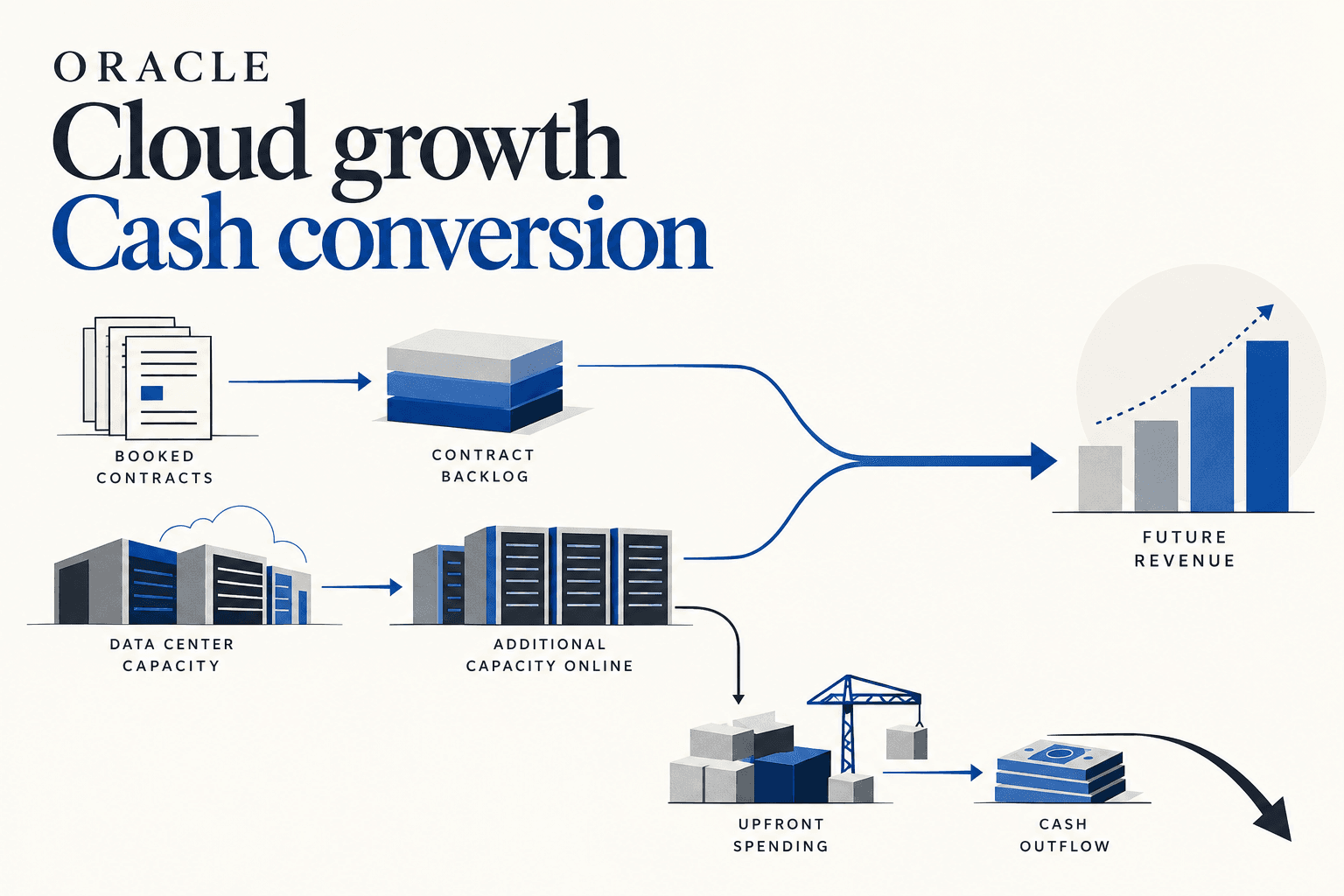
Oracle’s latest results show why investors remain interested. On September 10, 2026, the company reported fiscal first-quarter revenue of $19.3 billion, up 30% year over year. Cloud infrastructure revenue reached $7.4 billion, up 121%, while remaining performance obligations—the value of contracted future business yet to be recognized as revenue—rose to $664 billion.
But contracts are not the same as cash in hand. Oracle reported approximately negative $5 billion in quarterly free cash flow as it invested in capacity for its cloud business. That creates a timing question: how quickly can data centers become operational, serve customers and earn enough to justify the money spent building them?
A separate concern emerged on September 18, when Reuters reported, citing the Financial Times, that about $18 billion in loans tied to an Oracle-leased New Mexico data center were under pressure. The report also described local opposition and infrastructure obstacles facing the project. These are reported concerns about a particular project, not proof that Oracle’s wider AI contracts will fail. They do, however, explain why investors may examine execution and financing as closely as revenue growth.
Is Oracle Stock a Good Stock to Buy Now?
That depends on what an investor believes Oracle can earn after paying for its expansion. The bullish case starts with reported cloud infrastructure growth and a large contracted backlog. The cautious case starts with negative free cash flow, substantial construction needs and the possibility that projects take longer or cost more than expected. Both cases have evidence behind them.
A useful way to follow ORCL is to ask three questions at each earnings release:
- Is cloud infrastructure revenue still growing as contracted capacity comes online?
- Is free cash flow improving relative to the scale of investment?
- Are project delays, funding costs or customer concentration changing the expected return?
An answer based only on an AI growth percentage misses the cost of delivering that growth. An answer based only on a negative cash-flow quarter misses the potential value of contracts that are still being fulfilled.
Can Oracle Stock Reach $400?
It is possible for a stock to reach a particular price, but $400 is a scenario, not a forecast established by Oracle’s latest earnings. A credible case would need assumptions about future revenue, profit margins, cash generation and the valuation investors would pay for those results. Oracle’s $664 billion in remaining performance obligations cannot simply be added to today’s earnings or treated as guaranteed profit: the contracts must be delivered over time, and delivery has costs.
For readers asking where Oracle stock could be in five years, the same method is more useful than a single target. Track whether cloud growth persists, whether free cash flow recovers as facilities begin operating, and whether financing remains manageable. Changes in any of those assumptions can produce very different outcomes.
-- Price
Does KRAFTON Have a Stock, and Is the Company Profitable?
Yes. KRAFTON is a publicly listed South Korean game company, and its shares trade under 259960 on the Korea Exchange. It is the company behind the PUBG franchise, rather than the US food company Kraft Heinz.
KRAFTON is also profitable on an operating basis. For Q2 2026, it reported KRW 1.29 trillion in revenue, up 94.9% year over year, and KRW 410.9 billion in operating profit, up 67%. Operating profit describes the performance of the business before certain non-operating items; it should not be confused with net income or earnings per share.
That distinction matters when reading a stock summary. A company can report strong operating profit while a separate expense or accounting item weighs on its bottom-line result. Readers comparing KRAFTON’s headlines should check which measure—revenue, operating profit, net income or EPS—each headline actually uses.
Why Is KRAFTON Stock Weak When Revenue Is Growing?
The September 24 market snapshot showed KRAFTON at KRW 198,000, down 1.98% for the day and 10.41% over the preceding month. Those figures describe the price move; they do not establish a single cause for it.
One reasonable investor question is how much of KRAFTON’s current success can repeat. A live game franchise can keep earning through updates and player engagement, but future quarters still depend on what players choose to spend. New games offer another route to growth, though their commercial results cannot be assumed before release and sustained play.
This is why KRAFTON’s strong Q2 deserves two readings. The reported revenue and operating profit show that the business performed well in that period. The share-price decline shows that investors were still reassessing future expectations. The price movement alone does not tell us whether those expectations are too optimistic or too pessimistic.

What Is the Current Stock Price of KRAFTON, and Who Owns It?
In the September 24, 2026 market snapshot used for this article, KRAFTON stock was quoted at KRW 198,000 per share. That is a dated quote, not a live price. Check a current Korea Exchange market feed before publishing or trading, especially if this article is updated later.
Because KRAFTON is publicly listed, its shares are held by multiple shareholders; there is no need to assume that a game studio or a single executive owns the entire company. For an ownership analysis, use the latest company filings and separate major shareholders, treasury shares and shares available for public trading. Those categories answer different questions and can change over time.
Which Stock Has the Clearer Growth Test: Oracle or KRAFTON?
The comparison is useful precisely because the businesses are different:
| Question to monitor | Oracle | KRAFTON |
|---|---|---|
| What is already visible? | Fast cloud infrastructure revenue growth and a large contract backlog | Strong Q2 revenue and operating profit |
| What remains uncertain? | The cost and timing of turning contracts into cash | The staying power of existing games and returns from new titles |
| What would strengthen the case? | Capacity delivery alongside improving free cash flow | Continued operating performance and a broader set of successful games |
| What would weaken it? | Delays, financing pressure or persistently poor cash conversion | Franchise slowdown or new releases that fail to contribute enough |
This framework does not rank one stock above the other. It tells readers what evidence would change each investment case. It also avoids comparing a US dollar cloud backlog with a Korean won game publisher’s quarterly revenue as if they measured the same thing.
For WEEX readers following Oracle, there is an additional product distinction: ORCL/USDT perpetual futures on WEEX are a derivative, not ownership of NYSE-listed ORCL shares. A token named ORACLE is also a different asset. Confirm the instrument, contract terms and current trading status on its market page before placing an order.
FAQ
1. Is KRAFTON the Same Company as Kraft Heinz?
No. KRAFTON is the South Korean game company associated with PUBG and the stock ticker 259960. Kraft Heinz is a separate US food company.
2. Is Oracle’s Contract Backlog the Same as Revenue?
No. Remaining performance obligations represent contracted business that Oracle has not yet recognized as revenue. The company must still deliver the relevant services over time.
3. Does WEEX’s ORCL/USDT Contract Give Me Oracle Shares?
No. The WEEX market page identifies ORCL/USDT as a perpetual futures product. Trading that contract does not make the trader a shareholder of Oracle Corporation.
WEEX Editorial View: Look Past the Growth Headline
Oracle and KRAFTON both show why “revenue is up” is only the beginning of a stock analysis. Oracle’s most demanding test is whether its cloud buildout produces cash returns at a pace that justifies its cost. KRAFTON’s is whether it can keep earning from PUBG while building a wider portfolio of games. In my view, treating either recent share-price decline as an automatic bargain would be a mistake. The next useful evidence is operational: cash conversion and project delivery for Oracle; repeatable earnings and successful game releases for KRAFTON.
Sources
- Oracle Investor Relations, “Oracle Announces Q1 Results Driven by Triple Digit Growth in Cloud Infrastructure Revenues,” September 10, 2026.
- Reuters, “Oracle’s $18 Billion Data Center Debt Under Pressure, FT Reports,” September 18, 2026.
- KRAFTON, “KRAFTON Announces Second Quarter 2026 Results,” 2026.
- TradingView, KRAFTON (KRX:259960) market snapshot, September 24, 2026.
- WEEX, ORCL/USDT Perpetual Futures market page, accessed September 24, 2026.
This content is provided for general informational purposes only and doesn't constitute financial, investment, legal, or tax advice. Any events, rewards, online promotions, or related information mentioned herein should not be considered a recommendation, solicitation, or invitation to purchase, sell, trade, or otherwise deal in any crypto assets. Crypto assets are highly volatile and may result in loss. The availability of WEEX services, products, and related events may vary by region. You are responsible for ensuring that your participation is in accordance with applicable local laws and regulations.
You may also like
Citrini Research Points Out That the 'Wall' Between Traditional Finance and Cryptocurrency Is Beginning to Crumble

What is being said at the tables: Flávio Bolsonaro and Scott Bessent give air to Luis Caputo, but the market charges for the activity

Citrini Highlights AI Financial Stocks and Coins: 8 Listed Companies, 1 ETF, 15 Coins
Economist Who Called Bitcoin 'Revolutionary' Among Favorites for 2026 Nobel Prize in Economics
US Government Transfers 12267 BTC Worth 1010000000 USD from Bitfinex Hacker Seizure
From Web3 to the Real Economy: Erable° Becomes an Essential Player in Impact Financing

XDP Coin Price Drops Below $0.02 After Its September Listing: What Is Behind Doppler Finance's Post-Launch Slide?

Ledger Wallet – October 2026: Circulating Your Cryptos Without Losing Control

Money20/20 USA 2026: How Bitcoin, Stablecoins And AI Are Reshaping The Future Of Finance

SoFi Tech Solutions, Orbi, and Mastercard Partner to Launch Cryptocurrency-Linked Card in Mexico

Cedears: Record Rates, Euphoria for AI, and Brazil Reshaping the Stock Map—What Could Happen Next?

US Moves $470 Million in Crypto: What Does This Signal?

What Is Your Crypto Trading MBTI? Take the WEEX Personality Test
Discover what the WEEX Trading MBTI test at TOKEN2049 Singapore explores, how trading habits shape decision-making, and how to use your result constructively.

Standard Chartered plans institutional crypto custody service in Singapore

2.6 Trillion KOK Coin Fraud Case, Calls for Strengthening FIU Role in National Assembly
How Cryptocurrency is Fundamentally Reshaping the Financial System: A Conversation with a16z Partner
![[Exclusive] MemeCore "Has Never Sold Foundation's Holdings... September Transfers Were for Liquidity Supply"](/public-static/9_8dc682caea.png?format=avif)
[Exclusive] MemeCore "Has Never Sold Foundation's Holdings... September Transfers Were for Liquidity Supply"

U.S. Consumer Credit Cools Due to Sharp Drop in Credit Cards
September FOMC Meeting Minutes Released; Possibility of Further Rate Hike Exists
Capital Markets Increase Governance Requirements: Analysis by ID CTVM

Why Is VIX Rising Today? What VIX Means for Stocks and Bitcoin

Why did the US government send $71M in Bitcoin to Coinbase Prime?

Solana Launches Digital Payment Platform for Institutional Investors in Collaboration with JP Morgan

Wintermute Declares Early Stage of Crypto Bull Cycle

Solana launches tool to settle bank trades in seconds

How Are RWA Assets Tokenized in Hong Kong?

BitGo shifts focus from crypto custody to trading, lending
Bitcoin Fear and Greed Index: How It Works
Bitget hack laundering generated $761,725 in fees, researcher finds
B3 Launches Bitcoin Futures in Dollars for the Brazilian Market
Citrini Research Points Out That the 'Wall' Between Traditional Finance and Cryptocurrency Is Beginning to Crumble
What is being said at the tables: Flávio Bolsonaro and Scott Bessent give air to Luis Caputo, but the market charges for the activity
Citrini Highlights AI Financial Stocks and Coins: 8 Listed Companies, 1 ETF, 15 Coins
Economist Who Called Bitcoin 'Revolutionary' Among Favorites for 2026 Nobel Prize in Economics
US Government Transfers 12267 BTC Worth 1010000000 USD from Bitfinex Hacker Seizure
From Web3 to the Real Economy: Erable° Becomes an Essential Player in Impact Financing
Contents
Latest articles


Latest coin listings on WEEX


