
Solana developers propose major overhaul to address hidden risk that could disrupt its network

 Prefer us on Google


Solana developers are considering a new protocol rulebook designed to make independently developed validator software more reliable and easier to maintain.
The proposal, published Oct. 30, comes from Brennan Watt, CEO of Anza, the blockchain engineering company behind Agave, one of the main software programs used to operate the Solana network.
Watt wants Solana to establish a single, authoritative specification defining how its blockchain processes transactions, validates blocks and reaches consensus, rather than relying on rules scattered across existing software and separate technical proposals.
The change could address a growing challenge as Solana expands beyond its original validator software to include independently developed alternatives such as Firedancer, built by trading firm Jump Crypto.
Validators are computers that verify transactions and help secure the blockchain. Although different developers can create the software running these computers, every implementation must follow the same underlying rules to maintain agreement across the network.
Disagreements over those rules could cause validators to process identical transactions differently, potentially creating conflicting views of the blockchain and threatening network reliability.
Watt argues that Solana's existing development process makes it unnecessarily difficult for independent teams to determine exactly how the network is supposed to behave.
Under the current system, protocol changes are proposed through Solana Improvement Documents, known as SIMDs. These documents describe individual upgrades, but the network's complete operating rules are not consolidated into one authoritative reference.
As a result, developers sometimes have to examine existing validator code or reconstruct previous upgrade decisions to understand which rules are active.
Watt said this approach can produce repeated or inconsistent descriptions of existing behavior while making it harder to identify every part of the protocol affected by a proposed upgrade.
New rulebook could reshape Solana's upgrade process
Under the proposal, developers would continue discussing potential upgrades through the existing SIMD process, but formal technical changes would be submitted as edits to a shared protocol specification.
Each amendment would describe precisely how the upgrade affects transactions, network communications, consensus and other relevant functions.
The changes would undergo technical review and any required governance approvals before becoming part of the official specification when activated on Solana's Mainnet.
This would allow teams developing Agave, Firedancer and future validator software to work from the same documented requirements rather than relying on another implementation's code as their primary reference.
Where Solana's draft rulebook begins and ends
Forward conformance starts from trusted state and stays within reference epoch 1072.
TRUST INPUTDRAFT REFERENCE EPOCH 1072Trusted stateSnapshot, or stateauthenticated toForward conformanceApply the specified rules within EFirst bankof E+1Outsidethis versionEarlier retired rules need not be replayed.Schematic scope boundary; spacing does not represent time.epoch-E root
DRAFT REFERENCE EPOCH 1072Trust inputTrusted stateSnapshot, or state authenticatedForward conformanceApply the specified rulesWithin E onlyFirst bank of E+1Outside this versionEarlier retired rules need not be replayed.Schematic; spacing does not represent time.to epoch-E root
Where does the client start?
Where does the client start?Last bank before EAlready within E
Child-bank construction applies the epoch-E boundary transition once before its transactions.
LAST BANK BEFORE ETrusted stateApply onceEpoch-boundary transitionWITHIN ETransactionsBefore the child bank's transactions
Last bank before EApply onceEpoch-boundary transitionTransactions within ETransition precedes these transactions
The trusted state already includes the epoch boundary transition, so it must not be applied again.
WITHIN E WITHIN E Trusted state Transactions Boundary transition already included in the starting state
Already within E Trusted state Boundary transition already included in the starting state Transactions in E Continue without repeating the transition.
A common rulebook makes the target explicit. Starting-state trust and the next epoch remain separate requirements.
This is a draft specification, not an adopted protocol change. It does not establish starting-state correctness, historical replay or continuous operation into E+1. No client reliability gain is quantified.
Sources and evidence
Sources
- Scope and conformance
- Draft reference epoch
Supporting facts
- The draft landing page identifies its Mainnet reference epoch as E=1072; the scope starts an implementation from a trusted snapshot for that epoch or other state authenticated to an epoch-1072 root. [2] [1]
- The draft requires forward conformance within its reference epoch and does not require reproducing encodings or rule branches that stopped being accepted before that epoch. [1]
- The draft applies only to banks in reference epoch E and explicitly does not define the first bank of E+1, so conformance to this version alone does not establish continuous operation across that boundary. [1]
- Under the draft, an implementation starting at the last bank before E applies the epoch boundary transition once; a starting state already inside E must not apply it again. [1]
- Forward conformance leaves the starting snapshot or authenticated root as a trust input: the draft begins after that input has been accepted rather than requiring a new client to prove the entire earlier chain by replay. [1]
Method
Schematic based on the draft landing page and scope chapter captured November 4, 2026. Two selectable initialization states reproduce the draft's boundary rule; geometry is qualitative, with no duration or performance scale.
Scope
This is a draft specification, not an adopted protocol change. It does not establish starting-state correctness, historical replay or continuous operation into E+1. No client reliability gain is quantified.
Infographic by CryptoSlate
It could also make software testing more effective. When independent validators produce different results, developers would have a common standard against which to examine the disagreement and identify which implementation needs correction.
Watt has already published a draft specification covering 18 areas of Solana's operations, including transaction processing, network communications, consensus, fees, and validator rewards.
However, the draft remains limited to a defined period of Solana's blockchain history and assumes developers begin from an already trusted network state. Further work would be needed to cover subsequent upgrades and establish that implementations remain compatible over time.
-- Price
This content is provided for general informational purposes only and doesn't constitute financial, investment, legal, or tax advice. Any events, rewards, online promotions, or related information mentioned herein should not be considered a recommendation, solicitation, or invitation to purchase, sell, trade, or otherwise deal in any crypto assets. Crypto assets are highly volatile and may result in loss. The availability of WEEX services, products, and related events may vary by region. You are responsible for ensuring that your participation is in accordance with applicable local laws and regulations.
You may also like

Brale lets businesses launch USD stablecoins on Cardano

Ansem and Satoshi Nakamoto: Living Under the Same 'Stolen' Roof
Cyber Loses 5.213 Million CYBER in Theft, Equivalent Tokens Destroyed
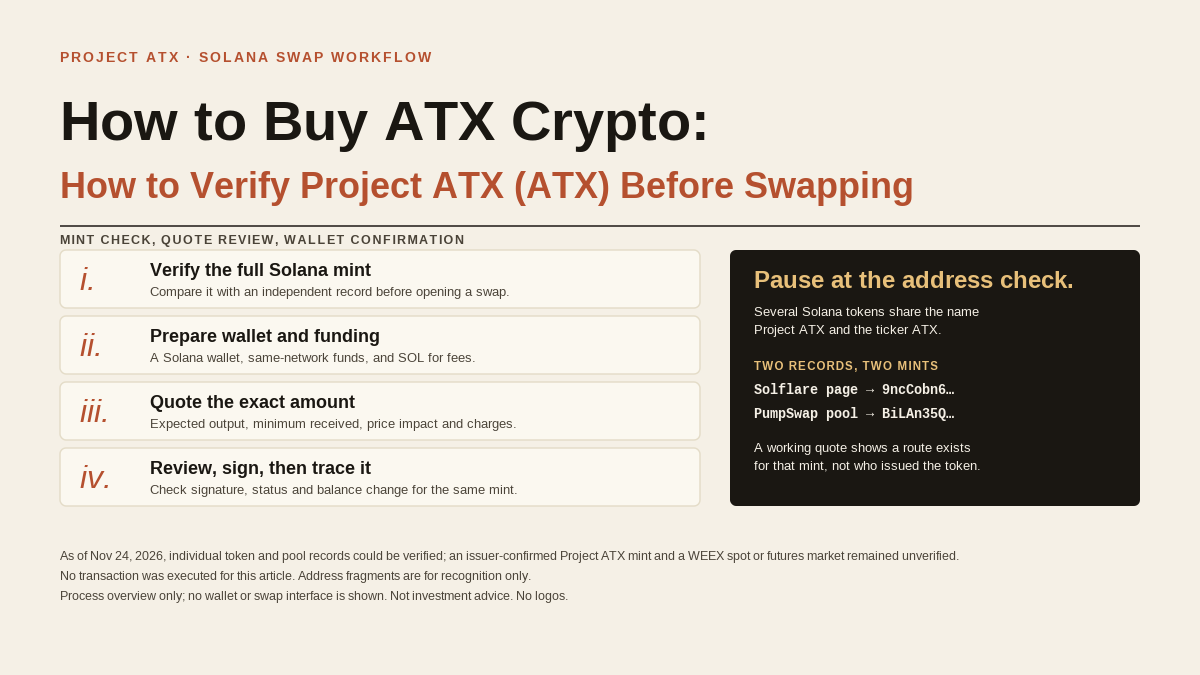
How to Buy ATX Crypto: How to Verify Project ATX (ATX) Before Swapping
Learn how to buy ATX crypto on Solana. Verify the Project ATX mint, review swap quotes and fees, and confirm the exact token you receive on-chain.

Why Is the ATX Crypto Price Different Across Platforms? Project ATX (ATX) Explained
See why the ATX crypto price varies across platforms. Compare Project ATX mint addresses, PumpSwap pools, and swap quotes for the same trade size.
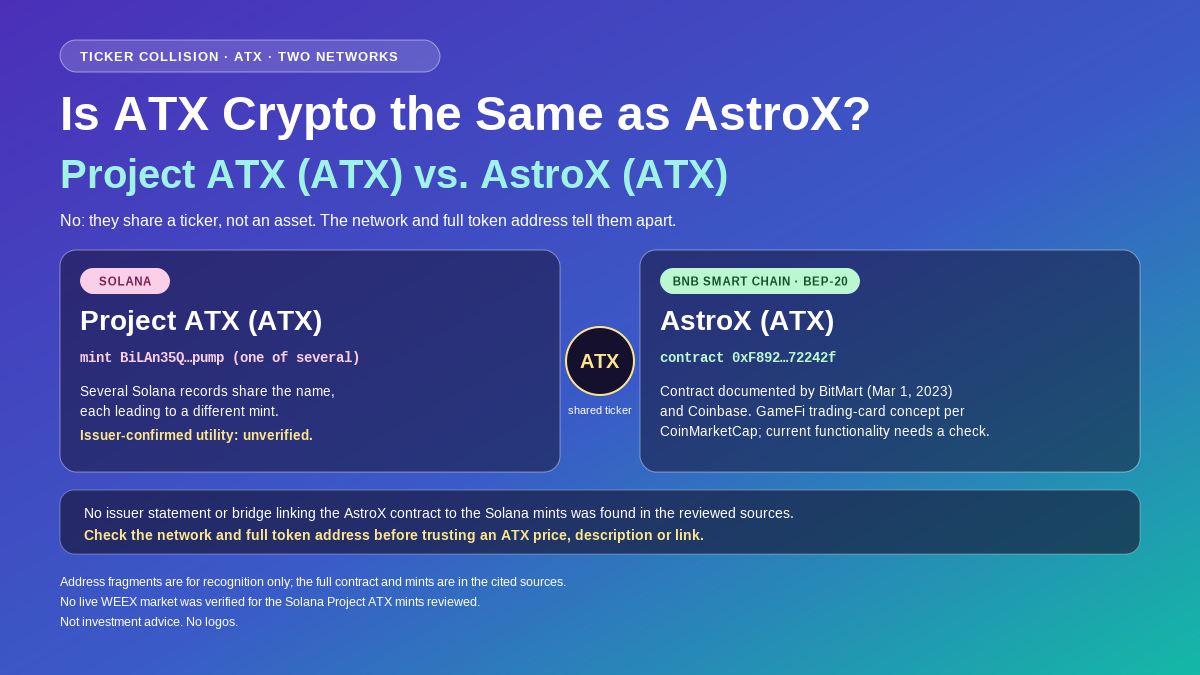
Is ATX Crypto the Same as AstroX? Project ATX (ATX) vs. AstroX (ATX)
Compare Project ATX on Solana with AstroX on BNB Smart Chain. Learn how to verify each token address before trusting an ATX price or buying guide.
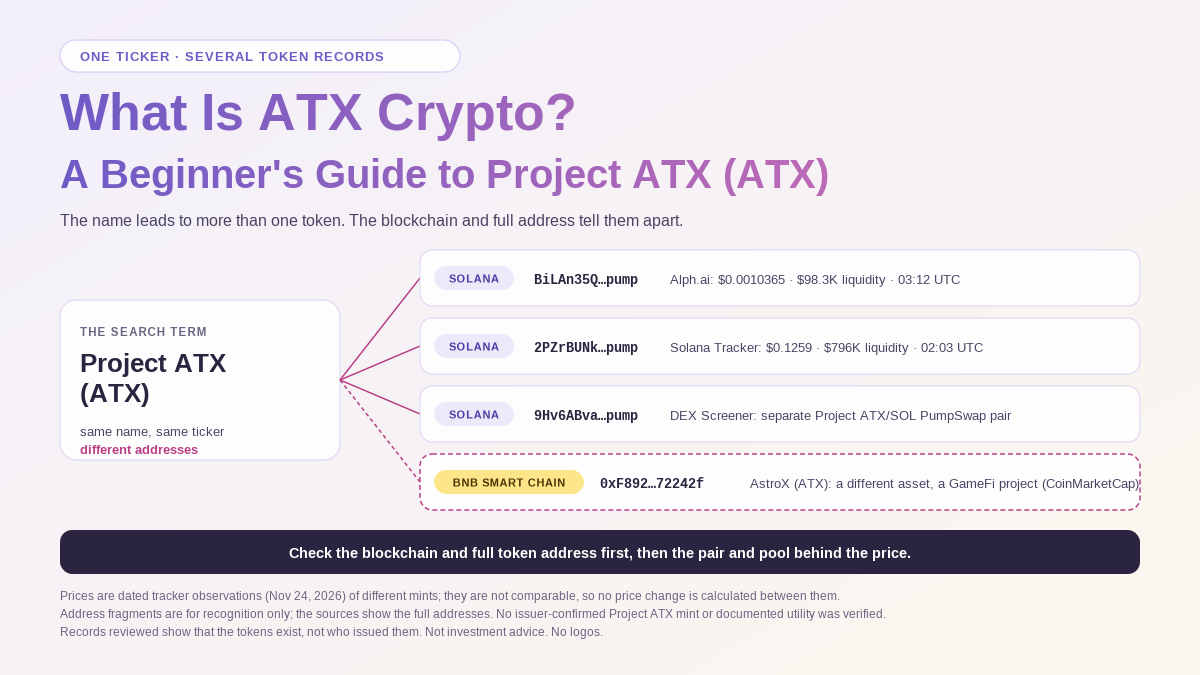
What Is ATX Crypto? A Beginner’s Guide to Project ATX (ATX)
Learn what ATX crypto means, why Project ATX appears under multiple Solana mint addresses, and how to tell those tokens apart from AstroX (ATX).

Amazon Supports Media AI Monetization with Article Access Fees in USDC

Samsung Wallet Starts Supporting Zero-Fee USDC Transfers via Sui Network

BitMine Increases Holdings by 7,819 ETH, Tom Lee States ETH's Annual Supply Growth Rate is Comparable to Bitcoin's

Trezor and Exodus Users Lose Over $600,000 on the Same iPhone

Polygon Labs launches Agglayer v1.0 with cross-chain settlement under 2 minutes

Solana Showcases AI Ecosystem Products and Development Tools

Cyber Prevents Cross-Chain Bridge Attack, Treasury Bears the Cost of Abnormal CYBER Issuance
KOSPI crash raises fears of further crypto market sell-off
Visa Crypto Labs launches new wallet that lets AI work and earn for you

Solana’s new memory checks could make some older app transactions fail
Solana upgrades to mainnet 1.0 as Foundation takes majority CoinGecko stake
IOSCO Warns of 'Quantum Delay' and Assesses Readiness for Quantum Threat
Cardano founder Hoskinson claims the network is functioning despite ADA price drop

PA Daily | US Spot Bitcoin ETF Has Seen Outflows of $3.47 Billion So Far in November; Abraxas Capital Buys $897 Million Worth of Bitcoin During Market Correction
Peter Schiff says Solana can replace Bitcoin exposure. Can it?

Cyber Faces Token Minting Issue on Solana

Solana 2027 Roadmap: Doubling Computing Power, Reducing Transaction Costs by 80%
Peter Schiff Points Out High Correlation in Mainstream Cryptocurrency Trends
Solana Heads Towards Its Worst Year in History
Follow the Money: Variational Raises $110 Million, Tether Activity and M&A Deals

Carl Moon Reveals Bitcoin Drops to $55,615

Anthropic's Largest IPO Ever Sees Stock Tokens Launch on Multiple Blockchains, Trading Volume Exceeds 1.5 Billion Yen

Hacker Transfers Approximately 488,000 ETH Worth About $860 Million
Brale lets businesses launch USD stablecoins on Cardano
Ansem and Satoshi Nakamoto: Living Under the Same 'Stolen' Roof
Cyber Loses 5.213 Million CYBER in Theft, Equivalent Tokens Destroyed
How to Buy ATX Crypto: How to Verify Project ATX (ATX) Before Swapping
Learn how to buy ATX crypto on Solana. Verify the Project ATX mint, review swap quotes and fees, and confirm the exact token you receive on-chain.
Why Is the ATX Crypto Price Different Across Platforms? Project ATX (ATX) Explained
See why the ATX crypto price varies across platforms. Compare Project ATX mint addresses, PumpSwap pools, and swap quotes for the same trade size.
Is ATX Crypto the Same as AstroX? Project ATX (ATX) vs. AstroX (ATX)
Compare Project ATX on Solana with AstroX on BNB Smart Chain. Learn how to verify each token address before trusting an ATX price or buying guide.
Latest articles





Latest coin listings on WEEX


