
Nebius Cuts 2026 Revenue Outlook: Are Data Center Delays a Threat to NBIS?

 设为Google首选来源

Nebius 2026 revenue guidance has become a key concern for investors after the AI cloud company reported third-quarter revenue of $980.8 million, up 571% year over year, but warned that some data-center capacity would arrive later than originally planned. In its November 12, 2026 earnings announcement, Nebius Group (NASDAQ: NBIS) said it now expects full-year revenue near the lower end of its previous $3.0 billion–$3.4 billion forecast range. The adjustment reflects delayed deployment at third-party facilities, not a confirmed cancellation of the underlying customer contracts.
The change in Nebius 2026 revenue guidance highlights a major challenge facing AI infrastructure companies: strong demand does not automatically produce immediate revenue when computing capacity is not yet operational. Nebius continues to secure large customer commitments, but delivering AI cloud services requires GPU hardware, electrical power, cooling, networking equipment, and functioning data centers. When any of those components arrives late, the financial impact can extend beyond a single construction schedule.
For investors evaluating Nebius 2026 revenue guidance, the most important question is whether delayed data-center openings indicate weakening AI demand or a temporary mismatch between customer commitments and available computing capacity. Nebius reported more than $12 billion in new contract value signed since the beginning of the third quarter and expects 2027 revenue of $12 billion–$13 billion. However, its increasingly capital-intensive expansion and revised deployment timetable introduce meaningful execution and financing risks. This article examines the guidance change, its impact on NBIS stock, and the evidence investors should monitor next.
Why Did Nebius Lower Its 2026 Revenue Expectations?
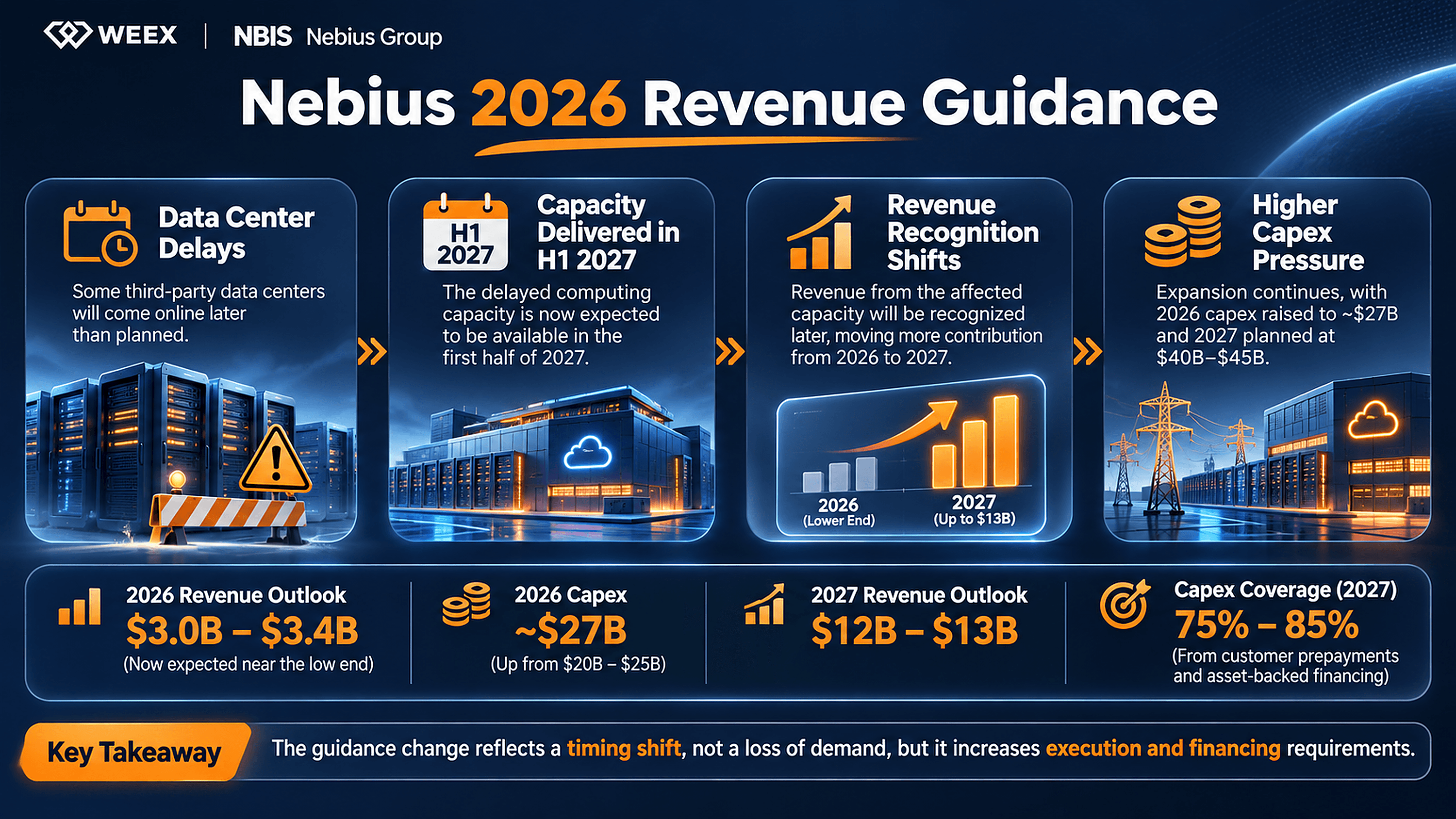
Nebius revised its revenue outlook because certain third-party computing facilities originally expected to contribute capacity during 2026 are now scheduled to become available in the first half of 2027. The company's November 12 shareholder letter explicitly states that the contracts associated with this delayed capacity remain in place. As a result, the updated outlook reflects a change in when Nebius expects to deliver services and recognize revenue, rather than confirmed evidence that its customers have withdrawn their commitments.
This distinction is particularly important for an AI cloud provider. Unlike a software company that can distribute a new digital product to customers almost immediately, an AI infrastructure operator must physically install and activate substantial computing capacity before delivering many contracted services. Even when customer demand is secured, the business cannot necessarily recognize the corresponding revenue until the necessary performance obligations are fulfilled.
Nebius has consequently shifted its expected 2026 revenue toward the lower end of its previously announced $3.0 billion–$3.4 billion range. The company also delayed its annualized revenue run-rate milestone, previously targeted for December 2026, to February 2027.
Nebius 2026 Guidance: What Actually Changed?
| Indicator | Previous Outlook | November 12 Update |
|---|---|---|
| Full-Year Revenue | $3.0B–$3.4B | Expected near the low end |
| Adjusted EBITDA Margin | Approximately 40% | Unchanged |
| Capital Expenditures | $20B–$25B | Approximately $27B |
| Annualized Revenue Run Rate | $7B–$9B by December | More than $7B expected in February 2027 |
| Third-Party Capacity | Selected deployments expected in 2026 | Some moved to H1 2027 |
| Year-End Contracted Power | 5 GW | Target unchanged |
Source: Nebius Q3 2026 Shareholder Letter, November 12, 2026.
The guidance table reveals two different developments. First, revenue recognition is shifting later because certain capacity additions have been postponed. Second, the company's spending requirements have increased, with capital expenditures now expected to reach approximately $27 billion in 2026.
Together, these changes create a more demanding financial outlook. Nebius is investing more capital while some of the revenue expected from its infrastructure is arriving later. Although this does not establish a permanent decline in customer demand, it increases the importance of execution timing and financing availability.
What Happened at Nebius's New Jersey Data Center?
The New Jersey facility provides a concrete example of the infrastructure challenges behind the guidance adjustment. Nebius is developing computing capacity associated with its agreement with Microsoft, but the deployment schedule has been affected by a transition from temporary power generation toward permanent infrastructure involving Bloom Energy fuel cells.
According to Nebius's shareholder letter, DataOne began retiring some temporary generation capacity during the third quarter in preparation for the change. That decision affected the timetable for delivering the remaining computing capacity at the site.
Nebius expects to deliver more than half of the capacity contracted with Microsoft by the end of 2026, with the remaining portions scheduled for the second quarter of 2027. The company said Microsoft has been involved in the planning process and that Bloom fuel-cell generation is already operational, with further capacity being scaled.
Why Does a Power Infrastructure Delay Matter?
AI data centers consume substantial electrical power because their computing systems operate with thousands of high-performance processors and supporting networking and cooling equipment. A facility can have GPU hardware ordered and customers contracted yet remain unable to operate at full capacity without sufficient electrical infrastructure.
This creates a dependency between physical construction and financial results. Customer agreements establish potential future revenue, but the infrastructure must be operational for Nebius to deliver the associated computing services.
The New Jersey delay illustrates this relationship. The company has not reported that the Microsoft contract was canceled, but part of the associated capacity is now scheduled to become available later than initially anticipated. That changes the expected timing of revenue recognition even if the underlying contractual demand remains intact.
Nebius also argues that increasing its proportion of owned facilities will improve its control over project execution and long-term economics. However, owned infrastructure generally requires significant upfront investment and does not eliminate construction, utility, or regulatory risks.
Does the Guidance Cut Mean AI Cloud Demand Is Weakening?
The available evidence does not establish that Nebius is experiencing a broad collapse in AI cloud demand. The company reported more than $12 billion in new contract value signed since the beginning of the third quarter, while management continued to describe customer demand as strong.
Those commitments demonstrate commercial interest in Nebius's computing infrastructure, but contracted value should not be confused with revenue already recognized. Depending on contract duration, delivery schedules, and accounting treatment, a large customer agreement may contribute revenue over several years.
The distinction helps explain why an AI infrastructure company can report both strong new contracts and weaker near-term revenue expectations. Demand may remain robust while the physical capacity required to serve customers arrives later than anticipated.
AI Demand vs. Infrastructure Delivery
| Indicator | What It Shows | What It Does Not Prove |
|---|---|---|
| New Customer Contracts | Future commercial commitments | Revenue already earned |
| GPU Orders | Planned computing expansion | Capacity currently operational |
| Contracted Power | Secured power arrangements | Fully functioning data centers |
| Active Computing Capacity | Infrastructure available to customers | Guaranteed utilization |
| Recognized Revenue | Services delivered under accounting rules | Future profitability |
| Customer Prepayments | Cash received under contract terms | Absence of delivery obligations |
The relationship between these measurements is particularly important when assessing companies undergoing rapid expansion. A large contracted pipeline supports a growth narrative, but its economic value depends on delivery, utilization, pricing, financing costs, and the ability to convert contractual commitments into cash-generating operations.
Nebius therefore faces an execution question rather than a demand question alone. Continued customer interest will be encouraging, but investors also need evidence that computing infrastructure can be completed and delivered on schedule.
-- 价格
What Do Nebius's Q3 Results Reveal About Its Growth?
Nebius reported third-quarter revenue of $980.8 million for the period ended September 30, 2026, compared with $146.1 million a year earlier. That represents a 571% increase, illustrating the substantial expansion of its AI infrastructure operations.
Adjusted EBITDA improved from a $5.2 million loss to positive $465.8 million, while the net loss from continuing operations narrowed from $119.6 million to $37.5 million. The company therefore demonstrated substantial improvements in operating performance despite remaining unprofitable on that particular net-income measure.
Nebius Q3 2026 Financial Snapshot
| Financial Metric | Q3 2025 | Q3 2026 | Change |
|---|---|---|---|
| Revenue | $146.1M | $980.8M | +571% |
| Adjusted EBITDA | -$5.2M | $465.8M | Turned positive |
| Net Loss from Continuing Operations | -$119.6M | -$37.5M | Loss narrowed 69% |
| Adjusted Net Income | -$100.4M | $90.9M | Turned positive |
| Cash Used in Operating Activities | $80.6M | $273.0M | Cash outflow increased |
| Purchases of Property, Equipment and Intangible Assets | $955.5M | $7.30B | Substantial expansion |
Source: Nebius Q3 2026 Financial Results — SEC Exhibit 99.1. Adjusted EBITDA and adjusted net income are non-GAAP measures.
The combination of higher adjusted EBITDA and substantial investment spending reveals the complexity of evaluating Nebius's financial position. Operating performance has improved as revenue increases, but expanding data centers and purchasing computing equipment require large amounts of capital.
Adjusted EBITDA should not be treated as equivalent to free cash flow. Infrastructure purchases, interest payments, working capital requirements, and other financing obligations can affect cash generation even when adjusted operating profitability appears strong.
How Much of Q3 Revenue Was Non-Recurring?
Nebius disclosed that approximately $325 million of its third-quarter revenue came from non-recurring activity associated with its asset-light partnership model.
Under this model, partners fund certain computing capacity while Nebius provides infrastructure architecture, cloud software, and related services. The company expects such partnerships to become a more regular part of its business as the model expands, but the timing and size of future revenue remain uncertain.
The identified $325 million represented approximately 33.1% of the company's $980.8 million reported quarterly revenue. Subtracting that amount produces roughly $655.8 million, but this is only an analytical breakdown and should not be described as an officially reported recurring-revenue figure.
The distinction matters because the headline 571% growth rate includes all recognized quarterly revenue, including the identified non-recurring contribution. Investors forecasting future growth should therefore examine both the composition of revenue and the timing of new infrastructure deployments.
Readers seeking a broader breakdown of the earnings report can refer to WEEX's earlier analysis, Why Did Nebius Stock Crash Despite 571% Revenue Growth?.
Why Is Nebius Increasing Capital Spending Despite Delayed Revenue?
Nebius raised its expected 2026 capital expenditures to approximately $27 billion from a previous range of $20 billion–$25 billion. The company also provided an initial 2027 capital expenditure outlook of $40 billion–$45 billion.
The higher investment targets reflect its plans to expand owned data centers, computing equipment, and infrastructure capacity. Management believes that owning more of its facilities will provide greater operational control and support improved long-term economics.
However, this strategy also raises the financial stakes. Large infrastructure investments require capital before the associated computing capacity can produce meaningful revenue. Delays can therefore extend the period between spending money and generating returns.
For 2027, Nebius expects revenue of $12 billion–$13 billion, implying substantial growth from its 2026 forecast. At the same time, planned capital expenditures will remain significantly larger than annual revenue.
Nebius's 2027 Expansion Outlook
| Metric | 2027 Management Outlook |
|---|---|
| Annual Revenue | $12B–$13B |
| Capital Expenditures | $40B–$45B |
| Additional Computing Capacity | More than 1 GW annually |
| Pre-Tax Profitability | Breakeven targeted in Q4 2027 |
| Expected Capex Coverage | 75%–85% through customer prepayments and asset-backed financing |
| Main Business Priority | Scaling AI cloud capacity and infrastructure |
Source: Nebius Q3 2026 shareholder letter, November 12, 2026.
At the midpoint of its forecasts, Nebius anticipates approximately $12.5 billion in 2027 revenue and $42.5 billion in capital expenditures. This means projected annual investment spending would be around 3.4 times annual revenue.
The comparison illustrates the capital intensity of the company's strategy, but it does not imply an accounting loss equal to the difference. Capital expenditures are investments in assets that generally provide economic benefits over multiple periods, while revenue and expenses follow separate recognition rules.
The financial question is whether those assets will eventually generate sufficient returns after considering operating costs, depreciation, maintenance, and financing expenses.
Can Customer Prepayments Reduce Nebius's Financing Risk?
Customer prepayments are becoming increasingly important to Nebius's business model. The company reported that prepayments associated with agreements signed in Q3 covered more than 100% of the relevant capital expenditures, compared with approximately 50%–60% for comparable arrangements in Q2.
For 2027, Nebius expects customer prepayments and financing secured against contracts with investment-grade customers to cover approximately 75%–85% of planned capital expenditures.
This can reduce reliance on conventional equity financing and unsecured debt, but it does not remove the company's obligations to deliver services under those agreements.
Consider a simplified example using the midpoint of its planned 2027 capital expenditures:
| Illustrative Financing Scenario | 75% Coverage | 85% Coverage |
|---|---|---|
| Assumed Capital Expenditures | $42.5B | $42.5B |
| Covered by Prepayments and Asset-Backed Financing | $31.88B | $36.13B |
| Remaining Amount to Finance or Fund | $10.63B | $6.38B |
Source: Illustrative calculation based on Nebius's announced capital expenditure and financing-coverage ranges. These are not company-reported financing shortfalls.
The calculation shows how the proposed funding structure could support a large portion of Nebius's expansion, while leaving the company dependent on additional resources such as available cash, operating cash flow, debt, or equity.
The company reported approximately $7.4 billion in cash and cash equivalents at the end of Q3. However, cash balances should be evaluated alongside existing liabilities, spending commitments, debt terms, and the timing of customer payments.
For investors, the financing model will be more convincing if future data-center deployments generate revenue and cash flow at the rates management expects. Strong customer commitments can support funding, but delayed project execution can still change the timing of financial returns.
For additional perspective, WEEX previously examined Nebius's spending model in Nebius Stock After a 34% Pop: What the Capex Math Says.
Why Did NBIS Stock React Negatively to the Guidance Change?
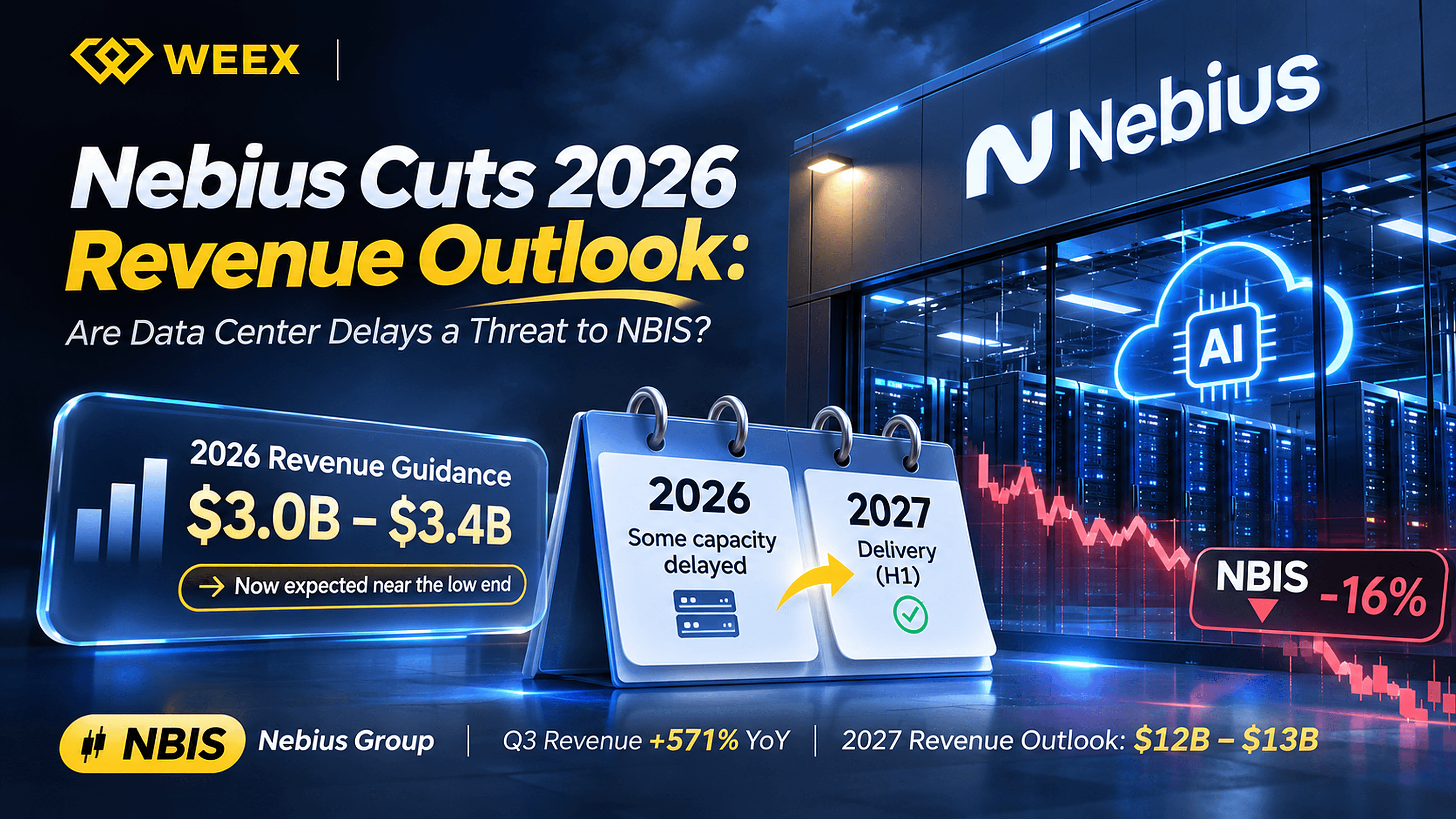
Nebius shares fell sharply following the November 12 announcement, with Reuters reporting a decline of approximately 16% during the U.S. trading session. The market reaction reflected concerns about delayed revenue, increased infrastructure spending, and financing conditions across the AI cloud sector.
The decline does not necessarily mean investors believe Nebius's AI cloud business has stopped growing. Rather, it indicates that market expectations can change when a company reports stronger historical results but weaker near-term timing for future revenue.
Equity valuations incorporate expected future cash flows and the risks associated with producing them. If investors anticipate that data-center capacity will become operational later than planned, they may revise the timing of future revenue and profitability even when total contracted demand remains unchanged.
Another consideration is the broader technology-sector environment. AI infrastructure companies have attracted substantial investor attention because of their rapid growth potential, but their expansion depends on capital availability, hardware supply, electricity, construction schedules, and customer utilization.
A change in any of these assumptions can influence valuations, particularly when expectations already anticipate rapid execution.
NBIS Market Snapshot: November 13
An internal WEEX promotional snapshot recorded at approximately 15:17 Beijing Time on November 13 displayed a closed-market NBIS stock-related reference quotation of 130.15 USDT and two NBIS perpetual-futures order-book quotations around 126.61 and 126.44 USDT.
| Market Observation | Recorded Value | Important Context |
|---|---|---|
| NBIS Stock-Related Reference | 130.15 USDT | Marked Closed |
| Perpetual Futures Quote A | Approximately 126.61 USDT | Order-book observation |
| Perpetual Futures Quote B | Approximately 126.44 USDT | Order-book observation |
| Observation Time | November 13, 15:17 Beijing Time | Historical snapshot |
Source: WEEX internal promotional market snapshot supplied November 13, 2026. Figures are historical observations, not live quotes or confirmed Nasdaq trading prices.
The difference between these quotations is important because WEEX's stock-related products and perpetual futures follow different trading mechanisms. A stock-linked reference price may remain unchanged when the underlying U.S. equity market is closed, while a futures market may display different order-book prices.
Therefore, the futures quotes should not be treated as the official percentage decline of Nasdaq-listed NBIS shares. Differences may reflect trading conditions, liquidity, product structure, and market hours.
For more information on stock-linked pricing, see When Can You Trade U.S. Stock Tokens? Trading Hours Explained.
What Should Investors Watch in 2027?
The clearest operational indicator will be the delivery of delayed data-center capacity, particularly the New Jersey deployment associated with Microsoft. If Nebius fulfills its revised schedule, the company may begin recognizing revenue previously expected in 2026. Further delays would raise questions about whether its infrastructure expansion is progressing at the pace required to support its outlook.
Investors should also distinguish revenue growth from the conversion of customer commitments into cash flow. A rising backlog or increasing contract value can indicate demand, but actual financial performance depends on services delivered, operating margins, equipment costs, and financing conditions.
Capital expenditure efficiency will become increasingly important as Nebius moves toward its planned $40 billion–$45 billion investment program for 2027. Metrics such as available operating capacity, customer utilization, payback periods, and cash generation may provide stronger evidence of business quality than revenue growth alone.
Finally, the company's objective of reaching pre-tax breakeven in the fourth quarter of 2027 should be monitored against actual reported results. Achieving that target would require substantial progress in revenue generation while managing depreciation, operating costs, and financing expenses.
The strongest investment case would involve both sustained customer demand and consistent infrastructure delivery. Neither factor alone is sufficient to establish long-term profitability.
How to View and Trade Nebius (NBIS) on WEEX
Users following Nebius's earnings and revenue outlook can explore NBIS-related stock products and perpetual futures through WEEX. These products provide different forms of market exposure and should not be confused with directly owning Nasdaq-listed Nebius common shares.
Step 1: Register on WEEX and Prepare Your USDT Balance
Visit the WEEX official website and create an account or log in. Complete any required identity verification, then prepare a USDT balance using an available funding method. Before trading, confirm that the relevant stock-related product is supported for your account and region.
Step 2: Open the NBIS Stock-Related Trading Page
Navigate to the WEEX NBIS/USDT Stock Trading page. Review the displayed reference quotation, current trading status, available order types, liquidity, and applicable fees. Stock-linked digital products provide price exposure under their individual terms and do not necessarily grant the ownership rights associated with ordinary Nasdaq shares.
Step 3: Review Your Order and Monitor the Market
If the product is currently available for trading, select a supported order type, enter the intended amount, and confirm the price and total transaction value before submitting. Once an order is executed, monitor the position through your WEEX account.
Experienced derivatives traders may alternatively review NBIS/USDT Perpetual Futures. Perpetual futures involve margin requirements, funding payments, leverage, and liquidation risks. Trading restrictions or circuit breakers may also apply, so users should verify the market's current status before attempting to open or close a position.
WEEX stock-related products and perpetual contracts are not equivalent to directly owning Nebius common shares. Users should understand the relevant product terms and market risks before trading.
Conclusion
Nebius's updated 2026 revenue guidance reflects the challenges of converting strong AI cloud demand into operational computing capacity. The company reported remarkable third-quarter growth and substantial new customer commitments, yet some third-party data-center deployments will arrive later than anticipated.
The most important distinction is between delayed revenue and canceled demand. Nebius has stated that the affected customer contracts remain in place, supporting the view that the immediate guidance adjustment concerns delivery timing. However, that does not eliminate the financial consequences of infrastructure delays, particularly when capital expenditures are rising sharply.
Nebius expects approximately $27 billion in capital expenditures for 2026 and a further $40 billion–$45 billion in 2027. Its ability to finance that investment and convert new capacity into profitable operations will be critical to evaluating the company's long-term growth prospects.
For NBIS investors, the next evidence should come from completed data-center deployments, recognized revenue, customer prepayments, and progress toward the company's 2027 profitability objectives. AI demand remains an important source of opportunity, but infrastructure execution will determine how much of that demand becomes sustainable financial performance.
FAQ
1. Why did Nebius lower its 2026 revenue guidance?
Nebius expects revenue near the low end of its previous $3.0 billion–$3.4 billion forecast range because some third-party computing capacity originally planned for 2026 has been delayed until the first half of 2027. The company stated that the associated customer contracts remain in place, meaning the change primarily affects the timing of capacity delivery and revenue recognition.
2. Does the Nebius guidance adjustment mean AI demand is slowing?
Not necessarily. Nebius reported more than $12 billion in new customer contract value signed since the beginning of the third quarter. This suggests continuing commercial demand, although contract value is not the same as recognized revenue. Future results will depend on whether Nebius can complete its planned infrastructure and deliver the corresponding computing services.
3. How much revenue did Nebius report in Q3 2026?
Nebius reported $980.8 million in consolidated revenue for the quarter ended September 30, 2026, representing 571% year-over-year growth. Adjusted EBITDA reached $465.8 million, while the net loss from continuing operations narrowed to $37.5 million. Approximately $325 million of quarterly revenue came from identified non-recurring asset-light partnership activity.
4. What is Nebius's revenue forecast for 2027?
Nebius expects $12 billion–$13 billion in revenue during 2027 and is targeting pre-tax breakeven in the fourth quarter. The company also plans capital expenditures of approximately $40 billion–$45 billion. These figures are management forecasts and depend on execution, financing, and the successful deployment of additional computin capacity.
5. Can I trade NBIS-related products on WEEX?
WEEX provides NBIS stock-related and perpetual futures market pages, subject to product availability and account eligibility. Stock-linked digital products offer exposure under their specific terms rather than direct ownership of ordinary Nebius shares, while perpetual futures involve leverage, funding, and liquidation risks. Users should verify market status and current trading conditions before placing orders
本内容仅供参考,不构成任何金融、投资、法律或税务建议。文中提及的任何活动、奖励、线上活动或相关信息,不应被视为对购买、出售或交易任何加密资产的推荐、招揽或邀请。加密资产具有高波动性,存在价值损失风险。WEEX服务、产品及相关活动的可用性可能因地区而异。用户在参与前有责任确保符合当地适用法律法规。


