
Crypto Trading Bot vs Manual Trading: Which Is Better?

 Prefer us on Google

As cryptocurrency markets operate 24/7, many traders face a common challenge: how to monitor markets and execute strategies consistently.
Some traders prefer manual trading, where they analyze market conditions and make decisions themselves. Others use crypto trading bots to automate repetitive tasks and execute predefined strategies.
But which approach is better?
The answer depends on the trader’s goals, experience, and strategy. Trading bots can improve execution speed and reduce emotional decisions, but they cannot replace strategy development or risk management. Manual trading provides more flexibility, but it requires more time and discipline.
What Is Manual Crypto Trading?
Manual crypto trading means a trader personally analyzes the market and places orders through a trading platform.
A manual trader may consider factors such as:
- Price movements;
- Technical indicators;
- Market news;
- Overall sentiment.
For example, a trader may analyze Bitcoin’s trend, decide that market conditions are favorable, and manually place a buy order.
The biggest advantage of manual trading is flexibility. Human traders can consider information that is difficult to convert into fixed rules, such as unexpected news events or sudden changes in market sentiment.
However, manual trading also has limitations. Cryptocurrency markets never close, which means traders cannot realistically monitor every price movement. In addition, emotions such as fear and greed can influence decisions.
Common mistakes include buying during market hype, selling during panic, or ignoring a predefined risk plan.
What Is a Crypto Trading Bot?
A crypto trading bot is a software program that automatically executes trades based on predefined rules.
Instead of manually watching charts, traders can create rules that tell the bot when to take action.
For example: A simple strategy may instruct a bot to buy when the price reaches a certain level and sell when a target price or stop-loss condition is triggered.
Most trading bots work through exchange APIs. The bot receives market data, analyzes conditions based on its strategy, and sends orders to the exchange.
However, a trading bot does not predict the market or guarantee profits. It only follows the instructions provided by the user.
If the strategy is poorly designed, the bot may continue making incorrect decisions faster than a human trader.
Crypto Trading Bot vs Manual Trading: Key Differences
| Category | Manual Trading | Trading Bot |
|---|---|---|
| Execution speed | Depends on human operation | Automated and faster |
| Emotional impact | More affected by emotions | Follows predefined rules |
| Market monitoring | Requires continuous attention | Can operate automatically |
| Strategy changes | Easy to adjust instantly | Requires code or configuration changes |
| Technical requirements | Lower | Requires setup and maintenance |
| Decision-making | Uses human judgment | Depends on programmed logic |
The main difference is that manual trading focuses on human judgment, while trading bots focus on consistent execution.
-- Price
Advantages and Disadvantages of Crypto Trading Bots
One major advantage of trading bots is that they reduce emotional decision-making.
A well-designed strategy can continue operating according to predefined rules without being affected by short-term market fear or excitement. This can be useful for strategies such as grid trading, trend following, or other systematic approaches.
Trading bots can also save time. Instead of constantly checking charts, traders can allow software to monitor conditions and execute trades automatically.
However, automation also creates new risks.
The biggest risk is strategy failure. A bot cannot understand whether its trading logic is still suitable for current market conditions. A strategy that worked in the past may perform poorly when volatility, liquidity, or market trends change.
Bots also require maintenance. Developers need to monitor API connections, update strategies, and handle technical issues such as failed orders or network interruptions.
Automation improves execution, but it does not remove the need for research and risk management.
Advantages and Disadvantages of Manual Trading
Manual trading remains popular because it gives traders direct control over decisions.
A human trader can react to unexpected events, adjust positions quickly, and combine different types of information that may be difficult for a program to process.
For example, a trader may decide not to open a position before a major economic announcement because of uncertainty. A simple trading bot may not consider this factor unless it has been specifically programmed.
The downside is that manual trading requires more time and discipline.
Because crypto markets operate continuously, traders may miss opportunities or make rushed decisions. Emotional reactions can also affect performance, especially during periods of extreme volatility.
Can Trading Bots Replace Human Traders?
Trading bots are not designed to completely replace human traders.
Instead, they are tools that help traders execute strategies more efficiently.
Humans are generally better at:
- Creating trading ideas;
- Understanding broader market conditions;
- Adjusting strategies when situations change.
Bots are generally better at:
- Processing data quickly;
- Following rules consistently;
- Executing repetitive tasks.
For many quantitative traders, the most practical approach is a combination:
Human designs the strategy → Bot executes the rules → Human monitors performance.
This approach uses automation while keeping human oversight.
How Do Exchange APIs Support Trading Automation?
Trading bots need a connection to an exchange before they can execute orders. This is where APIs become important.
An exchange API allows software to communicate with a trading platform. Depending on available functions, a bot can use APIs to:
- Access market data;
- Check account information;
- Submit orders;
- Monitor order status.
For developers interested in building automated systems, exchange APIs provide the technical foundation for connecting trading programs with markets.
For example, developers can review the WEEX API resources to understand API-related functions and integration processes.
A typical workflow includes: Review API documentation → Create API Key → Connect market data → Test trading functions → Monitor system performance
WEEX API can support automated trading development, but it does not determine whether a strategy will succeed. Traders still need to design strategies, manage risk, and evaluate performance.
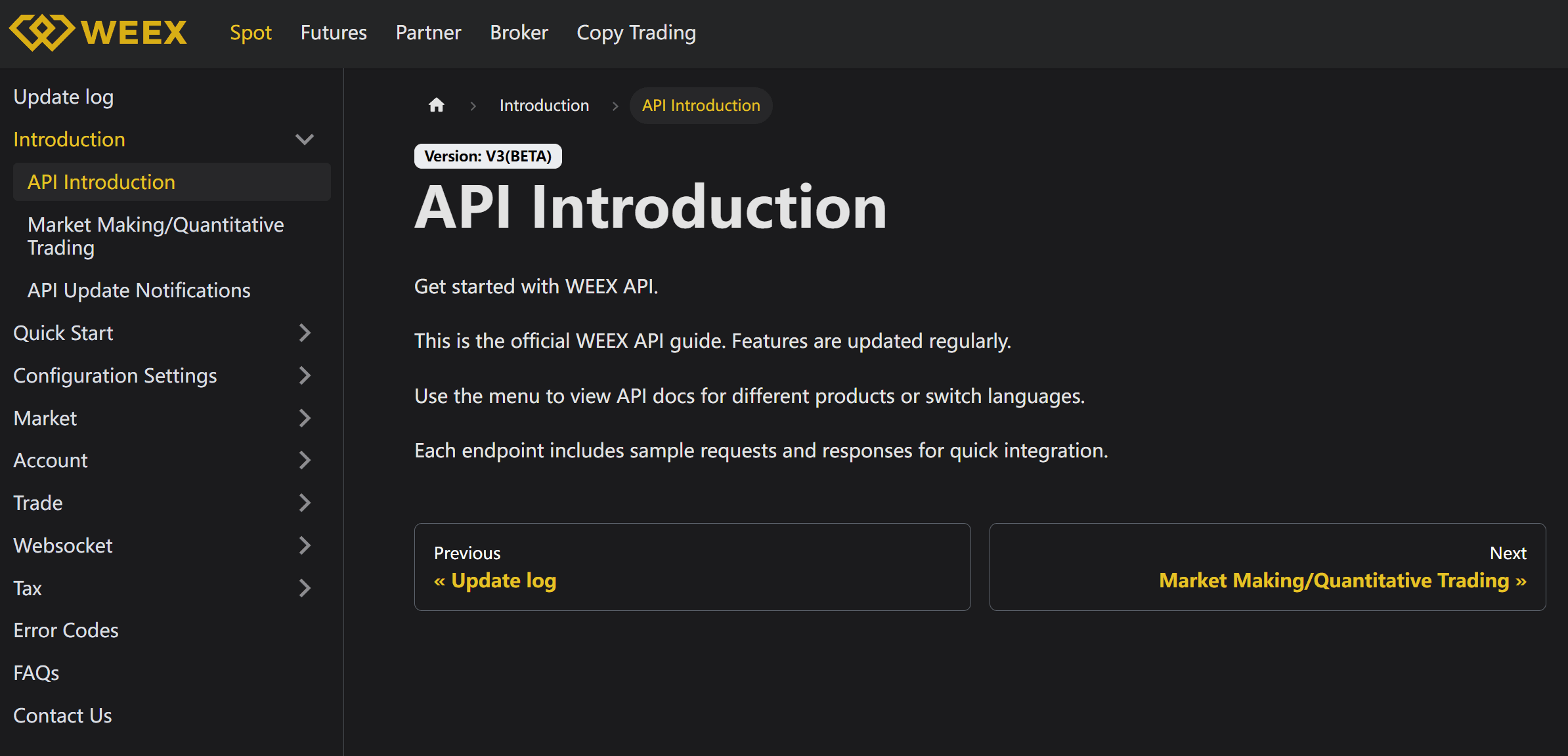
When using any exchange API, security is also important. Users should only enable necessary permissions, protect API credentials, and avoid sharing API Secret information.
Should Beginners Use Trading Bots or Manual Trading?
For beginners, manual trading is often a better starting point because it helps users understand how markets work.
Before using automation, traders should understand:
- How orders are executed;
- How strategies generate signals;
- How risk affects results.
Trading bots may be useful for users who already understand a strategy and want to automate execution.
A reasonable learning path is: Learn trading basics → Test a simple strategy → Understand risks → Try automation with limited funds
Using a trading bot without understanding the underlying strategy can create unnecessary risks.
Conclusion
Crypto trading bots and manual trading are not competitors. They are different approaches designed for different needs.
Manual trading provides flexibility and human judgment but requires time and emotional discipline. Trading bots provide automation and consistent execution but depend entirely on the quality of their strategies.
For quantitative traders, the most effective approach is often combining both methods: humans create and evaluate strategies, while bots handle repetitive execution.
Exchange APIs, such as WEEX API, provide the infrastructure needed for automated trading systems, but technology alone cannot guarantee results. Successful trading still depends on strategy quality, risk control, and continuous evaluation.
This content is provided for general informational purposes only and doesn't constitute financial, investment, legal, or tax advice. Any events, rewards, online promotions, or related information mentioned herein should not be considered a recommendation, solicitation, or invitation to purchase, sell, trade, or otherwise deal in any crypto assets. Crypto assets are highly volatile and may result in loss. The availability of WEEX services, products, and related events may vary by region. You are responsible for ensuring that your participation is in accordance with applicable local laws and regulations.
You may also like
View moreWEEX Elite Trader Support: Exposure, Levels, Fund and Payouts
Beginner3 minCopy TradingCan You Close a WEEX Copy Trade Early? How to Take Profit Now
Beginner3 minCopy TradingWEEX Copy Trading: Can You Set Your Own Leverage and Stop-Loss?
Beginner3 minCopy TradingHow Copy Trading Platforms Stop Churning and Bag-Holding Traders
Beginner4 minCopy TradingHow to Use Flicker with WEEX to Review Crypto Trades
Beginner5 minHow to Become a WEEX Elite Trader: Levels, Rules and Profit Share
Beginner3 min


