
Ethereum Glamsterdam Hits 200M Gas on Sepolia: What Changes After the Upgrade?

 Prefer us on Google


The Ethereum Glamsterdam upgrade has reached a new milestone following its October 6 activation on the Sepolia testnet. Early testing has pushed the block gas limit close to 200 million, more than three times the previous level of roughly 60 million. The result is an important step toward increasing Ethereum's execution capacity, but it does not mean the network is already processing three times as many transactions, since initial observations suggest blocks have been using only part of the available gas capacity.
For ETH holders and developers following the Ethereum Glamsterdam upgrade, the next questions are whether the network can sustain higher activity, what the results mean for transaction fees and when Glamsterdam could reach Ethereum mainnet. This article covers what the Sepolia test showed, what the 200 million gas figure does and does not mean, and what remains unconfirmed.
What Happened During the Ethereum Glamsterdam Sepolia Upgrade?
The Ethereum Glamsterdam upgrade activated on the Sepolia testnet on October 6, 2026, allowing developers to evaluate its changes before any deployment on mainnet. One of the most closely watched developments was the increase in block gas capacity, with early testing showing block gas limits approaching 200 million compared with approximately 60 million previously. According to CoinDesk, this higher limit was a Sepolia test setting, and the figure that mainnet eventually uses will depend on the results.
Gas measures the computational resources consumed by operations on Ethereum, so increasing the gas available per block can create room for more execution activity. Actual transaction capacity, however, depends on the types of transactions being processed and how much of that capacity is used. The Sepolia activation is therefore a testing milestone rather than confirmation that Glamsterdam is ready for mainnet, and early observations of successful block proposals and finalization during a limited monitoring period, while encouraging, do not establish long-term performance under sustained demand.
What Does the 200 Million Gas Limit Mean for Ethereum?
The 200 million gas figure is the approximate maximum amount of gas that a block can accommodate under the tested configuration. This is different from the gas actually consumed by transactions in a block. A block with a 200 million gas limit does not necessarily contain 200 million gas worth of transactions, and if demand is lower, a substantial portion of that capacity stays unused. Initial Sepolia observations showed sampled blocks consuming roughly 26% to 46% of their available gas.
A larger gas limit also brings technical considerations. Validators and other network participants must be able to process the resulting execution workload without unacceptable delays or infrastructure demands. The key question is therefore not whether Ethereum can configure a block gas limit near 200 million, but whether the network can operate reliably as that extra capacity is actually used.
Did Glamsterdam Improve Network Performance on Sepolia?
Early observations suggest the network remained operational during the initial testing period. During one reported six-minute window, all 32 scheduled blocks were successfully proposed, and about 99.97% of eligible staking weight took part in finalization voting. These figures give an early indication of stability under the observed conditions, but they should not be read as proof that Ethereum can hold the same performance through prolonged heavy demand.
There are three reasons for caution. Sepolia is a testnet, and its transaction activity does not necessarily resemble mainnet. The observed blocks also did not fully use the increased gas capacity, and short-term measurements cannot capture every potential issue involving execution time, network propagation or validator infrastructure. The most meaningful result so far is that Sepolia has begun testing substantially higher block gas capacity without showing major disruption in the reported window, and further testing will show whether the improvements remain practical under more demanding conditions.
-- Price
Will Glamsterdam Lower Ethereum Gas Fees?
Higher block gas capacity could help Ethereum accommodate more activity before demand puts pressure on fees. Transaction fees are influenced by demand for block space, and when many users compete for inclusion, fees can rise. Additional capacity may reduce some of that competition, provided demand and other conditions remain favorable.
Glamsterdam also changes how Ethereum accounts for computational and data-access costs. Its planned improvements include enshrined proposer-builder separation (ePBS), block-level access lists (BALs) and adjustments to gas pricing, which are intended to improve how blocks are built, verified and processed rather than simply raise a numerical limit. The Sepolia results do not establish how much mainnet fees will fall, because actual fees will depend on network demand, the mix of transactions, the final upgrade configuration and how applications respond. Cheaper gas is possible, but it is not guaranteed by the 200 million gas test alone.
When Will Ethereum Glamsterdam Reach Mainnet?
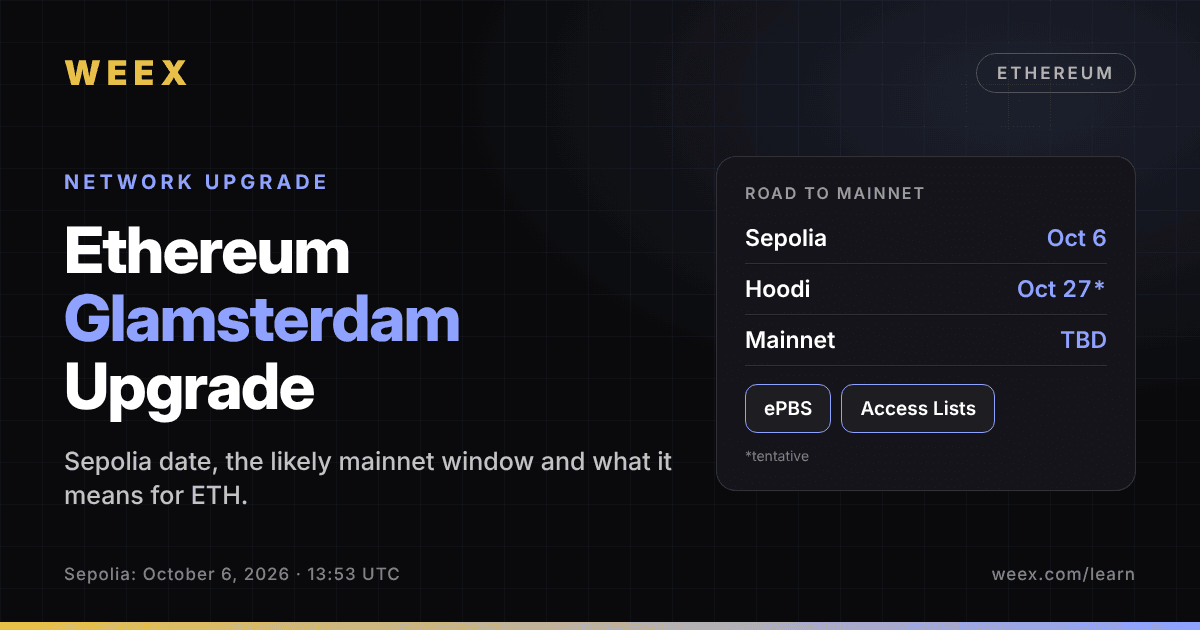
After Sepolia, attention turns to the Hoodi testnet and eventually Ethereum mainnet. According to CoinDesk's October 8 report, Hoodi testing is tentatively targeted for October 27, 2026, depending on the Sepolia results. The Ethereum Foundation's official activation schedule still lists the Hoodi and mainnet dates as unconfirmed. Ethereum's roadmap currently points toward Q4 2026 for mainnet deployment, but no final activation date has been set.
Before mainnet, developers need to confirm that the protocol changes work reliably across supported clients and under different network conditions. The upgrade also requires preparation from node operators and application developers, because Glamsterdam changes certain gas-accounting assumptions and some smart contracts and infrastructure tools may need adjustments. The next milestones to watch are continued Sepolia testing, an official Hoodi activation announcement and confirmation of the mainnet schedule.
What Could Glamsterdam Mean for ETH Price?
Glamsterdam is a significant technical development, but its effect on the ETH price is less straightforward. A successful upgrade could strengthen confidence in Ethereum's ability to scale its base layer, and greater execution capacity may support applications that need more transaction activity. That could be positive for Ethereum's longer-term adoption outlook.
Stronger technical performance does not automatically translate into a higher ETH price, though. The market may have already priced in some expectations around the upgrade, and broader crypto sentiment, institutional demand, macroeconomic conditions and network activity can all influence ETH. Increasing capacity also does not necessarily increase the amount of ETH burned through fees, since that depends on demand and fee levels. For traders, the Sepolia results are better understood as evidence of technical progress than as a direct buy signal, and the more useful indicators will be stable further testing, a clearer mainnet timeline and how network activity develops after deployment.
Conclusion
The Ethereum Glamsterdam Sepolia test has reached a notable milestone, with block gas limits approaching 200 million and early observations showing stable block production. The larger gas budget creates room for more execution capacity, but the sampled blocks were not running at full capacity, and more testing is needed before the benefits can be judged under mainnet conditions. Hoodi is the next expected testing stage, while the mainnet activation date remains unconfirmed.
FAQ
1. Has the Ethereum Glamsterdam upgrade launched?
Glamsterdam activated on the Sepolia testnet on October 6, 2026. It has not yet been deployed on Ethereum mainnet.
2. What does 200 million gas mean for Ethereum?
It is the approximate block gas limit being tested on Sepolia. A higher limit allows more potential execution per block, but it does not mean Ethereum is already processing three times as many transactions.
3. Did the Glamsterdam Sepolia test succeed?
Early observations showed successful block production and strong finalization participation over a limited period. More testing is needed to judge sustained, high-demand performance.
4. Will Glamsterdam reduce Ethereum gas fees?
It may help Ethereum handle more activity, but actual fees will still depend on demand, gas pricing changes and network conditions.
5. When will Glamsterdam launch on Ethereum mainnet?
Ethereum's roadmap points toward Q4 2026, but no official date is confirmed. Hoodi testing is tentatively targeted for October 27.
This content is provided for general informational purposes only and doesn't constitute financial, investment, legal, or tax advice. Any events, rewards, online promotions, or related information mentioned herein should not be considered a recommendation, solicitation, or invitation to purchase, sell, trade, or otherwise deal in any crypto assets. Crypto assets are highly volatile and may result in loss. The availability of WEEX services, products, and related events may vary by region. You are responsible for ensuring that your participation is in accordance with applicable local laws and regulations.
You may also like

How to Buy New Crypto Before Listing: 5 Routes and Their Traps
Ethereum Glamsterdam Upgrade: Sepolia Date and ETH Price Impact

Best Crypto Wallet App in 2026: How to Choose Between Hot, Cold, Custodial, and Web3 Wallets

What Is a Decentralized Crypto Exchange (DEX)? How It Works, Costs, Risks, and When to Use One
Ethereum Glamsterdam Upgrade Countdown: Can ETH Price Break Out?

What Is Coinbase Wrapped Zcash (cbZEC)? How It Brings Zcash to Base Without Native ZEC Privacy
What Is Gno.land (GNOT)? How GnoVM, Storage Deposits, Tokenomics, and GovDAO Work

Phantom Wallet vs MetaMask: What's the Difference
What a Blockchain Explorer Can and Cannot Tell You
How to Look Up a Wallet Address and Transaction History
龙虾 (Lobster) 0 Fee on WEEX: How to Buy Spot and Trade Futures
Circle's Arc Mainnet Is Live: Can It Actually Close the Gap With Tether's USDT?
What Is a Blockchain Explorer and How Does It Work?
Is SafePal Safe? A Look at Its Security Features
What Is SafePal Wallet? A Complete Beginner's Guide
LONGARC Token Explained: Arc Chain Stock Memes, Contract, Risks
What Is Aptos (APT)? Complete Layer-1 Blockchain Guide
HYPE Futures Trading Strategy: Sizing Rules Around Unlocks
Donald Trump Oil Stock Investments: 9 Names, 6 Tradable Now

MetaMask Transaction Stuck or Failed? Here's How to Fix It
XST Stock: Why This Ticker Points to Four Completely Different Companies
What Is Arbitrum (ARB) and How Does This Ethereum Layer 2 Work?
Plasma Released 88.89 Million XPL Tokens Today—Why the Allocation Matters
What Is IMX Crypto? How Immutable's Layer 2 Became the Largest Web3 Gaming Blockchain

ETH to USDT: What the Converter Rate Leaves Out
Pakistan Stock Exchange Performance in 2026: What Is Driving the KSE 100 to Record Highs
What Is Niulai Coin? How a 342 Yuan Chinese Animated Film Spawned a Viral BNB Chain Meme Token
SpaceX Rocket Crashes on the Moon: What It Means for SPCX Traders
TradFi Perpetual Futures API: 26 Symbols and How to Wire Them
WEEX TradFi Trading Fest: Trade Stock Futures and Share 50,000 USDT Rewards
How to Buy New Crypto Before Listing: 5 Routes and Their Traps
Ethereum Glamsterdam Upgrade: Sepolia Date and ETH Price Impact
Best Crypto Wallet App in 2026: How to Choose Between Hot, Cold, Custodial, and Web3 Wallets
What Is a Decentralized Crypto Exchange (DEX)? How It Works, Costs, Risks, and When to Use One
Ethereum Glamsterdam Upgrade Countdown: Can ETH Price Break Out?
What Is Coinbase Wrapped Zcash (cbZEC)? How It Brings Zcash to Base Without Native ZEC Privacy
Contents
Popular coins
Latest articles