
How to Buy New Crypto Before Listing: 5 Routes and Their Traps

 Prefer us on Google


How to buy new crypto before listing comes down to five routes: a presale or launchpad sale, a decentralized exchange (DEX) pool the moment liquidity is added, an exchange launchpool or airdrop program, pre-market trading or pre-launch perpetuals, and airdrops earned through points. Each gets you a token, or exposure to its price, before a centralized exchange opens spot trading. None is a discount on a sure thing.
Most guides stop at "join the presale." That skips what decides the outcome: how much of your allocation unlocks on day one, how much supply is still coming, and whether the contract will let you sell at all. Memento Research tracked 118 major token generation events in 2025, and 100 of them (84.7%) were trading below their opening fully diluted valuation, with the median token down 71% from its launch price, CryptoSlate reported on 24 December 2025.
Below, each route gets the same treatment: what you need, what it costs and how people lose money. A worked presale example, a pre-purchase checklist and WEEX's own pre-listing products as of October 2026 follow. Eligibility for presales and pre-market products varies by jurisdiction, so read the terms for your country first.
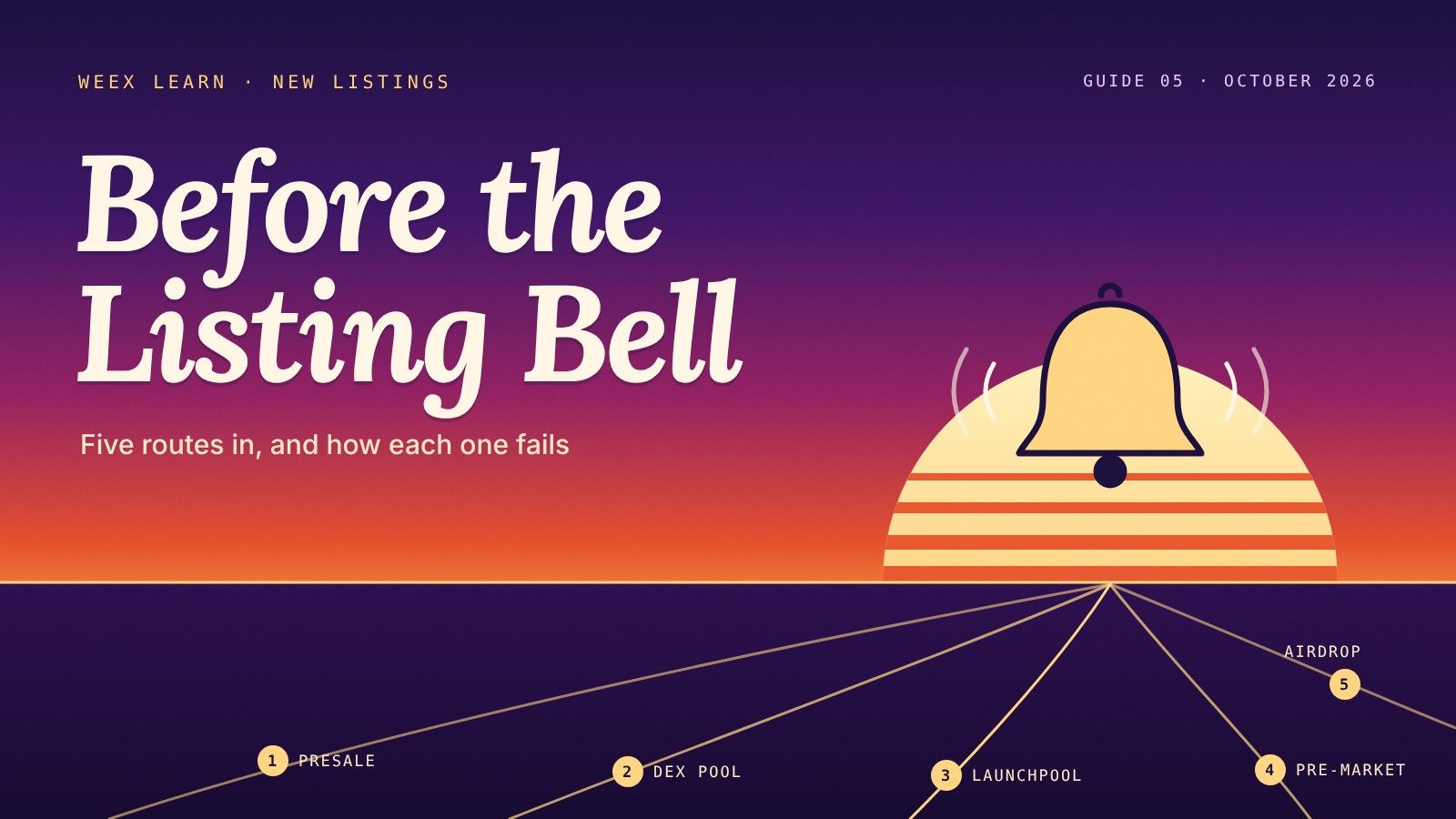
Five Routes to New Crypto Before Its Exchange Listing
Presales, ICOs and Launchpad IDOs
A presale or initial coin offering (ICO) sells tokens straight from the project before any market exists. An initial DEX offering (IDO) does it through a launchpad that runs the sale contract.
- Read the sale terms on the project's own site: price, raise cap, the share unlocked at the token generation event (TGE), cliff and vesting.
- Pass the whitelist or identity check, and stake the launchpad's token if allocation tiers require it.
- Send the accepted asset, usually a stablecoin, from your own wallet to the sale contract.
- Claim at TGE, then again at every unlock.
The visible cost is network gas; the hidden one is price exposure to any launchpad token you staked. Money is lost three ways: the allocation stays locked while the price falls, the "sale site" is a clone with a different deposit address, or the token never lists.
Buying on a DEX the Moment Liquidity Is Added
Many tokens trade on a DEX before any centralized listing: someone deposits the token and a paired asset into a pool, and trading starts in that block.
You need a wallet holding the chain's gas token and the exact contract address. Paste the address into the DEX instead of searching by ticker, then make a small test buy and a test sell before committing size. You pay the pool's swap fee, gas, slippage and any tax written into the token.
A honeypot contract accepts buys and blocks sells. A fake token copies the real one's ticker and logo. A rug pull happens when the deployer still controls the liquidity pool (LP) tokens and withdraws the paired asset. Solidus Labs' May 2025 rug pull report found that 98.6% of tokens created on Pump.fun between January 2024 and March 2025 had fallen below $1,000 of liquidity.
Exchange Launchpool and Airdrop Programs
Centralized exchanges hand out new tokens to users who hold or stake a qualifying asset, subscribe funds to a sale, or complete trading tasks. You need a verified account and the qualifying asset. The exchange handles custody, so there is no contract to vet.
The cost is price risk on whatever you hold to qualify, plus a pro-rata reward you cannot size until the event ends. The usual loss is quiet: the qualifying asset drops by more than the reward is worth, or recipients all sell in the first minutes of trading.
Pre-Market Trading and Pre-Launch Perpetuals
Two products share the "pre-market" label.
- Pre-market spot, order-book or OTC. Buyers and sellers agree a price for tokens that do not exist yet. Sellers typically post collateral and must deliver after TGE inside a settlement window. If the seller defaults you get compensation from that collateral, not tokens, and if the TGE slips your funds stay locked.
- Pre-launch perpetuals. A futures contract on a token with no spot market. You never receive the token. With no spot index as an anchor, price comes from the contract's own thin order book, so one large order can liquidate leveraged positions. When spot opens, the contract converges to it, sometimes with a gap.
Airdrops and Points Campaigns
Here you earn instead of buying: use a protocol, bridge, provide liquidity or hold an asset before the token exists. The price is gas, fees and time. Teams can change criteria, filter wallets as duplicates, or set an allocation smaller than the fees you spent. The sharper risk is a fake "claim" page that asks for a wallet signature and empties the wallet.
Why a Cheap Presale Price Can Still Lose Money
A presale price means little until you know the float. Take a hypothetical token with a 1 billion total supply sold at $0.02, which values the whole supply (the fully diluted valuation, FDV) at $20 million. Terms: 10% unlocked at TGE, a three-month cliff, then monthly vesting.
Put in $1,000 and you hold 50,000 tokens. The token lists at $0.05, a 2.5x. On paper you have $2,500. In your wallet you have 5,000 sellable tokens worth $250.
Now apply the 2025 median. A 71% fall from $0.05 puts the price at $0.0145, below your presale entry. Sell the unlocked 10% at the open and the other 45,000 tokens at $0.0145, and you collect $250 plus $652.50: $902.50. A 2.5x listing became a loss of nearly 10%, and that assumes you could exit at those prices.
This is high FDV with low float. If 8% of supply circulates at listing, a $0.05 price implies a $4 million market cap against a $50 million FDV. The other 92% belongs to someone, and unlock dates are when they get to sell.
How to Check a New Token Before You Buy
The first check screens out fake tokens; the fifth screens out bad deals.
- Contract address. Take it from the project's official site or verified social account and confirm it in a second official place. Never use an address from an ad, a search result or a direct message.
- Contract code. Open the address on the chain's block explorer. Is the source verified? Can the owner mint, pause transfers, blacklist wallets or change the sell tax?
- Liquidity. Compare pool depth with your order size. Find who holds the LP tokens: a time-lock contract with a visible expiry, a burn address, or the deployer's wallet.
- Holder concentration. On the explorer's holders tab, set aside pool, burn and vesting contracts, then see what the top ten wallets control.
- Vesting schedule. Note the TGE unlock, cliff, monthly unlocks and insider shares. Work out FDV and day-one float yourself.
- Audit. Check who performed it, which contract address it covers and which findings remain open. An audit reviews code, not intentions.
- Team. Named people with a traceable history give you recourse; an anonymous team gives you none.
- Listing claims. Believe a listing only when it appears on the exchange's own announcement page.
-- Price
What WEEX Offers Before a Token Starts Trading
As of October 2026, WEEX's pre-listing offering is not a presale desk. Three things on its own pages matter.
WE-Launch. WE-Launch is WEEX's airdrop program for holders of WXT, its platform token. Under the Help Center guide you must press Join on the event page, since holding WXT alone does not count, and keep an average hourly spot balance of at least 300 WXT, capped at 500,000 WXT of effective holdings by default, though event pages can differ. WXT is not locked or staked. Random hourly snapshots are averaged, and your reward is your weighted share of the pool.
The Nova USD (USDN) event was set for 6 to 9 October 2026, closing at 07:00 UTC, with a 10,000 USDN pool; WEEX scheduled USDN trading for 08:00 UTC that day, one hour after the snapshot window closes. The Hela dmd (HDMD) event began on 14 September 2026 at 08:00 UTC, the same minute HDMD trading opened, and other pools paid established tokens such as XLM and APT. Treat it as a reward for holding WXT, with WXT's price as your real exposure.
Pre-market perpetuals. WEEX launches these by individual announcement. Its notice for ESPUSDT perpetual pre-market trading set a start of 10 February 2026 at 19:00 (UTC+8) and warned that pre-market trading "operates differently from standard futures markets," with "limited liquidity, wider bid-ask spreads, and price volatility." None of the 25 most recent futures-listing notice titles on 8 October 2026 mentioned pre-market, and we found no standing spot pre-market on weex.com that day.
Listing notices. The Spot listings feed titles notices "coming soon," "Initial listing" or "New listing." Read the deposit, trading and withdrawal times on each, because the order changes. For KiiChain (KII), trading started on 14 August 2026 at 13:10 UTC, 50 minutes before deposits opened. A "coming soon" notice with no pair or schedule is not an offer, and anyone selling a "pre-listing allocation" off the back of one is not WEEX.
Once a token is live, WEEX's how-to-buy guides cover the steps coin by coin; the hub ran to 172 pages on 8 October 2026.
The honest answer on how to buy new crypto before listing: the routes with the least fraud risk also give the least early-price edge. Presales and fresh DEX pools offer the low entry, and carry the locks, the supply overhang and the contracts that will not let you out.
FAQ
1. How do I find new crypto before it lists on an exchange?
Start from primary sources: a project's own site and verified accounts for sale dates, launchpad calendars for IDOs, and exchange announcement pages for confirmed listings and airdrop events. Treat token trackers and social feeds as leads to verify.
2. Can I buy a coin on an exchange before it is listed there?
Not on the spot market. Before spot opens, an exchange can only offer a pre-market contract, a pre-launch perpetual, or a reward program that distributes the token. Treat any "exchange allocation" offered by direct message as a scam.
3. Are presale tokens locked after the sale?
Often, but not always. Many sales release a portion at TGE and vest the rest over months, sometimes after a cliff. If a project will not publish its unlock schedule before taking money, treat that as the answer.
4. Can I get new crypto for free before it lists?
Yes, through airdrops, points campaigns and exchange reward programs. You still pay in gas, fees, time, or price exposure to an asset you must hold to qualify.
This content is provided for general informational purposes only and doesn't constitute financial, investment, legal, or tax advice. Any events, rewards, online promotions, or related information mentioned herein should not be considered a recommendation, solicitation, or invitation to purchase, sell, trade, or otherwise deal in any crypto assets. Crypto assets are highly volatile and may result in loss. The availability of WEEX services, products, and related events may vary by region. You are responsible for ensuring that your participation is in accordance with applicable local laws and regulations.
You may also like
Anonymous Crypto Wallet: What Each One Hides and Where It Fails
What Is Blockchain and How Does It Work? One Real Payment Traced
WEEX API Key Setup: How to Connect a Third-Party Platform Safely
WEEX Broker Models: Strategy Bots, Copy Trading and Sub-Exchanges
What Is Artificial Superintelligence Alliance (FET) Crypto? The ASI Token, Migration Status, and Real-World Demand Test
Best Crypto Wallet App in 2026: How to Choose Between Hot, Cold, Custodial, and Web3 Wallets
RSI Indicator Settings: What 7, 9, 14 and 21 Did on BTC Charts
Ethereum 2030 Roadmap: Vitalik's Cryptographic World Computer
Best Decentralized Crypto Wallet for Beginners: What Self-Custody Really Asks of You

Best Crypto App for Beginners: Exchange App, Wallet App, or Both?
QNT Futures: Funding Rate and Long vs Short After a 4x Rally
Which Crypto to Buy for Beginners: A Simple 3-Tier Starter Plan
Taiwan's Travel Rule Starts in October: What Domestic Crypto Transfers Will Require
WEEX Futures Trading: What 400x Leverage Really Costs You
Is Hyperliquid Safe? Risks You Should Know Before You Trade
What Is Hyperliquid? A Complete Guide to the Perpetuals Exchange
What Is Pi Network? A Complete Beginner's Guide
What Is a Funding Rate? How Perpetual Futures Charge Longs and Shorts
Lighter (LIT) Futures: Cross vs Isolated Margin on a 17% Range
XRP Futures: How to Long or Short XRP After the Clarity Act Vote
What Is ZCAT and Is It Worth Buying? Anonymous Cat (ZCAT) Guide for 2026

MU Stock Reclaims $1,000 Again: What's Actually Different This Time
GPT-6 Astra and Crypto: The AI Token Bid and the Cyber Risk
StonkFun Just Became Solana's Hottest Launchpad: STONK Surges 250% to Prove It
What Is Tangem Wallet? A Complete Beginner's Guide
AAPL Under Ternus: What Apple's CEO Change Means for Traders
PONS Robinhood Chain Token: What the Buyback Rally Rests On
Cathie Wood’s $50 Million Crypto Stock Bet Explained: What Did ARK Invest Buy?
BISCOTTI Crypto: Robot Dog Token Behind Emblem Vault's Debut
Is CyberLeek (CYBERLEEK) Safe? Price Crash and Key Token Risks Explained
Anonymous Crypto Wallet: What Each One Hides and Where It Fails
What Is Blockchain and How Does It Work? One Real Payment Traced
WEEX API Key Setup: How to Connect a Third-Party Platform Safely
WEEX Broker Models: Strategy Bots, Copy Trading and Sub-Exchanges
What Is Artificial Superintelligence Alliance (FET) Crypto? The ASI Token, Migration Status, and Real-World Demand Test
Best Crypto Wallet App in 2026: How to Choose Between Hot, Cold, Custodial, and Web3 Wallets


