
Hyperbeat, to launch a "bank" on Hyperliquid

 Prefer us on Google


Original Title: "Hyperbeat: The Person Behind the 'Bank' on Hyperliquid"
Original Author: Sanqing, Foresight News
On April 8, the Hyperliquid native protocol Hyperbeat launched Liquid Banking, deploying a self-managed "bank" on HyperEVM, integrating stablecoin deposits, VISA card spending, perpetual contract trading, and multi-currency fiat transactions into a single on-chain smart wallet.
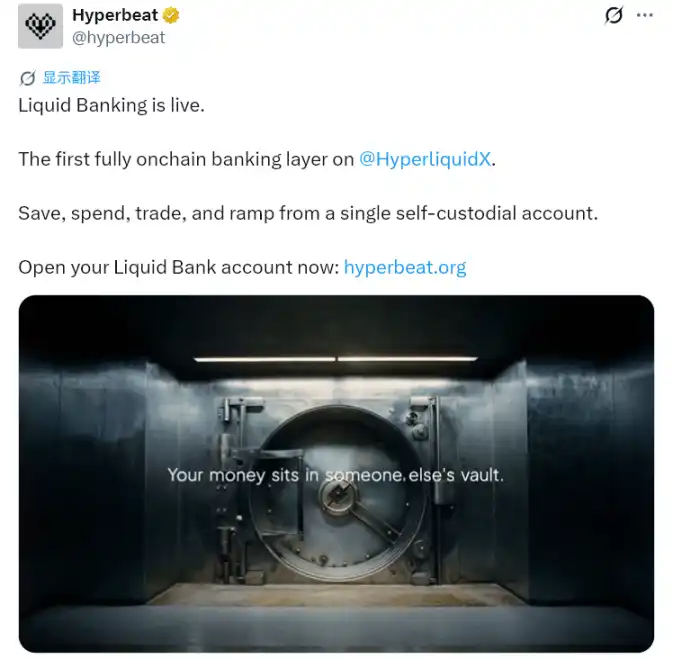
Image Source: Hyperbeat Tweet
The Hyperbeat team transitioned from the Hyperliquid testnet's initial validators, starting with only 5 members and self-raising around $200,000 to kick off. The two co-founders, Kilian Boshoff (@Fundi_Crypto) and 800.HL (@degennQuant), have kept a low profile, with the former having a background from Stellenbosch University in South Africa, and the company registered in the Cayman Islands.
In August 2025, they completed a $5.2 million seed round, led by ether.fi Ventures and Electric Capital, with participation from Coinbase Ventures, Maelstrom, Anchorage Digital, among others, valuing the company at around $40 million.
Morpho Powers the Engine, Creating a 'Bank' in Ten Months
The core selling point of Liquid Banking is Credit Mode.
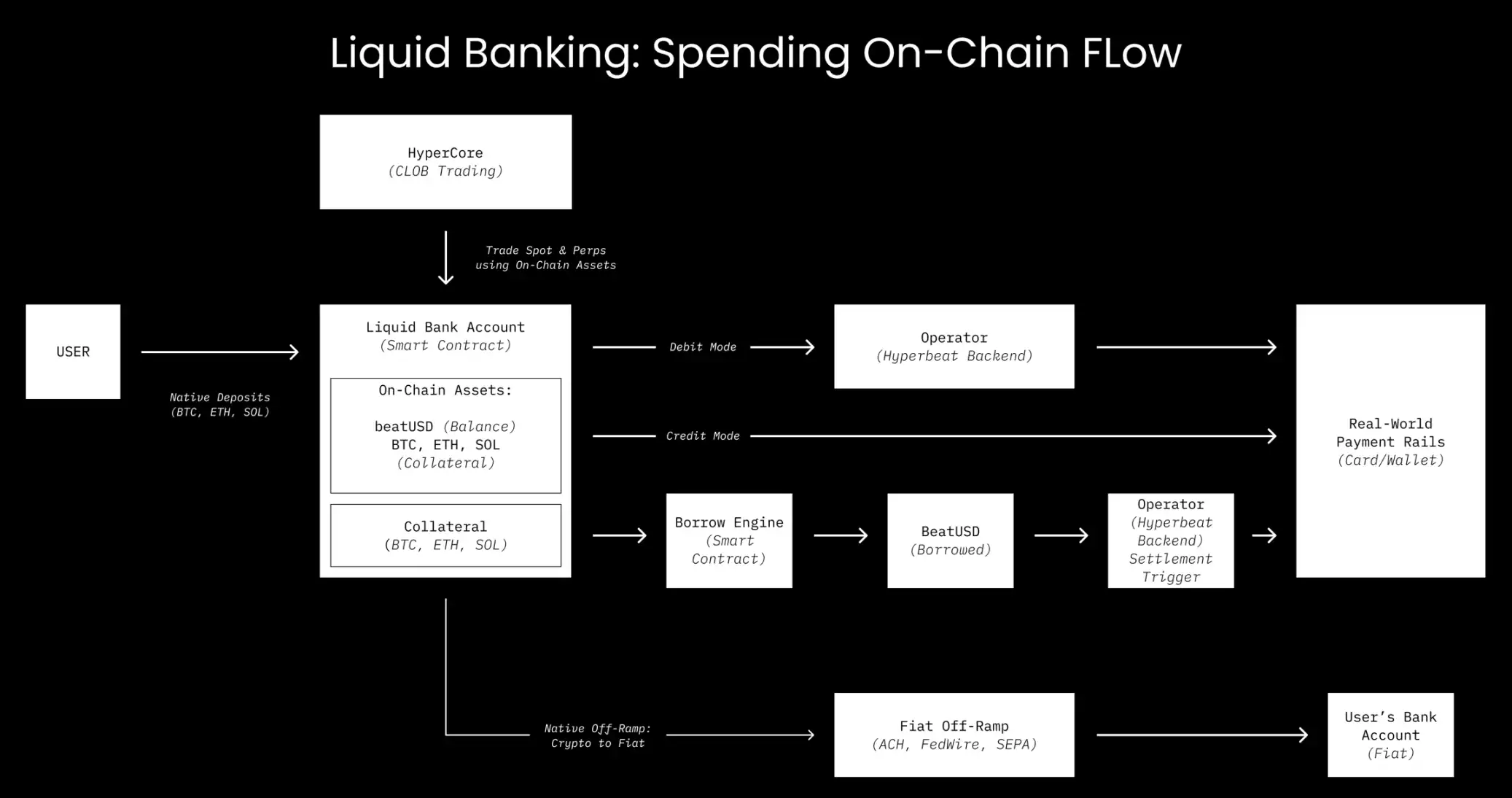
CREDIT Mode | Image Source: Hyperbeat Docs
Users deposit assets such as BTC, ETH, HYPE as collateral, and when they swipe their VISA card, the system instantly borrows stablecoins through the Morpho Blue market to complete the payment, while the collateral remains on-chain to continue earning rewards. Users never interact with a lending interface throughout the process, as the act of swiping the card itself constitutes an on-chain loan.
The underlying lending engine comes from Morpho. Hyperbeat integrates Morpho into users' smart wallets through an on-chain whitelist mechanism. Currently, Credit Mode is running on six isolated markets, with collateral including HYPE, UBTC, UETH, USOL, and even the gold token XAUT.
Hyperbeat does not touch the core lending logic, and Morpho does not touch the user interface. The former creates the "bank frontend," while the latter provides the "credit engine."
The stablecoin deposits in Liquid Banking are centered around the native stablecoin beatUSD issued in collaboration with Paxos Labs. Paxos provides the stablecoin infrastructure (based on USDG0), with reserve earnings flowing directly back into Hyperbeat's reward program and ultimately distributed to users, rather than remaining with the issuer.
The USD+ Treasury on the deposit side automatically allocates user funds to Morpho and protocols like Hypuur, Hyperlend, Felix, offering an annual percentage yield of 3%-8%.
The earnings come from real lending interest from Credit Mode consumers. The more the consumption, the higher the deposit yield. However, whether this cycle can be sustained depends on the actual consumption volume.
Non-selling coin consumption, but card swiping accrues interest
The fiat deposits and withdrawals in Liquid Banking are provided by Noah, supporting USD (ACH, FedWire) and Euro (SEPA) deposits, with each account linked to a unique IBAN.
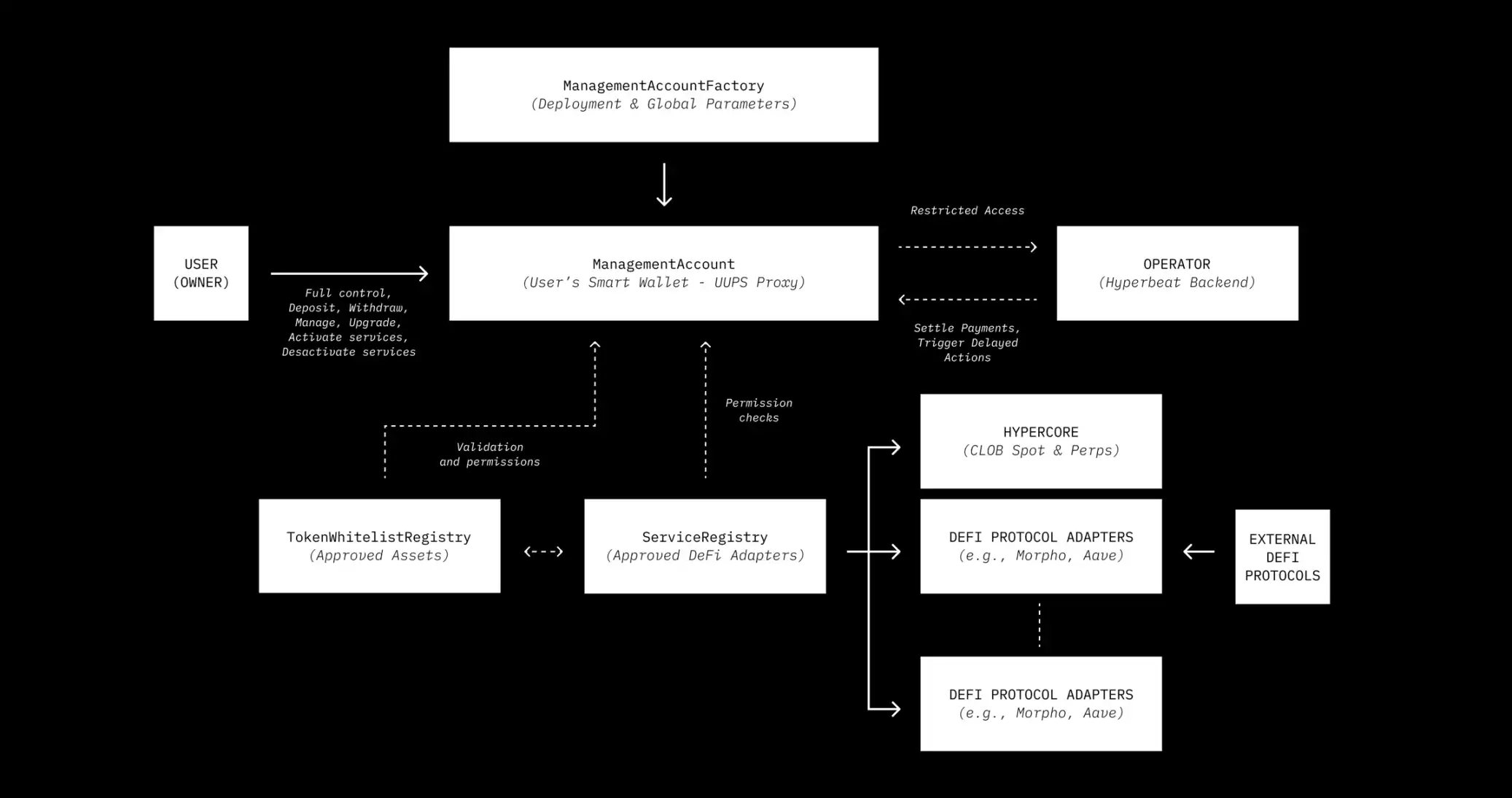
Liquid Banking Architecture | Source: Hyperbeat Docs
In March 2026, direct deposits and withdrawals for the Vietnamese Dong and Malaysian Ringgit will be further enabled, with withdrawals also covering currencies like Pound Sterling, Dirham, Baht, among a dozen others.
The VISA card is issued by Third National, with the underlying infrastructure provided by Rain, a Visa Principal Member. By early January 2026, its funding valuation had reached $1.95 billion, with an annualized processing volume exceeding $30 billion, covering over a hundred countries.
The card is classified as Visa Signature, with benefits such as airport lounge access. Foreign exchange transactions incur a 1% FX fee (based on Visa's official rate), no annual fee, no swipe fees; ATM withdrawals cost $1 + 0.65%; default monthly spending limit of $100,000.
The Credit Mode's lending interest rate fluctuates with the Morpho market utilization rate, but there is no interest-free period; interest on each "HODL & Borrow" transaction starts accruing from the moment of the transaction.
The Hyperbeat official "no hidden fees" refers to the transparency of the yield strategy, not the card fee pricing. The Credit Mode lending interest rate is dynamically determined by the Morpho market, without an interest-free period, meaning that the real-time cost of "HODL & Borrow" convenience exists and is not low.
Self-Custody Comes with a One-Day Cooling-Off Period
Unlike all centralized crypto cards, user assets always stay in their self-controlled ManagementAccount smart wallet. The Hyperbeat backend only has a limited Operator role, which can only settle within the user-set limits and cannot transfer assets to unauthorized addresses.
However, self-custody must address one issue: what if users front-run withdrawals after swiping their card? Hyperbeat has introduced an on-chain time-lock mechanism.
Settlement token withdrawals require a cooling-off period and confirmation process, collateral withdrawals require Operator approval to prevent defaults, and mode switches also have delays. The contract has been audited by Zellic and Nethermind, and key management is provided by Turnkey.
These frictions are not bugs but features. It acknowledges the speed difference between on-chain settlement and offline consumption, filling the gap with contract rules instead of "trust us." However, users must monitor their health factor themselves, as there is no customer service to help undo operational errors.
-- Price
This content is provided for general informational purposes only and doesn't constitute financial, investment, legal, or tax advice. Any events, rewards, online promotions, or related information mentioned herein should not be considered a recommendation, solicitation, or invitation to purchase, sell, trade, or otherwise deal in any crypto assets. Crypto assets are highly volatile and may result in loss. The availability of WEEX services, products, and related events may vary by region. You are responsible for ensuring that your participation is in accordance with applicable local laws and regulations.
You may also like

ETHFI Rallies as ether.fi Pivots to Neobanking — Can the Momentum Last?
ETHFI rallies as ether.fi expands into crypto neobanking with MoonPay. Explore the $0.80 resistance, price outlook, key catalysts and risks.

Aave submitted a governance proposal to the Arbitrum DAO, requesting the release of frozen ETH to be injected into DeFi United

Data: A certain whale has accumulated 19,300 ETH, with an unrealized profit of 1.453 million USD
Cryptocurrency VC collectively boosts presence, is the market starting to bottom out and rebound?

ETHZilla: Currently Holding 102,246 ETH, with a Maximum of $250 Million Available for Stock Buyback

ether.fi Foundation: This week spent 73 ETH from protocol revenue to purchase 264,000 ETHFI tokens

Ripple and SBI Team Up for RLUSD Stablecoin Launch in Japan by Early 2026
Latest Crypto Market Snapshot as of August 22, 2025 BTC Soars to $115,250.00 ETH Hits $4,450.75 XRP Climbs…

Circle Partners with Tereina to Integrate USDC and EURC into SAP Enterprise Payments

Hedge Funds Forced to Sell to Cut Losses, U.S. 10-Year Treasury Yield May Break 6%
Q3 2026 Earnings Preview: Why Strong Results May Not Lift Stocks & How to Predict Stock Moves with WEEX

Who Will Share the Profits of Cross-Border Remittances in the Stablecoin Era?

Crypto firms turn to Anthropic AI to find security flaws
MedCred: a clandestine publication claims exposure of data from 274,534 users
Citrini Research Points Out That the 'Wall' Between Traditional Finance and Cryptocurrency Is Beginning to Crumble

President Trump unveils $215M quantum computing plan amid crypto fears

Tiger Research: Five Key Changes in Crypto VC for Q3 2026
Mobile Sellers Are Here to Grab Stablecoin Access

The race in tokenized stocks has accelerated! Nasdaq CEO: "Tokenization could unlock billions of dollars in capital"

High Yields Pressure Tech as PYTH Buyback Expectations Rise | WEEX Weekly Market Recap (October 5-October 9, 2026)
WEEX Weekly Market Recap focuses on elevated long-end yields, AI compute-chain divergence, crude rebound, BTC weakness, and PYTH buyback expectations. The week’s main thread was high rates pressuring valuations, AI infrastructure validation, and high-beta crypto rotation.

Long-Bond Highs Pressure Tech| WEEX TradFi Daily Brief (October 9, 2026)
Indexes were mixed on October 8 ET. The long-bond yield touched about 5.35% intraday, near levels last seen in 2002. OpenAI’s annualized revenue of about $50 billion came in below higher figures that had circulated, pressuring tech and chip names. Nasdaq fell clearly, while Dow edged higher. Energy led, with WTI up about 3.2% to about $91. Bitcoin pulled back from about $86,000 and traded near $81,000, down about 5%. September PPI is the focus on October 9.
Pearl: Can AI Inference and Mining Happen Simultaneously?|Project Introduction

BigTime|Behind the Market Maker's Entry: The Transparency Gap in Market Making Contracts

Financial Services Agency Requests Acceleration of IC Chip Reading Due to Document Image Leak, Including Cryptocurrency Exchanges

Q3 Crypto Investment Review: Strategic Capital Rises, Seed Rounds Cool Off

AI may be keeping Bitcoin’s biggest macro headwind alive after the Fed stops hiking

Why Are AI Stocks Still Rising Despite Soaring US Treasury Yields?
What is being said at the tables: Flávio Bolsonaro and Scott Bessent give air to Luis Caputo, but the market charges for the activity

Venture Capital Firm USV Announces $900 Million New Fund to Increase Investments in AI and Robotics

Why Did Most DeFi Protocols Disappear in 2021?

Citrini Highlights AI Financial Stocks and Coins: 8 Listed Companies, 1 ETF, 15 Coins
ETHFI Rallies as ether.fi Pivots to Neobanking — Can the Momentum Last?
ETHFI rallies as ether.fi expands into crypto neobanking with MoonPay. Explore the $0.80 resistance, price outlook, key catalysts and risks.
Aave submitted a governance proposal to the Arbitrum DAO, requesting the release of frozen ETH to be injected into DeFi United
Data: A certain whale has accumulated 19,300 ETH, with an unrealized profit of 1.453 million USD
Cryptocurrency VC collectively boosts presence, is the market starting to bottom out and rebound?
ETHZilla: Currently Holding 102,246 ETH, with a Maximum of $250 Million Available for Stock Buyback
ether.fi Foundation: This week spent 73 ETH from protocol revenue to purchase 264,000 ETHFI tokens
Contents
Latest articles


Latest coin listings on WEEX


