
Market Downturn: Which Assets Are Worth Watching?

 Prefer us on Google


Original Title: The「Investible」Crypto Tokens
Original Author: Ignas, DeFi Analyst
Original Translation: Saoirse, Foresight News
CoinGecko tracks 17,148 tokens.
But in the current crypto market environment, how many tokens truly meet the following criteria to be considered 「investible」?
1. Can provide returns to the holder;
2. Have protocol revenue, even if not yet distributed;
3. Strong narrative and market recognition to survive a bear market.
I tried to figure this out.
Most of the data is from DefiLlama, CoinMarketCap, and some protocols reflecting market heat (Dexu, Moni, Lunarcrush, etc.).
I used Claude Code to process the data, trying to minimize personal bias—
I would have originally excluded some tokens (such as XRP, ADA, BCH, etc.), but they have gone through multiple cycles and have sustained vitality due to sufficient liquidity.
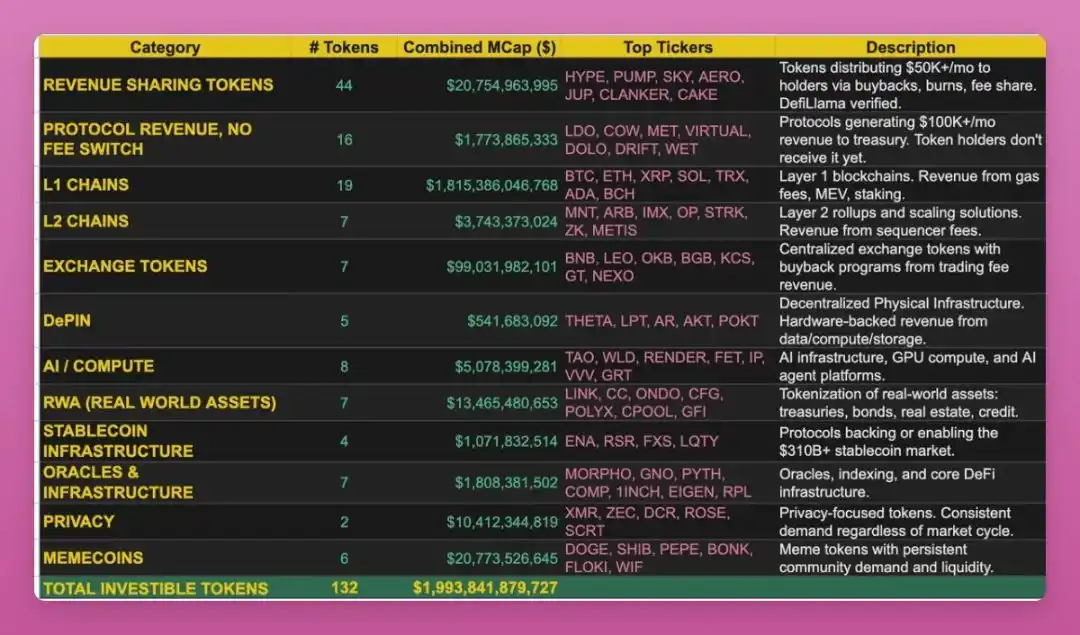
Claude still made many mistakes, and debugging took 10 times longer than writing the article, so the tabular data is for reference only (link at the end of the article).
Final Results:
· A total of 12 categories, 132 investible tokens were filtered;
· Among them, 45 tokens provide dividends to holders (excluding those with very low returns);
· Annualized returns to holders: $1.8 billion.
These classifications are entirely based on my subjective judgment of 「survivability and future potential,」 which you may disagree with.
First Key Finding: The truly investible crypto market is tiny.
And tokens that can actually make holders money are almost monopolized by two projects. Details will follow below.
It's funny that, in the process of organizing this list and checking each token one by one, I came to this conclusion:
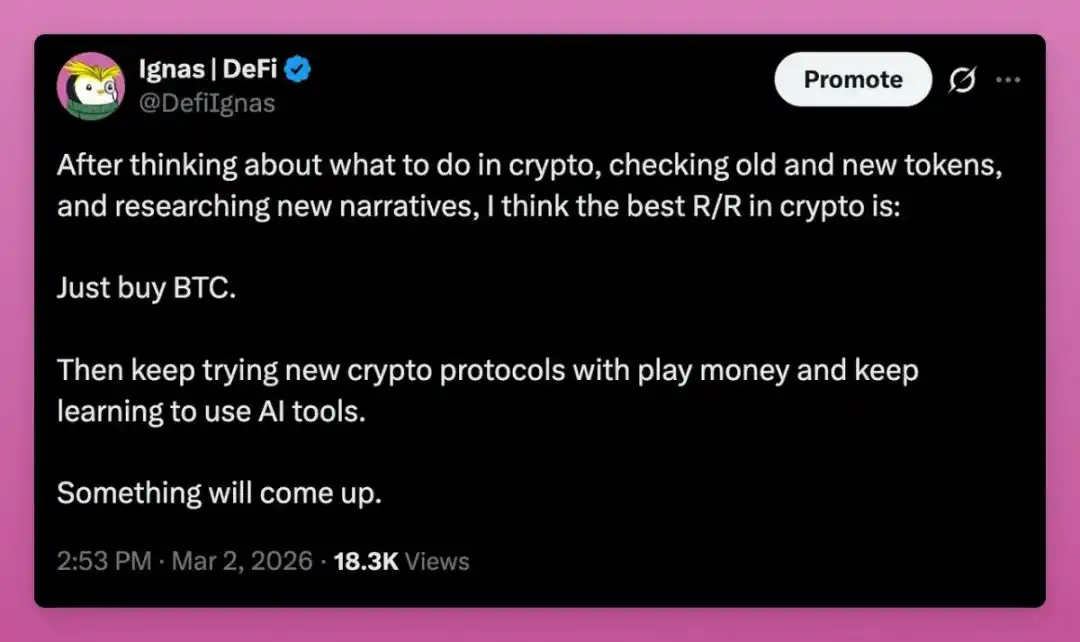
After much consideration on how to navigate the crypto space, reviewing old and new tokens, and researching new narratives, I believe the most optimal risk-reward ratio (R/R) in the crypto world is:
Directly buying Bitcoin (BTC).
Then using "play money" to continuously try out new crypto protocols while consistently learning to use AI tools.
New opportunities will always arise.
Most Investment-Worthy Token: Revenue-Sharing Category
The current market's mainstream narrative is:
A project without revenue will eventually die!
Even ETH finds it hard to escape this "value by revenue" narrative.
Therefore, the most investable tokens are those that can distribute revenue to holders through buybacks, burns, fee sharing, etc.
I've set the threshold at: DefiLlama 30-Day Holder Revenue ≥ $50,000.
These 45 tokens bring holders $153 million in revenue monthly,
with a total annualized revenue of $1.8 billion.
Top 10 Revenue Shares:
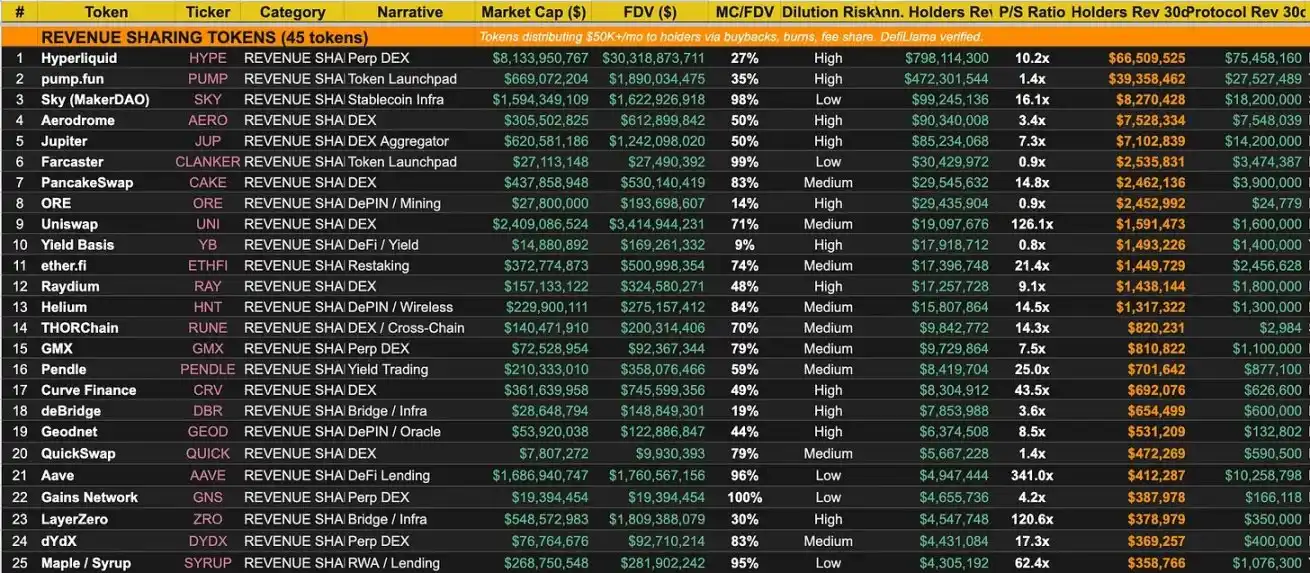
Note: Revenue share ≠ Holder revenue on DefiLlama.
For example: EtherFi doesn't make the holder revenue list, but it has buybacks.
L1 chains like Tron have been categorized separately.
After the top five, monthly revenue quickly drops to below $3 million.
If the crypto market continues toward the logic of "tokens = stocks,"
So the P/S (Price-to-Sales, Market Cap / Revenue) ratio will become increasingly important.
· Pump.fun: 1.4x
· Aerodrome: 3.4x
By traditional financial standards, these are extremely cheap.
Based on current revenue pace, the entire market cap could be recouped in less than 3 years.
However:
· Uniswap: P/S as high as 121x
· Aave: P/S even at 341x
Because the market has valued them far beyond "current returns."
Aave recently started buybacks finally, distributing only $412k per month, whereas the protocol generates $10m in monthly revenue. Subsequent governance changes could alter this.
Lowest P/S Ratio Tokens:
· Farcaster's Clanker: 0.9x
· ORE: 0.9x
· Yield Basis: 0.8x
· Pump.fun: 1.4x
· QuickSwap: 1.4x
All of these could recoup their market cap in 3 years based on revenue.
Key Takeaway:
Hyperliquid + Pump.fun = 69% of total holder revenue!
Among 45 tokens, only two projects contribute over 2/3 of the cash flow.
This level of concentration is very worth considering.
Ansem's tweet nicely summarizes the HYPE investment thesis:
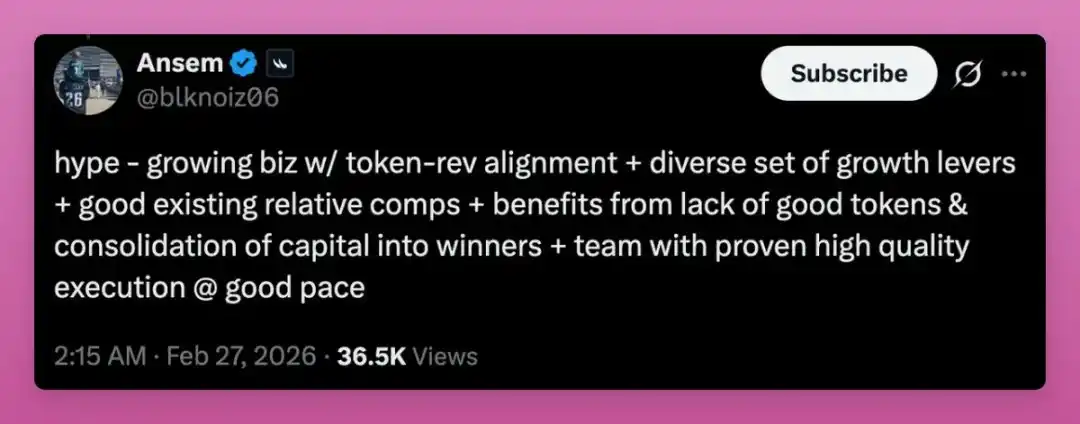
HYPE:
· Business on a growth trajectory, with token closely tied to revenue;
· Possessing diversified growth levers;
· Existing comparable projects perform well;
· Benefit from a market environment with high-quality token scarcity and funds flowing to top projects;
· Strong team execution, steady pace, and impressive track record.
Has Protocol Revenue, But Has Not Enabled Dividends
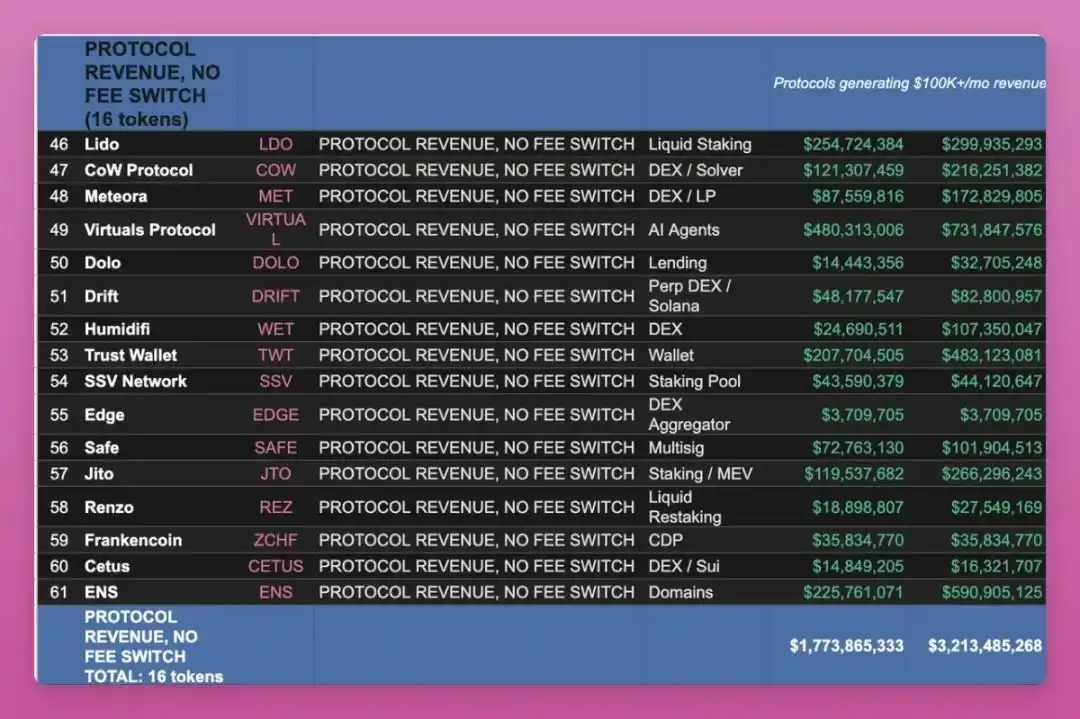
This category consists of 16 tokens, with monthly protocol revenue ≥ $100,000, which is retained in the treasury.
Top Projects:
· Lido: $4.3 million per month, TVL $32 billion (previously proposed staking dividends last year);
· CoW Protocol: $3 million per month;
· Meteora (Solana): $2 million per month;
· Virtuals Protocol: $1.4 million per month;
· Drift: $868,000 per month.
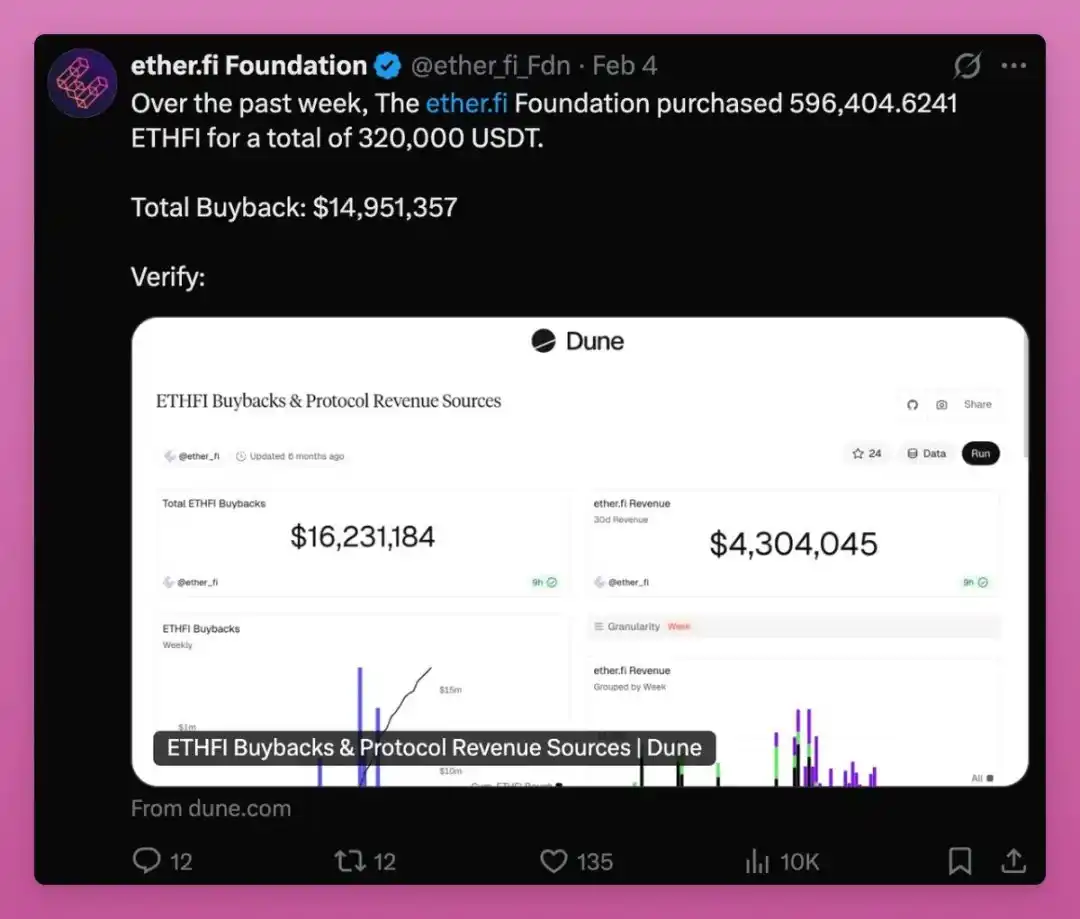
The comparison between Lido and ether.fi is quite interesting:
· Lido has a TVL that is 10 times higher and revenue that is 3 times higher, but LDO holders don't receive a cent;
· ether.fi distributes $1.5 million to holders monthly through buybacks.
If you were to go through a bear market, you would want to be with the one that can give you money.
The investment logic for these targets is:
These protocols will sooner or later enable the "dividends switch."
Lido has been talking about it for many years.
Jito has total monthly fees of $5.3 million, but only $544,000 enters the treasury.
The gap between total fees and holder earnings is both an opportunity and a risk.
Overview of Other Sectors
Exchange platform tokens (7 tokens, total market value $990 billion, including BNB)
You can make money regardless of market conditions. CEX trading volume may decrease, but it will not go to zero.
· BNB: $850 billion;
· LEO, OKB hardly dropped during the 2022, 2024 bear markets.
Many have buyback programs, just not reflected in DefiLlama data.
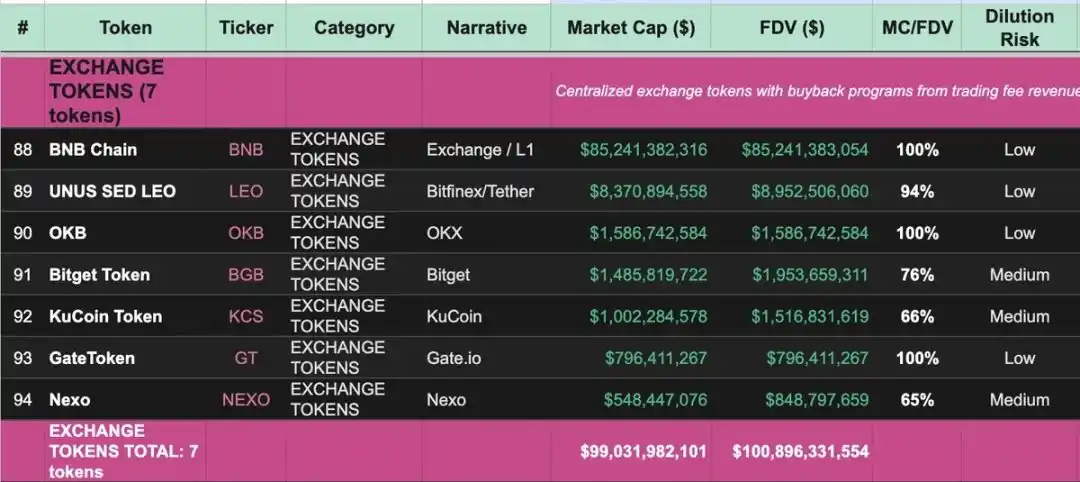
CEX tokens have a high circulation ratio, further reducing downside risk.
L1 Blockchains (19, total market cap $1.8 trillion)
L1 is the base layer.
· BTC: $1.36 trillion
· ETH: $245 billion
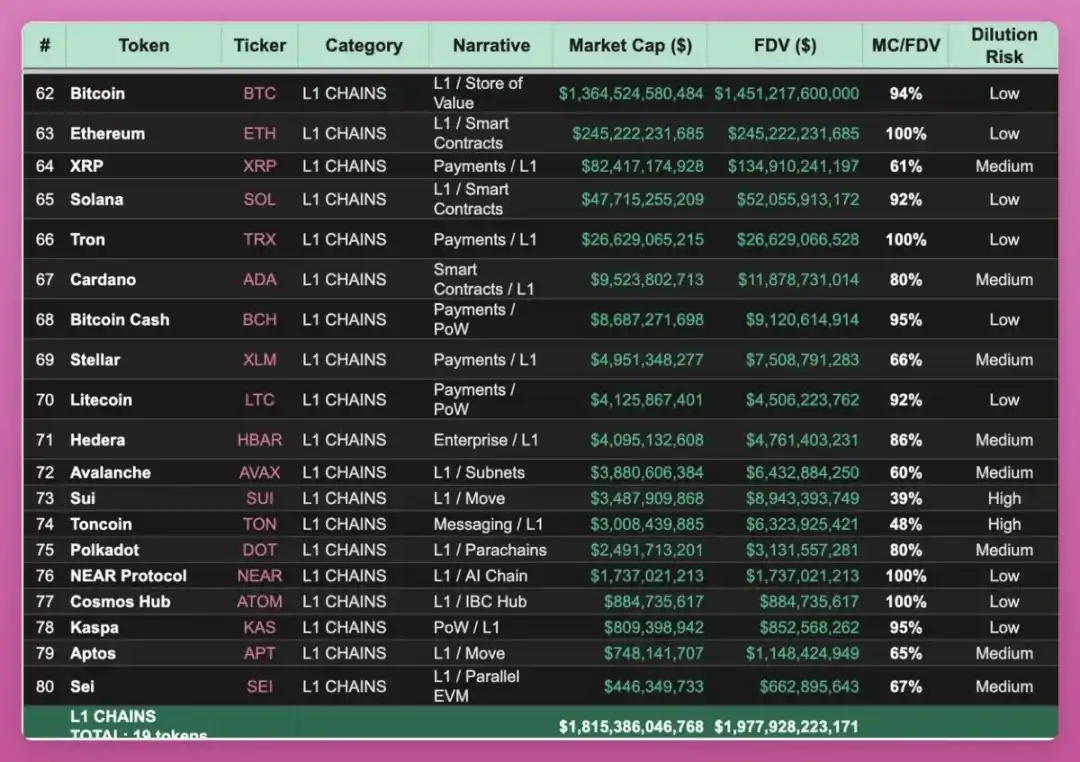
I have relaxed standards for XRP, ADA, especially Cosmos, as they have survived multiple cycles, have believers and liquidity, and demonstrate enduring vitality.
You may dislike TRON TRX, but it generates $26 million in monthly fees—more than Solana and Ethereum.
It has also shown strong performance this cycle; you can check the candlestick chart yourself.
L1 blockchains will not disappear, but valuation fluctuations will be significant. Trade at your own risk.
AI & Computing (8, total market cap $5.1 billion)
Most have no actual revenue, except for one:
Venice (VVV): The only AI token supported by subscription and API revenue for buyback and burn, with 43% of the supply already burned.
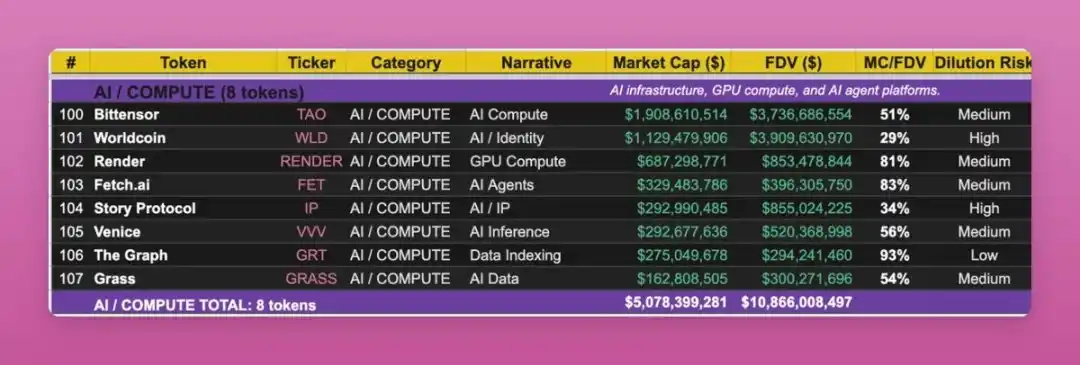
· Bittensor: $1.9 billion market cap, 128 subnets, no protocol revenue;
· Render, Akash: Sell GPU computing power cheaper than centralized platforms;
· Grass: Provides decentralized network data for AI training.
Note: Some AI tokens not listed are currently experiencing a surge and may be suitable for short-term trading, but whether they are "investable" is debatable.
RWA Asset Tokenization (7, total market cap $13.5 billion)
Growing quietly, I believe the real RWA bull market has yet to come.
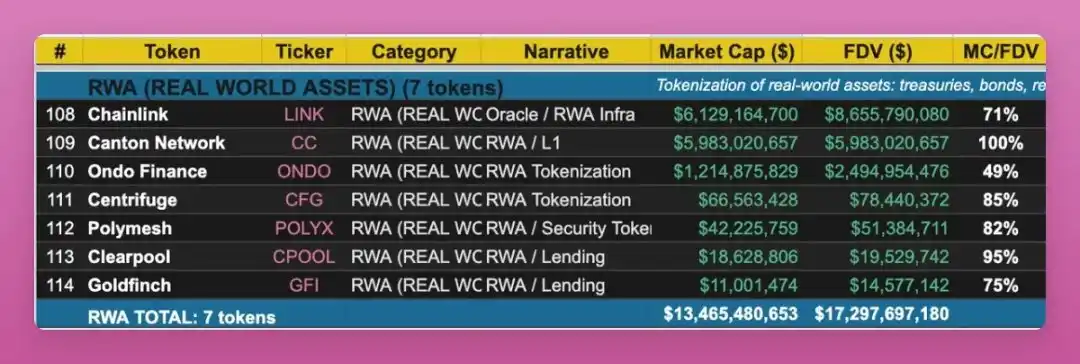
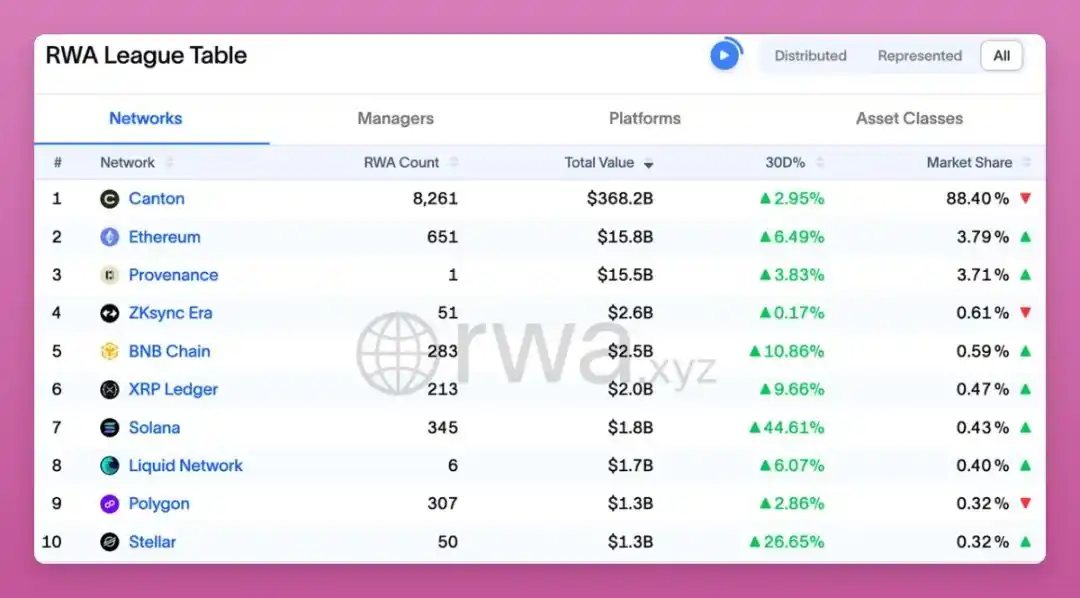
The Canton Network holds 88.57% of on-chain RWA, approximately $372 billion in tokenized assets. However, real-world assets are not as simple as they may seem on the surface.
Chainlink is the key oracle for RWAs, but LINK staking rewards come from inflation and a fixed reward pool, not protocol revenue sharing.
Chainlink revenue is solid, but flows to node operators and the treasury, not directly to holders.
Privacy Coins (2, total market cap $97 billion)
High-risk track: either increasingly important with tightening regulations or outright bans.
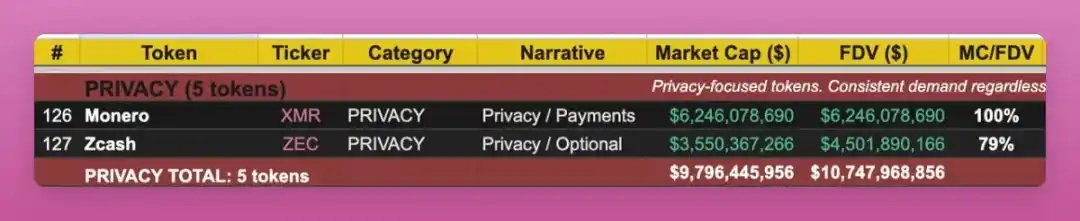
But regardless of the bull or bear, the demand remains stable.
· Monero: $6.2 billion
· Zcash: $3.6 billion
Meme Coins (6, total market cap $208 billion)
Categorizing them as "investable" may be controversial.
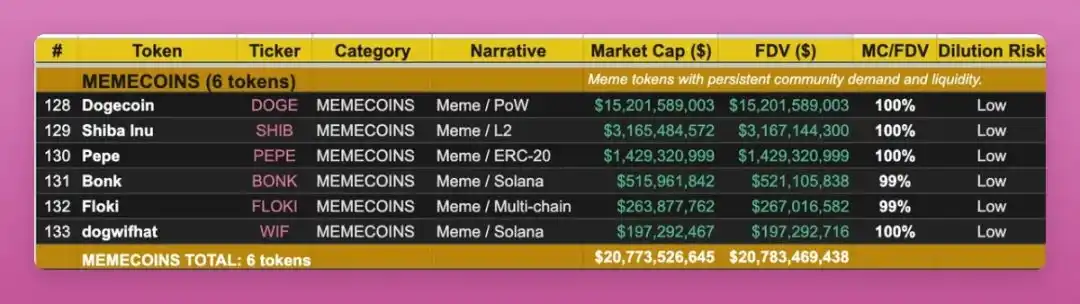
But like Bitcoin, they survive on community.
· DOGE: $15.2 billion market cap, in existence for over a decade;
· SHIB, PEPE, BONK, FLOKI, WIF are also on the list.
If the market rebounds, they may outperform high-yield tokens.
Because there is no income ceiling, there is no cap either.
And they are almost all in circulation, with little selling pressure.
Other Categories
· L2 Chains (7, total market cap $37 billion);
· DeFi Protocols (5, total market cap $5 billion): decentralized storage, data oracles;
· Oracles / Infrastructure (7, total market cap $18 billion);
· Stablecoin Infrastructure (4, total market cap $11 billion): Ethena leading.
-- Price
Super Profitable Projects Without Tokens
Some of the most profitable crypto businesses have no investable tokens at all.
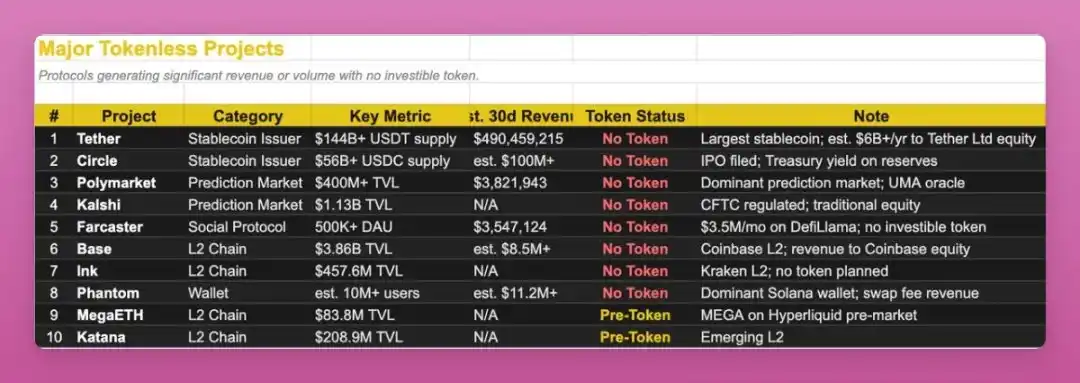
· Tether: Annual revenue of over $6 billion, more than the sum of those 45 income tokens, all go to shareholders;
· Polymarket: Monthly revenue of $3.8 million, no native token;
· Base: Revenue goes to Coinbase shareholders, potential future token issuance;
· Phantom: Millions of users, very high fees;
· Circle: Issuer of USDC, revenue reflected in IPO;
· Kalshi: CFTC-regulated, no native token;
· Farcaster: Acquired, expected significant airdrop reduction, but possible future token issuance.
So, how to use this information?
Ideal holdings in a bear market meet four criteria:
1. Have holder revenue
2. Low P/S ratio (market cap / revenue)
3. High MC/FDV (circulating market cap / fully diluted valuation)
4. Sustained stable demand
Very few tokens meet all criteria.
Closest candidates:
· PUMP: 1.4x P/S, 33% MC/FDV
· AERO: 3.4x, 50%
· JUP: 7.3x, 51%
· SKY: 16x, 98%
· CAKE: 15.1x, 96%
Low-risk picks:
Exchange platform tokens: LEO, OKB, GT
Almost fully circulating, supported by exchange platform profit buybacks, most stable performance in a bear market.
High-risk high-reward:
HYPE: Leading in revenue but only 25% MC/FDV.
After Coingecko's new stats excluding long-term non-circulating and burned tokens, it dropped to 41%.
Trading opportunities:
Watch for governance changes:
Bet on projects with revenue but no dividend distribution yet, turn on the "dividend switch".
Key focus:
Lido, Meteora, Drift, CoW Protocol
Everything else is a matter of faith.
Do you believe in AI computation on-chain?
Do you believe RWA tokenization will continue to grow?
I believe it will, but are these tokens the right bet?
This content is provided for general informational purposes only and doesn't constitute financial, investment, legal, or tax advice. Any events, rewards, online promotions, or related information mentioned herein should not be considered a recommendation, solicitation, or invitation to purchase, sell, trade, or otherwise deal in any crypto assets. Crypto assets are highly volatile and may result in loss. The availability of WEEX services, products, and related events may vary by region. You are responsible for ensuring that your participation is in accordance with applicable local laws and regulations.
You may also like
Secret Network lost 4.67 million dollars due to a cross-chain vulnerability, and the attack went undetected for seven days

CoW Swap released a report on the attack incident, stating that the domain was hijacked for several hours, resulting in an estimated loss of 1.2 million dollars
A user lost approximately 50 million dollars in a single transaction due to slippage, and the founder of Aave stated that the interface had issued multiple warnings
Endeavor Catalyst Raises $320 Million to Invest in Startups Outside Silicon Valley

IPCA Above the Target Ceiling: What Changes for Interest Rates and Investments
Behind the Boom of Stock Tokenization: Who is Making Money and Who is Being Used?

Ondo Private Markets Launches Tokenized Pre-IPO AI Notes: How They Work, Who Can Buy, and Why They Are Not Shares
Insights from TOKEN2049: What Changes Are Happening in the Industry?

Samsung Wallet Adds USDC on Solana for 82 Million US Galaxy Devices: What Launches in October and What Remains Unconfirmed

When Agents Learn to 'Collude': As AI Becomes Smarter, How to Define Safe Boundaries?
ESMA Gives EU Crypto Platforms Three Months to Drop Non-MiCA Stablecoins: What It Means for USDT Holders in Europe

What still works in crypto marketing in 2026 (and what doesn’t)
Trump's Tax Cuts and Strategic Reserve Release Fail to Curb Oil Prices; Energy Price Pressure Before Midterm Elections Ultimately Depends on Middle East Situation

Is AI Breaking the Mathematical Fortress? Is the 'Mathematical Apocalypse' of Cryptocurrency Just a False Alarm?

Sha Ai Lun Talks to Sun Yuchen: How Can Young People Seize Opportunities in the AI Era?
AI agents can pay for your shopping. Who gets your money back?
Kevin O'Leary's Latest Interview: The Next Stop for AI is Not Models, But Energy
Florida imposes new limits for using cryptocurrency ATMs ranging from $2,000 to $10,000
Bitcoin and Quantum Risk: This Study Shows Which Exchanges Are Most Exposed
Polkadot Launches Stablecoin 'dotUSD' Under DAO Governance with USDT Issuance and US Treasury Seed Funding
PLTR Stock Near $200: Can Palantir Break Its Recent High After Goldman's $230 Target and a $250 Call?
PLTR stock climbed about 2% to roughly $198 to $199 on October 8, 2026, after Goldman Sachs upgraded Palantir to Buy with a $230 target. The all-time high sits near $207, and the valuation is steep. This article covers what the upgrade says, where the price levels are and what could stop a breakout.

Debt in Pesos: Market Fears a New 'Wall' of Maturities Every Three Months

Strategy's $150 million-a-day STRC market has a hidden dependency on its own buybacks
Crypto, Starting to Doubt the Narrative
Did the US Government Sell Bitcoin? What the 12,267 BTC Transfer Shows and What On-Chain Data Cannot Prove
No sale has been confirmed. On October 8, 2026, US government-linked wallets moved 12,267 BTC, worth about $1.01 billion, out of a wallet holding funds seized in the 2016 Bitfinex hack, to new unlabeled addresses with no exchange deposit recorded. On-chain data shows movement, not intent, and no US agency has explained the transfers.

National Tax Agency Discusses Next-Generation System "KSK2" and Tax Investigations on Cryptocurrency Assets
Why Bitcoin Could Drop Below $80,000 After Another Failed Bounce

Circle Partners with Tereina to Integrate USDC and EURC into SAP Enterprise Payments
Hedge Funds Forced to Sell to Cut Losses, U.S. 10-Year Treasury Yield May Break 6%
Q3 2026 Earnings Preview: Why Strong Results May Not Lift Stocks & How to Predict Stock Moves with WEEX
Secret Network lost 4.67 million dollars due to a cross-chain vulnerability, and the attack went undetected for seven days
CoW Swap released a report on the attack incident, stating that the domain was hijacked for several hours, resulting in an estimated loss of 1.2 million dollars
A user lost approximately 50 million dollars in a single transaction due to slippage, and the founder of Aave stated that the interface had issued multiple warnings
Endeavor Catalyst Raises $320 Million to Invest in Startups Outside Silicon Valley
IPCA Above the Target Ceiling: What Changes for Interest Rates and Investments
Behind the Boom of Stock Tokenization: Who is Making Money and Who is Being Used?
Contents
Latest articles


Latest coin listings on WEEX


