
Anonymous Crypto Wallet: What Each One Hides and Where It Fails

 Prefer us on Google


An anonymous crypto wallet, in the sense most people mean, mostly does not exist. Wallets that skip ID checks are easy to find, and a handful can hide amounts, counterparties or your IP address, but anonymity depends on how the coins reached the wallet and what you do with them next, not on the app's label. This guide separates the three things sold as "anonymous" (pseudonymous addresses, no-KYC self-custody and real privacy technology), then goes through named wallets by what each hides and fails to hide, checked against the projects' own sites and documentation in October 2026.
The distinction matters because most "anonymous wallet" rankings are really lists of wallets that never ask for a passport. Several put hardware devices near the top. A hardware wallet keeps keys offline, which protects against theft. It does nothing to stop a stranger reading your transaction history on a block explorer.
Wanting that history kept private is ordinary, not suspicious. Nobody hands a coffee shop their bank statement when they pay, yet on a transparent chain anyone you pay can look up the address the money came from, see its balance and follow where the rest goes. Privacy tools narrow that view. They are not a way around a court order, and no wallet below claims to be.
What "Anonymous" Actually Means for a Crypto Wallet
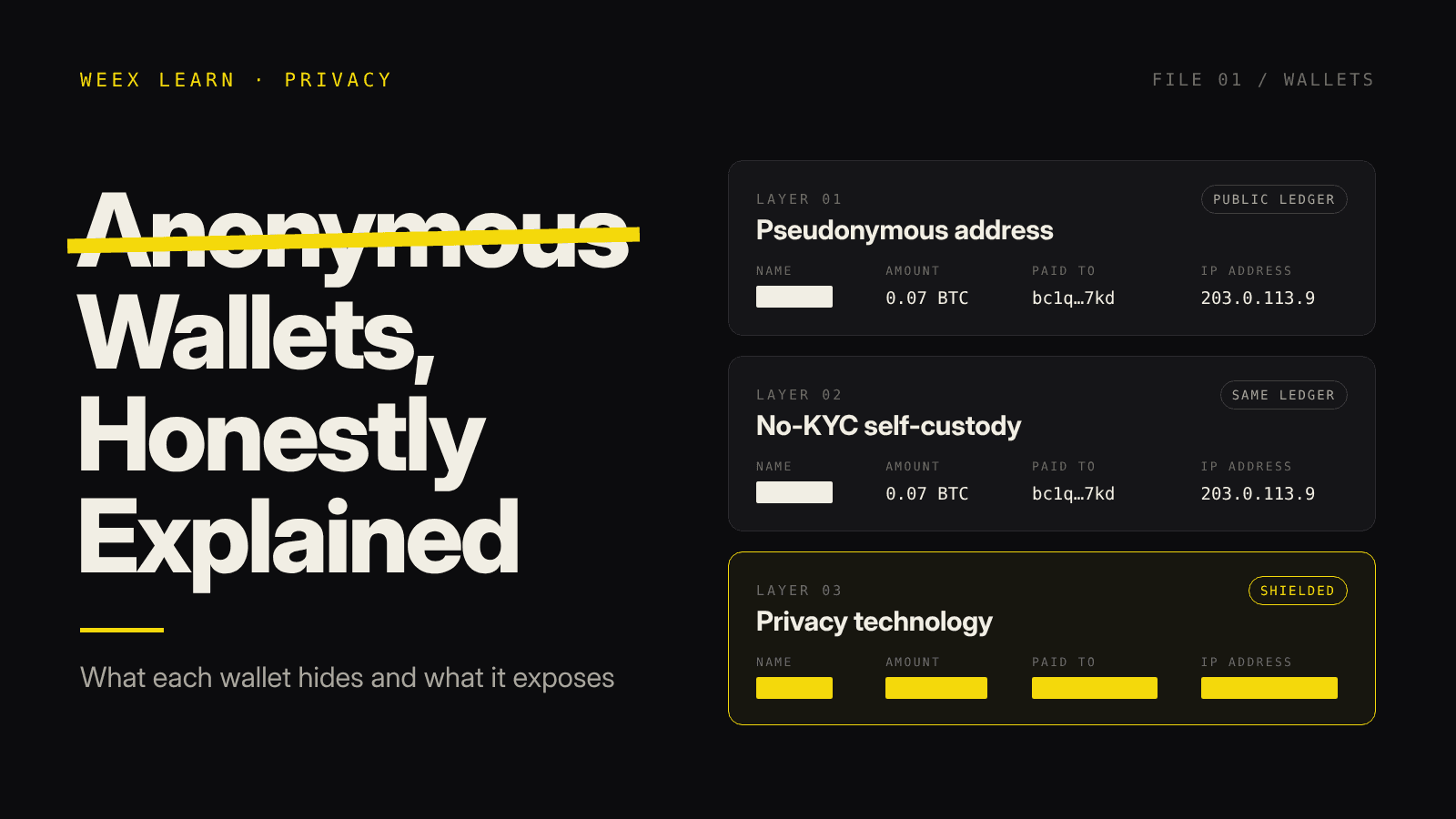
Three different properties hide under one word.
- Pseudonymous addresses. The default on Bitcoin, Ethereum, Solana and most other chains. Your name is not on the ledger, but every payment is, permanently. Bitcoin.org's privacy page notes that Bitcoin "is often perceived as an anonymous payment network", then explains why that perception is wrong.
- No-KYC, non-custodial wallets. Software that generates keys on your device with no account behind it. Cake Wallet's documentation puts it plainly: "no accounts, logins, or sign-ups". That tells you the developer does not know who you are. It says nothing about what the blockchain or your internet provider can see.
- Privacy technology. Features that shrink what observers learn: coin control (choosing which coins fund a payment), Tor routing (hiding your IP address from the servers a wallet talks to), collaborative transactions such as CoinJoin and Payjoin (blurring who paid whom), and protocol-level privacy, where the chain itself conceals the data, as on Monero or in Zcash's shielded pool.
An app with only the second property is a no-KYC crypto wallet. That is worth having. Calling it anonymous oversells it.
Anonymous Crypto Wallets Compared: What Each One Hides
This is not a ranking and it is not based on hands-on testing. Entries had to meet three criteria: non-custodial with no account required, still operating in October 2026, and documented by the project itself. Each is read for what it hides and what stays exposed.
Sparrow Wallet: Bitcoin Desktop With Coin Control
Sparrow advertises "full coin and fee control", built-in Tor and a direct connection to your own Bitcoin node or Electrum server. Its docs also cover PayNym payment codes and a "fake" two-person coinjoin you build alone. Amounts and addresses still sit on Bitcoin's public ledger. As of October 2026, Sparrow's feature and documentation pages make no mention of Whirlpool mixing, though some 2026 roundups still credit it with that.
Wasabi Wallet: CoinJoin, but You Pick the Coordinator
Wasabi is desktop-only (v2.8.3 on its download page as of October 2026) and says "all your traffic is routed through the Tor Network". It still supports coinjoin, where many users combine payments into one transaction so that outputs cannot be matched to inputs. zkSNACKs, the company that ran the original coordinator, discontinued that service on 1 June 2024. The docs now say "a coordinator must be configured before using coinjoin for the first time", and finding a third-party one is the user's job. They also say the client will not join rounds that charge a coordination fee, so reviews quoting a 0.3% fee are out of date.
Cake Wallet: Monero Plus Bitcoin Privacy Tools on Mobile
Cake's documentation lists 16 supported assets as of October 2026, including Monero, Zcash, Bitcoin and Litecoin. On the Bitcoin side it documents Payjoin v2 and Silent Payments, a reusable sp1 address that lands each payment at a fresh on-chain address. Litecoin MWEB and built-in Tor are there too. Two caveats come from its own pages: Tor is marked experimental because "not every connection type supports Tor routing yet", and Payjoin only helps when both wallets support it.
Monero GUI and Feather: Privacy Built Into the Chain
Monero is the clearest case of protocol-level privacy. Getmonero.org states that "the sender, receiver, and amount of every single transaction are hidden", using stealth addresses, ring signatures and RingCT. The official GUI wallet was at version 0.18.5.0 as of October 2026; Feather, a third-party desktop wallet, was at 2.8.1. No Monero wallet hides how you obtained the XMR.
Zodl (Formerly Zashi): Shielded Zcash
Zashi's team left Electric Coin Company, formed Zcash Open Development Lab and announced the rename to Zodl on 16 February 2026. The mobile wallet is "designed for shielded Zcash", and the qualifier matters. In z.cash's words: "Shielded Zcash addresses keep your financial information private. Transparent addresses make that information public." Zodl accepts transparent ZEC and prompts you to shield it, so the privacy depends on funds staying shielded.
MetaMask and Other Multi-Chain Wallets: No KYC, Little Privacy
No ID is needed, but Ethereum-style accounts reuse one address for everything, so a single lookup shows the lot. The network layer leaks as well. MetaMask's privacy notice, last updated 30 September 2026, says Infura is the default RPC provider and that default configurations involve processing your wallet address and, temporarily, your IP address. A different RPC provider or your own node changes who sees that data.
Can an Anonymous Crypto Wallet Be Traced to You?
Usually yes, and rarely by breaking cryptography. Tracing works on the activity around the wallet, as one ordinary week of payments shows.
You buy 0.05 BTC on an exchange that verified your ID and withdraw it to address A in a fresh wallet. The exchange's records now tie A to your name. A week later a friend repays you 0.02 BTC to address B, which nothing connects to you. Then you pay a merchant 0.06 BTC. Neither coin covers it alone, so the wallet spends both: 0.07 BTC in, 0.06 to the merchant, an illustrative 0.0001 in fees and 0.0099 back to a change address, C.
That one transaction links all three addresses. The Bitcoin whitepaper conceded the point in 2008: multi-input transactions "necessarily reveal that their inputs were owned by the same owner". B inherits the identity attached to A, and C gives itself away as change because 0.06 is round and 0.0099 is not. Nobody was hacked.
The breaks cluster in four places:
- Identified on-ramps and off-ramps. The withdrawal or deposit record at a regulated exchange is the strongest link, and no wallet feature removes it.
- Address reuse and merged coins. Coin control shows you the merge before you sign; Payjoin weakens the same-owner assumption; Monero and shielded Zcash avoid exposing the data at all.
- IP addresses. Bitcoin.org warns that it is possible to "log their IP addresses" when transactions are relayed. Tor or your own node addresses this layer only.
- Amounts and timing. A distinctive sum leaving one place and arriving in another minutes later is a fingerprint on any transparent chain.
-- Price
Are Anonymous Crypto Wallets Legal?
Holding your own keys without showing ID is not what recent enforcement has targeted. Services have been. US authorities seized Samourai Wallet's servers and domain on 24 April 2024, and in November 2025 its two founders were sentenced to five and four years for conspiring to operate a money transmitting business that, prosecutors said, moved more than $237 million in criminal proceeds. Any list still recommending Samourai in 2026 has not been maintained.
In the EU, the Anti-Money Laundering Regulation (2024/1624) applies from 10 July 2027 and bars crypto service providers from keeping anonymous accounts or handling privacy coins. It is aimed at providers, not at people running their own wallet software, but expect fewer regulated venues for XMR and ZEC in Europe after that date.
Regulated exchanges sit on the identified side of this line, WEEX included. As read on 8 October 2026, WEEX's Help Center says the exchange "will proactively require users to complete KYC identity verification based on their user's level", and the KYC verification rules tie that to its user agreement and anti-money-laundering terms. The check runs through Sumsub: an ID document plus a liveness check, with manual review "generally" completed within three working days. WEEX's guide on how to buy crypto adds that "you may need to complete identity verification to access certain services or features", depending on payment method and region. Whatever you buy there and withdraw arrives in your wallet with a known origin.
How to Choose an Anonymous Wallet for What You Need
Start from who you want privacy from, because each answer points at a different layer.
- The people you pay. Fresh addresses and coin control are enough. A Bitcoin wallet in the Sparrow mould covers it.
- Server operators logging your IP next to your addresses. Tor routing or your own node. Check whether it is on by default or opt-in.
- Anyone reading the chain. Only protocol-level privacy hides amounts and counterparties by default, at the cost of a narrowing set of regulated venues.
- A company holding your coins. Any non-custodial wallet solves this, with no privacy claim needed.
The more mundane way to lose money with a privacy wallet has nothing to do with surveillance: a fake download or a badly stored recovery phrase. Download only from the project's own site, and before moving a balance off an exchange, set up and test the wallet with a small transfer. The honest reading of "anonymous crypto wallet" is a wallet that reveals less, to fewer parties, when used with care.
FAQ
1. What is the most anonymous crypto wallet?
It depends on the chain more than the app. Monero wallets hide sender, receiver and amount by default because the protocol does. A Bitcoin wallet can limit what leaks, but it cannot make a transparent ledger private.
2. Can police or tax authorities trace an anonymous crypto wallet?
Often, yes. Exchange records and public ledger data are the usual routes, and regulated platforms answer lawful requests. Privacy tools reduce what the general public can see. They do not remove reporting or tax duties.
3. Can I buy crypto anonymously inside a wallet app?
Rarely. In-app buy buttons are run by third-party payment providers. Cake Wallet's FAQ says "some buy and sell (fiat on-ramp) providers require identity verification", a requirement that comes from the provider, not the wallet.
This content is provided for general informational purposes only and doesn't constitute financial, investment, legal, or tax advice. Any events, rewards, online promotions, or related information mentioned herein should not be considered a recommendation, solicitation, or invitation to purchase, sell, trade, or otherwise deal in any crypto assets. Crypto assets are highly volatile and may result in loss. The availability of WEEX services, products, and related events may vary by region. You are responsible for ensuring that your participation is in accordance with applicable local laws and regulations.
You may also like

How to Use an APR Boost on WEEX Auto Earn Without Wasting It
What Is a Blockchain Node? Types, 2026 Counts, and Real Costs
Taiwan Stock Market Nears 50,000: Can the TAIEX Break the Milestone After the Holiday?

How to Buy USDT in Thailand: Payment Methods, Fees and Transfer Checks
WEEX API Key Setup: How to Connect a Third-Party Platform Safely
How to Become a WEEX Broker: Application, API Setup and Go-Live
What Is WEEX Broker? API Program, Commissions and How It Works
WEEX Broker Models: Strategy Bots, Copy Trading and Sub-Exchanges
What Is Orca (ORCA) Crypto? The Solana DEX, USDY Liquidity, and the ORCA Name Confusion

WEEX TOKEN2049 Day 1 Live Preview: Booth, MBTI and AI Demo
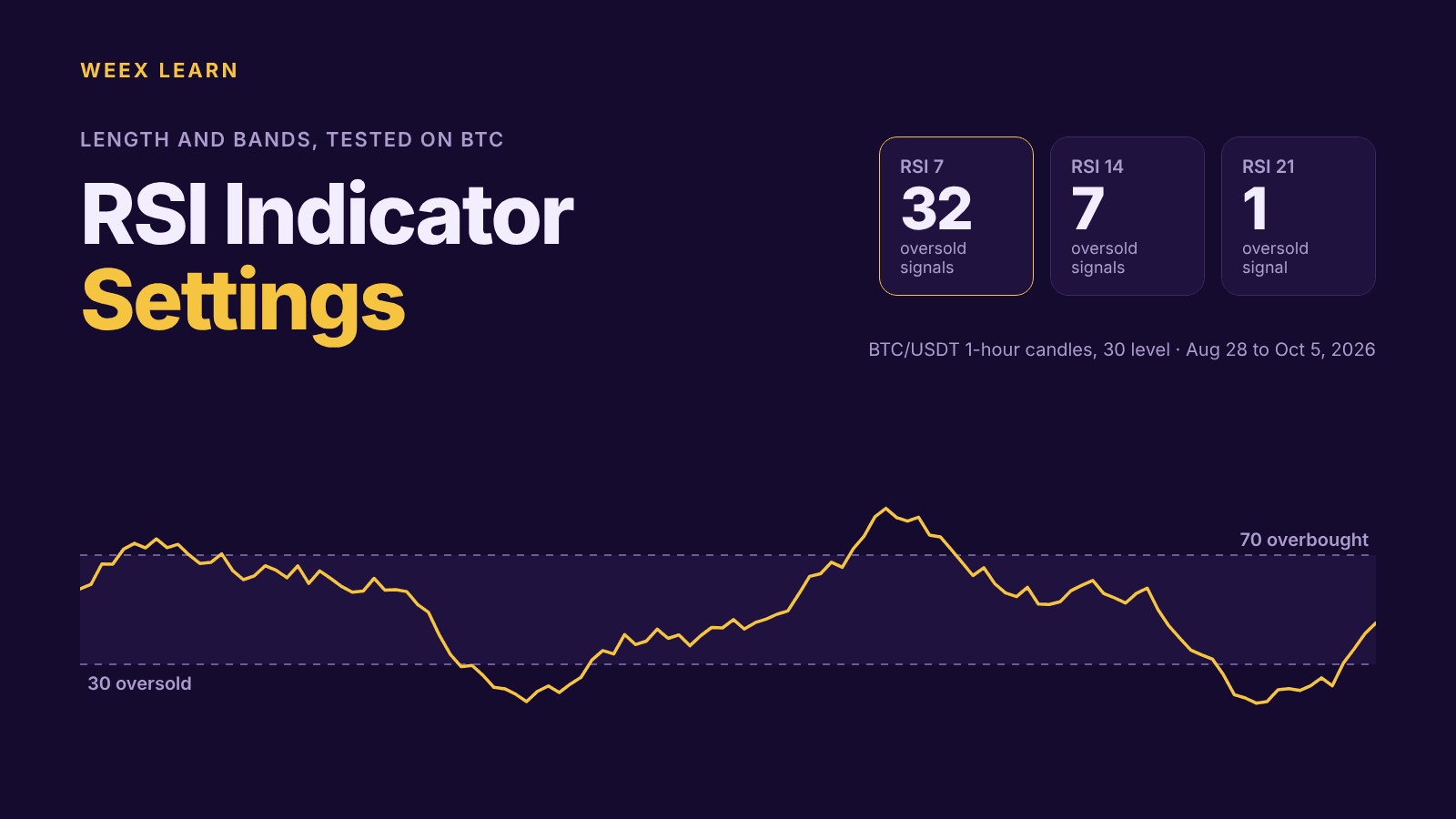
RSI Indicator Settings: What 7, 9, 14 and 21 Did on BTC Charts
Best Crypto Apps for Beginners: The Five Features That Actually Matter on Your Phone
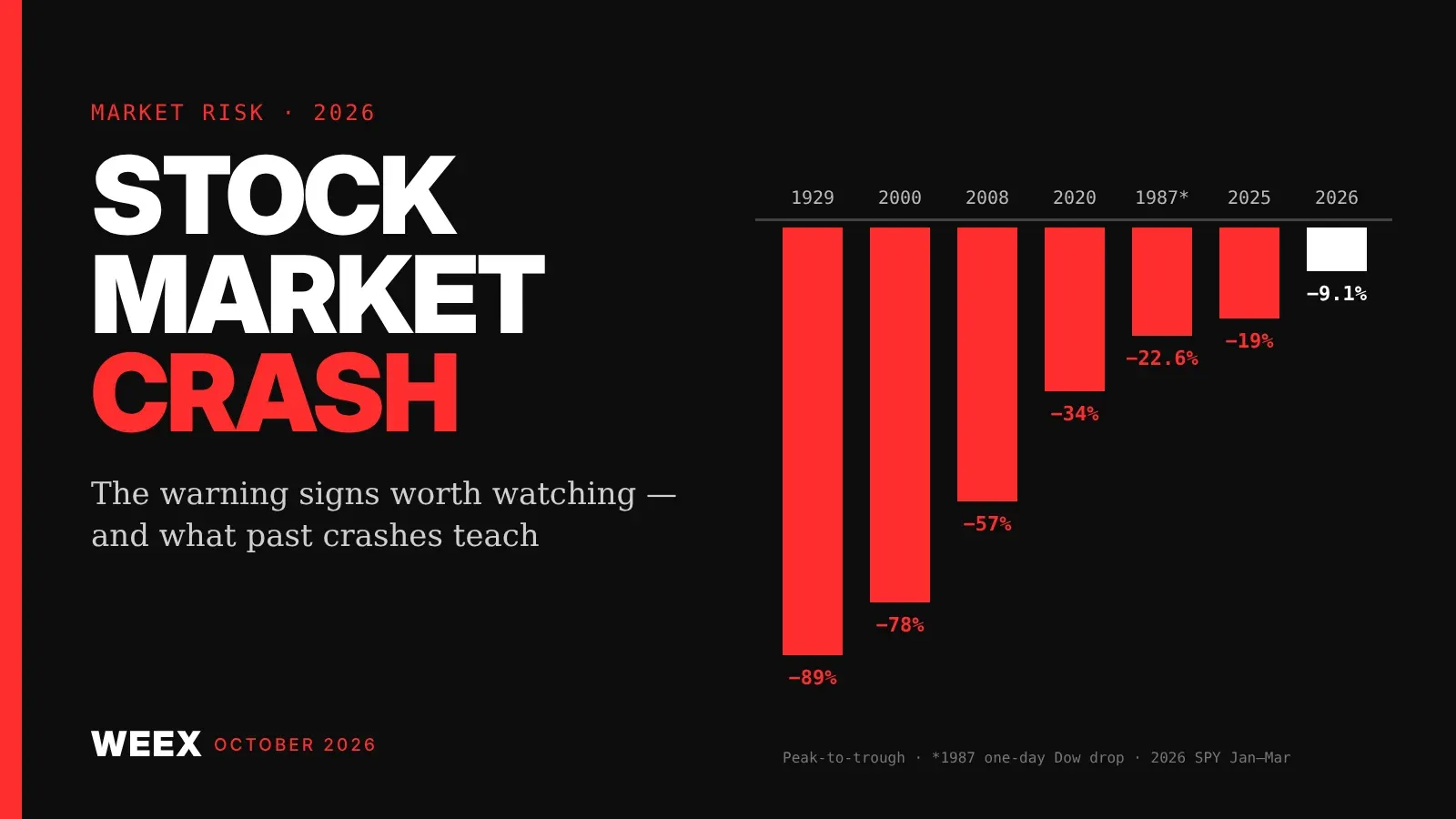
Stock Market Crash Risk in 2026: The Warning Signs Worth Watching
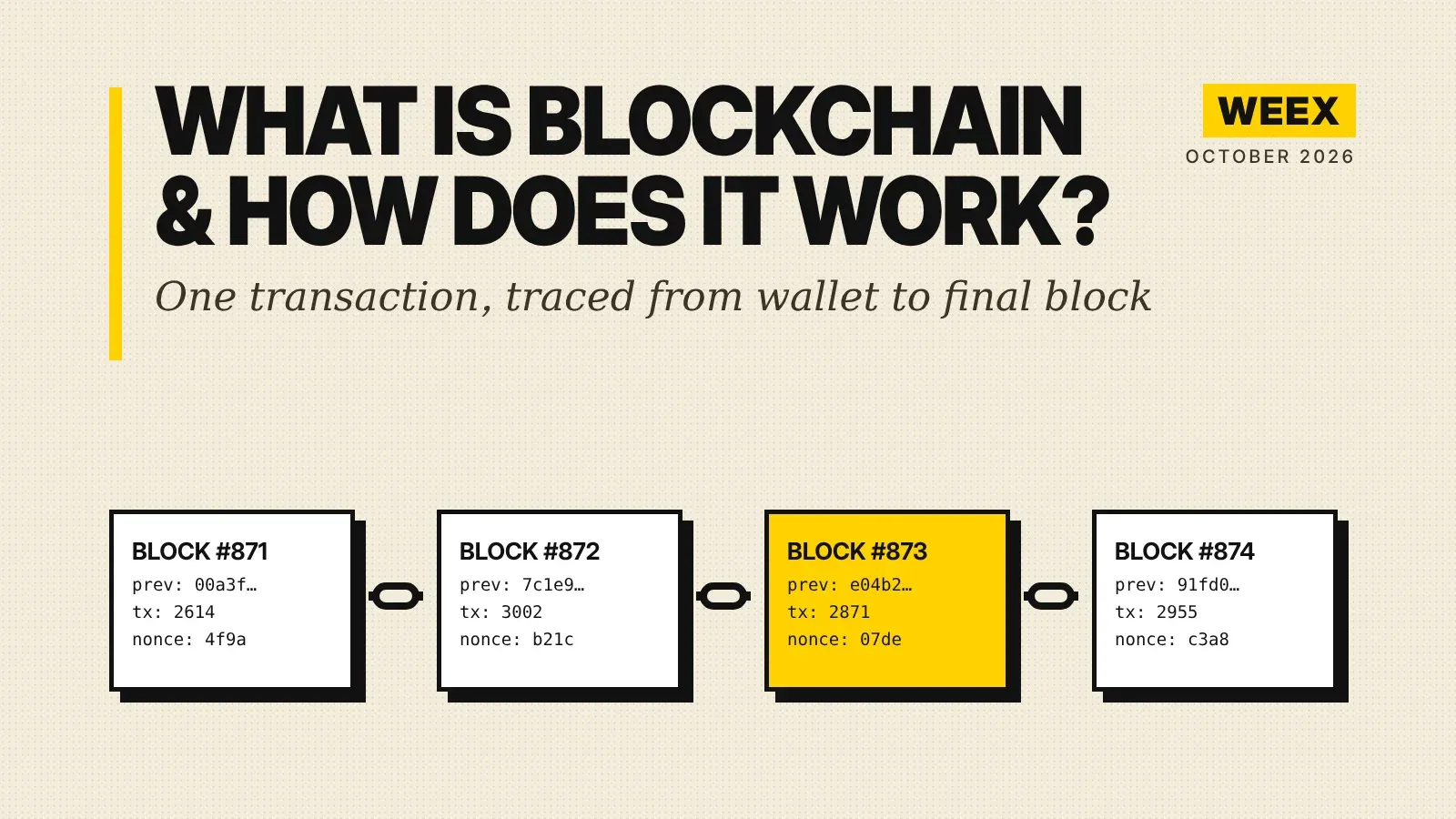
What Is Blockchain and How Does It Work? A Transaction Traced
How to Buy Crypto with PayPal: The Custody Catch Most Beginners Miss
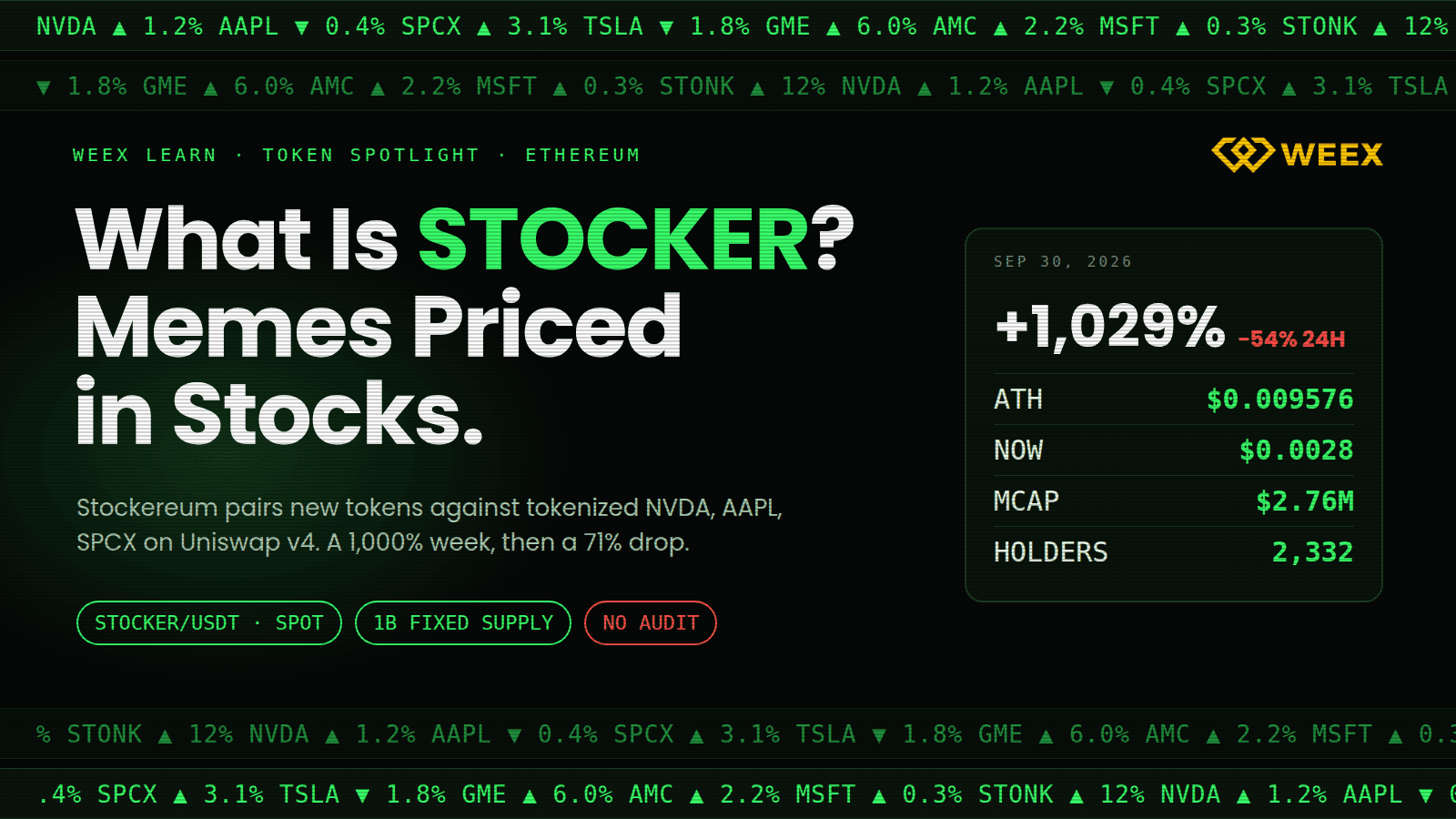
What Is STOCKER? Stockereum, Stock-Paired Meme Tokens, and Risks
XRP Upgrade Update: XRPL Batch Slips to Oct 9 and What Changes

What Is Coinbase Wrapped HYPE (cbHYPE)? How It Works on Base, 1:1 Backing, Risks, and HYPE Conversion
Is QNT a Stock or Crypto? Quant (QNT) and Quantinuum Stock Are Not the Same Asset
No KYC Crypto Wallet: 6 Picks and 5 Places Your ID Still Leaks
What Is Quant (QNT) Crypto? How Overledger Works, QNT Utility, and Token Supply Explained
Best Decentralized Crypto Wallet for Beginners: What Self-Custody Really Asks of You
Does a Negative Funding Rate Mean a Short Squeeze Is Coming?

Best Crypto Exchange for Beginners 2026: What Actually Matters When Choosing One
Best Crypto Cold Wallet 2026: Top Picks Matched to How You Hold
How to Connect Phantom Wallet to a Solana DApp
How to Install and Set Up Phantom Wallet
Funding Rate Crypto: What BTC and ETH Are Paying Right Now

INTC Stock Surged 14%: Intel Only Has Enough Chips for Half Its Clients
XPL Unlock on Sept 25: How to Long or Short Plasma Futures Safely
How to Use an APR Boost on WEEX Auto Earn Without Wasting It
What Is a Blockchain Node? Types, 2026 Counts, and Real Costs
Taiwan Stock Market Nears 50,000: Can the TAIEX Break the Milestone After the Holiday?
How to Buy USDT in Thailand: Payment Methods, Fees and Transfer Checks
WEEX API Key Setup: How to Connect a Third-Party Platform Safely
How to Become a WEEX Broker: Application, API Setup and Go-Live


