
What Is Blockchain and How Does It Work? One Real Payment Traced

 Prefer us on Google


What is blockchain and how does it work? A blockchain is a shared record of transactions that thousands of independent computers store and check, updated in batches called blocks, with each block cryptographically tied to the one before it so old entries cannot be quietly rewritten. This guide makes that concrete by following one real $18 Bitcoin payment from signature to confirmation on 7 October 2026, then covers hashing, proof of work versus proof of stake, what blockchains do badly, and what really happens when you buy or withdraw crypto on an exchange.
Most definitions stop at "distributed ledger," which is accurate and tells a beginner almost nothing. Real numbers help, and every figure below can be checked on a public block explorer.
What Is Blockchain in Simple Terms?
Picture a spreadsheet of payments that anyone can read, anyone can add a line to by paying a small fee, and nobody can edit afterwards. Lines are bundled into a block, and a new block is attached to the end of the chain every few seconds or minutes, depending on the network.
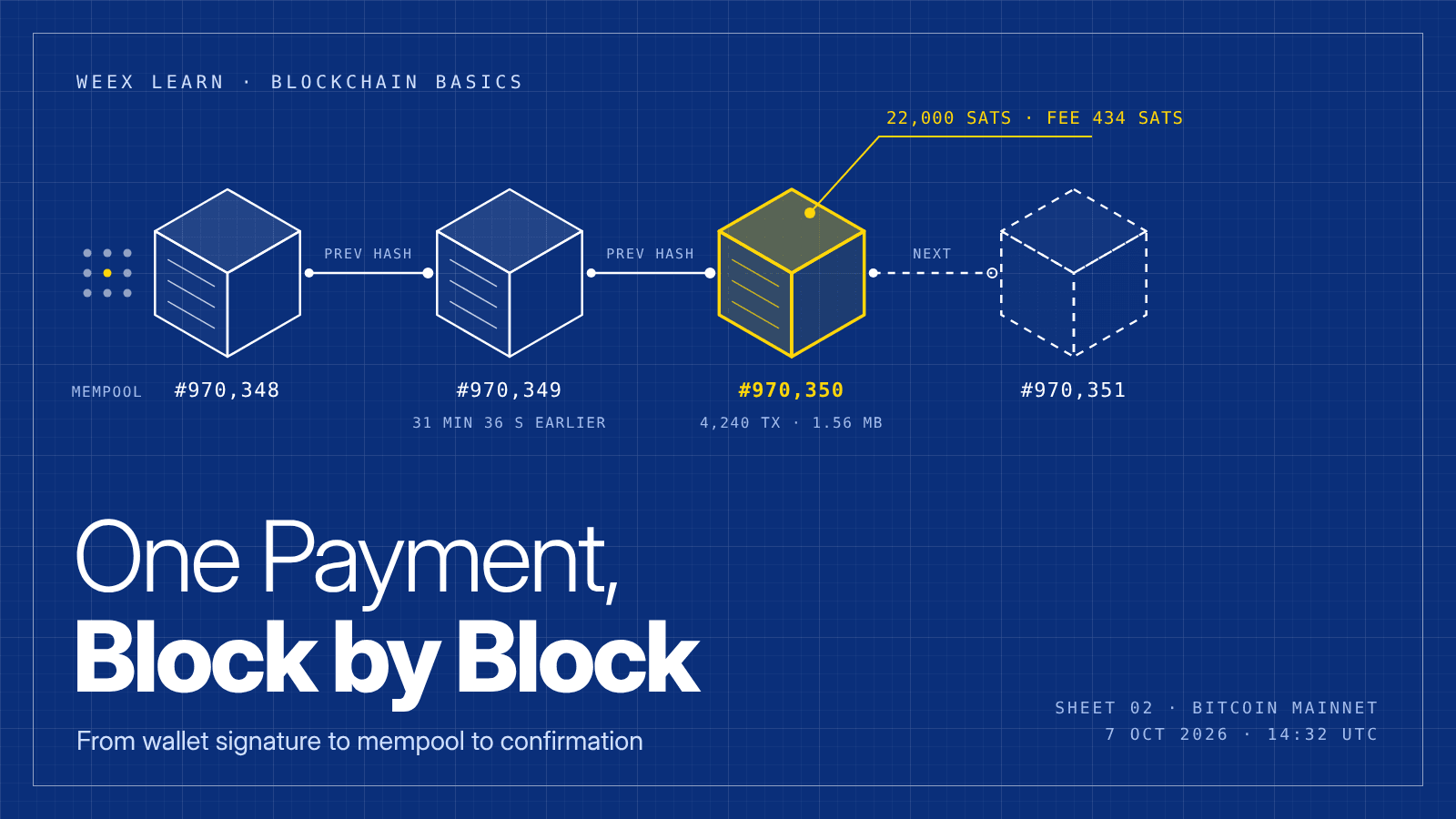
Two things separate this from an ordinary database. There is no administrator: the computers running the network, called nodes, each keep a full copy and reject anything that breaks the rules. And every block carries a fingerprint of the block before it, which locks history into a fixed order. Bitcoin's chain had passed block 970,390 as of 8 October 2026.
How Does a Blockchain Transaction Work? One Real Payment
The payment is Bitcoin transaction bef85641…907f, picked from the middle of an ordinary block. It passed through four stages.
Signature. A wallet controlled one unspent "coin" of 461,934 satoshis (a satoshi is a hundred-millionth of a bitcoin), about $385 at the 8 October 2026 price of roughly $83,400 per BTC. It wrote a message splitting that coin in two: 22,000 sats, about $18.34, to one address, and 439,500 sats to another, most likely change returning to the sender. The wallet then signed the message with its private key, which proves ownership without revealing the key.
Mempool. The network's computers checked the signature, confirmed the coin had not already been spent, and parked the transaction in a waiting room called the mempool. About 71,700 transactions were queued there when we checked in October 2026, roughly 41 blocks' worth of data. Miners serve the highest bidders first, and the bid is whatever the sender leaves unclaimed: 461,934 minus 22,000 minus 439,500 equals 434 sats, about $0.36. That works out to 3.09 sats per virtual byte, in line with the 3 sat/vB that mempool.space was recommending for fast confirmation as of October 2026.
Block. At 14:32 UTC on 7 October 2026, the mining pool AntPool found block 970,350 and included the payment with 4,239 other transactions. The block was 1.56 MB and 99.8% full by Bitcoin's weight limit. It arrived 31 minutes 36 seconds after its predecessor, which had taken under ten minutes. "Ten-minute blocks" describes an average, about 9.5 minutes as of October 2026, not a timetable.
Confirmations. Landing in a block counts as one confirmation. Every block added on top is another, and each makes reversal more expensive. By block 970,393, the latest we saw on 8 October 2026, it had 44. Many services treat six, about an hour, as settled for larger sums.
How long did it wait? Its locktime field reads 970,349, the chain height wallets commonly stamp at signing, so probably no more than half an hour.
Why Changing One Old Block Breaks Every Later Block
A hash function turns any data into a fixed-length fingerprint, and Bitcoin uses one called SHA-256. Change a single character of the input and the output is unrecognizable. Here is a three-block toy chain in which each block is hashed together with the full fingerprint of the block before it:
- Block A,
Ana pays Ben 5, hashes to a value beginningf499016c. - Block B, A's hash followed by
Ben pays Cy 2, begins9dd888c4. - Block C, B's hash followed by
Cy pays Dee 1, begins1825f75a.
Now cheat. Change the 5 in Block A to a 6 and its hash becomes 21dde871. Block B contained the old fingerprint, so its hash turns into 522dfd00, and Block C's into f666fe19. One digit moved and every later fingerprint broke. Anyone comparing copies spots the forgery at once. You can reproduce these values with any SHA-256 calculator.
On a real chain, repairing those fingerprints costs money. Bitcoin only accepts a block whose hash falls below a target, which is why block 970,350's hash starts with 20 zeros. A script we ran needed 126,941 guesses to find a hash with just four leading zeros for the toy block, and each extra zero multiplies the work by 16. Bitcoin miners were making about 974 quintillion guesses per second as of October 2026. To rewrite that $18 payment, an attacker would have to redo block 970,350 and everything after it faster than the rest of the network extends the chain.
-- Price
Proof of Work vs Proof of Stake: Who Adds the Next Block?
Somebody has to pick the next block, and the right to do so must be costly to fake.
Proof of work is Bitcoin's. Miners spend electricity on the guessing game above, and the winner publishes the block and collects the reward. For block 970,350 that was 3.125 newly issued BTC plus 0.0476 BTC in fees, about $264,500 in total. Cheating means outspending everyone else on hardware and power.
Proof of stake is what Ethereum has used since 2022. Validators lock up at least 32 ETH as collateral, and one is chosen at random every 12 seconds to propose a block while the others vote on it. Break the rules and part or all of that stake can be destroyed, according to ethereum.org. Roughly 44 million ETH, about 35% of supply, was staked across some 857,000 active validators as of October 2026, and a block takes about 15 minutes to become final.
Proof of work anchors security in physical cost and burns a great deal of energy. Proof of stake uses a sliver of the electricity but anchors security in capital, which hands the most influence to whoever holds or manages the most coins. Neither is free.
What Are the Disadvantages of Blockchain?
Blockchains are slow, sometimes expensive, and unforgiving, and all three follow from the design.
- Throughput. Across 144 consecutive blocks mined on 6 and 7 October 2026, about one day's worth, Bitcoin averaged 5,131 transactions per block. That is under nine per second for the entire world.
- Fees that swing. Block space is auctioned. Early October 2026 was cheap: Bitcoin fees averaged 293 sats, about $0.24, over those 144 blocks, and a basic ETH transfer cost about $0.02. When demand jumps, so does the price of getting in.
- A thin security budget. Fees made up just 0.48% of miner income over those 144 blocks. The rest was new issuance, which halves roughly every four years. How Bitcoin funds its security decades from now is an open question.
- No undo. There is no chargeback and no help desk. Send to a mistyped address or over the wrong network and the coins are usually gone for good.
A blockchain is worth these costs only when the parties do not trust a common administrator. That narrows the list of what blockchain is used for to far fewer cases than the hype suggests.
Does Buying Crypto on an Exchange Use the Blockchain?
Usually not. When you buy bitcoin on an exchange, no blockchain transaction happens. The exchange edits its own internal database: your balance goes up, the seller's goes down. The coins stay in wallets the exchange controls. That is why trades settle in milliseconds, and why your balance is a claim on the exchange until you withdraw.
The blockchain appears at the edges:
- Deposits. Coins sent from an outside wallet travel on-chain, and the exchange credits you after a set number of confirmations. As of October 2026, WEEX's deposit FAQ lists at least 1 confirmation for BTC, 12 for USDT on Ethereum (ERC-20) and 1 for USDT on TRON (TRC-20), with a 1 USDT minimum on those two networks.
- Withdrawals. The exchange signs and broadcasts a transaction for you. It pays a network fee and produces a transaction ID that you can track through the mempool and into a block, exactly like the payment above.
- Internal transfers. Moving funds between two accounts on the same exchange never touches the chain. WEEX's help center lists these as free, and there is no transaction ID to look up.
The usual way beginners lose money here is the network menu. USDT exists on several chains, and picking one the receiving wallet does not support can strand the funds. Send a small test amount first.
The quickest way to understand all this is to do it once. Buy Bitcoin on WEEX, follow the steps to withdraw funds from WEEX to a wallet you control, starting small, and paste the transaction ID into a block explorer. Watching it move from mempool to block to confirmations answers "what is blockchain and how does it work" better than any definition.
FAQ
1. Is blockchain the same as Bitcoin?
No. Bitcoin is one blockchain, launched in 2009 to move a single asset. Ethereum, Solana, TRON and many others are separate chains with their own rules, coins and block times. "Blockchain" is the record-keeping method, and Bitcoin is its first and largest use.
2. Can a blockchain be hacked?
Rewriting a large chain is impractical: an attacker would need to out-compute Bitcoin's roughly 974 quintillion hashes per second, as of October 2026. Smaller chains are weaker. In practice most losses happen at the edges, through stolen private keys, phishing, faulty smart contracts and compromised bridges or platforms, not through broken blocks.
3. How long does a blockchain transaction take?
It depends on the chain and the fee you pay. Bitcoin blocks averaged about 9.5 minutes as of October 2026, yet the block in this article took more than 31, and six confirmations take about an hour. Ethereum adds a block every 12 seconds and finalizes in about 15 minutes. Exchanges add their own processing time on top.
4. Who controls a blockchain?
On a public chain, no single party. Nodes enforce the rules, miners or validators produce blocks, and changing the rules needs broad agreement among them. Influence is still uneven: AntPool mined four of the six consecutive blocks from 970,345 to 970,350, a small sample but a telling one. Private blockchains are different and are run by a company or consortium.
This content is provided for general informational purposes only and doesn't constitute financial, investment, legal, or tax advice. Any events, rewards, online promotions, or related information mentioned herein should not be considered a recommendation, solicitation, or invitation to purchase, sell, trade, or otherwise deal in any crypto assets. Crypto assets are highly volatile and may result in loss. The availability of WEEX services, products, and related events may vary by region. You are responsible for ensuring that your participation is in accordance with applicable local laws and regulations.
You may also like
Anonymous Crypto Wallet: What Each One Hides and Where It Fails
How to Buy New Crypto Before Listing: 5 Routes and Their Traps
WEEX API Key Setup: How to Connect a Third-Party Platform Safely
WEEX Broker Models: Strategy Bots, Copy Trading and Sub-Exchanges

What Is Artificial Superintelligence Alliance (FET) Crypto? The ASI Token, Migration Status, and Real-World Demand Test
Best Crypto Wallet App in 2026: How to Choose Between Hot, Cold, Custodial, and Web3 Wallets
RSI Indicator Settings: What 7, 9, 14 and 21 Did on BTC Charts
Ethereum 2030 Roadmap: Vitalik's Cryptographic World Computer
Best Decentralized Crypto Wallet for Beginners: What Self-Custody Really Asks of You

Best Crypto App for Beginners: Exchange App, Wallet App, or Both?
QNT Futures: Funding Rate and Long vs Short After a 4x Rally
Which Crypto to Buy for Beginners: A Simple 3-Tier Starter Plan
Taiwan's Travel Rule Starts in October: What Domestic Crypto Transfers Will Require
WEEX Futures Trading: What 400x Leverage Really Costs You

Is Hyperliquid Safe? Risks You Should Know Before You Trade
What Is Hyperliquid? A Complete Guide to the Perpetuals Exchange
What Is Pi Network? A Complete Beginner's Guide
What Is a Funding Rate? How Perpetual Futures Charge Longs and Shorts
Lighter (LIT) Futures: Cross vs Isolated Margin on a 17% Range
XRP Futures: How to Long or Short XRP After the Clarity Act Vote
What Is ZCAT and Is It Worth Buying? Anonymous Cat (ZCAT) Guide for 2026

MU Stock Reclaims $1,000 Again: What's Actually Different This Time
GPT-6 Astra and Crypto: The AI Token Bid and the Cyber Risk
StonkFun Just Became Solana's Hottest Launchpad: STONK Surges 250% to Prove It
What Is Tangem Wallet? A Complete Beginner's Guide
AAPL Under Ternus: What Apple's CEO Change Means for Traders
PONS Robinhood Chain Token: What the Buyback Rally Rests On
Cathie Wood’s $50 Million Crypto Stock Bet Explained: What Did ARK Invest Buy?
BISCOTTI Crypto: Robot Dog Token Behind Emblem Vault's Debut
Is CyberLeek (CYBERLEEK) Safe? Price Crash and Key Token Risks Explained
Anonymous Crypto Wallet: What Each One Hides and Where It Fails
How to Buy New Crypto Before Listing: 5 Routes and Their Traps
WEEX API Key Setup: How to Connect a Third-Party Platform Safely
WEEX Broker Models: Strategy Bots, Copy Trading and Sub-Exchanges
What Is Artificial Superintelligence Alliance (FET) Crypto? The ASI Token, Migration Status, and Real-World Demand Test
Best Crypto Wallet App in 2026: How to Choose Between Hot, Cold, Custodial, and Web3 Wallets


